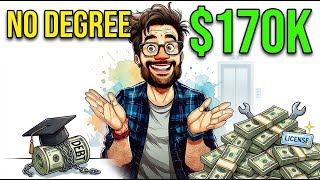
Most people assume a four-year college degree is the only reliable path to a six-figure income. The data says otherwise. Eight specific licensed trades consistently out-earn the bachelor's degree median of roughly $80,000 per year — and they do it without $50,000 or more in student debt. The common thread is what can be called the License Moat: a government-issued license that legally caps the supply of workers in a given field, which floors the price of labor and pushes wages upward.
Key Takeaways
- Government licensing restricts the supply of qualified workers, which structurally raises wages — a dynamic that applies to all eight trades covered here.
- Entry costs for trade training range from under $1,000 to roughly $15,000, compared to the $60,000–$120,000+ typical cost of a four-year degree.
- Elevator mechanics have a BLS median income of $102,420, with the 90th percentile reaching $149,250 — among the highest wage floors of any licensed trade.
- Plumbing and electrical journeymen in high-cost states routinely earn $98,000–$104,000+, with top owner-operators generating $350,000 or more per truck.
- Solo operators in garage door, appliance repair, and locksmithing regularly report $300,000–$900,000 in annual revenue after building small teams.
- This is for educational purposes only and is not personal financial advice.
The License Moat: Why These Trades Pay More
In most industries, wages are set by supply and demand. If a job pays well, more people enter the field, supply rises, and wages fall back toward average. Licensed trades break this cycle. A state or local government requires workers to pass exams, log apprenticeship hours, and carry liability — and only those who clear every hurdle can legally perform the work. That bureaucratic barrier is an economic moat. It keeps supply artificially constrained, which keeps prices and wages elevated regardless of broader labor market conditions.
This same principle underlies many boring businesses that make money with low startup costs — the boring part is a feature, not a bug, because low glamour means low competition. Licensed trades combine that low-competition dynamic with state-enforced barriers that even ambitious competitors cannot shortcut.
1. Locksmith
Locksmithing is one of the most accessible entry points into the licensed trades. Penn Foster offers a locksmith diploma program that takes roughly two months to complete and costs $1,139. The BLS reports a mean wage of $52,130 for locksmiths, with the 90th percentile reaching $76,460. Government-employed locksmiths average $74,550. On Reddit, one locksmith reported earning $41,000 in year one and $112,000 by year four after building a client base. Business brokers at BizBuySell show median locksmith shop owners earning $166,567 on approximately $550,000 in annual revenue. Startup costs for a mobile operation run $15,000–$25,000. One persistent industry figure: the average shop loses approximately $186,000 per year in revenue simply from missed calls — a gap a well-run one-person operation can close on day one with a 24/7 answering service.
2. Appliance Repair
Appliance repair sits inside a $6.3 billion industry (2023) that most people overlook. Appliance University offers a three-month online program for $999.95. The EPA Section 608 certification required to handle refrigerants costs an additional $20–$30. Total credentialing cost: well under $1,100 — compared to a comparable period of college coursework averaging $15,875, a more than 15-times difference. BLS data shows a mean wage of $50,640 and a 90th percentile of $72,660. On the ownership side, a Reddit operator documented growing from $300,000 to $500,000 in annual revenue after hiring three technicians and one office hire. Startup costs run approximately $23,000 for a van-based operation.
3. Garage Door Technician
Garage door installation and repair barely registers in mainstream career discussions, yet the unit economics are exceptional. The average invoice runs approximately $3,964, and the effective billing rate documented by active operators works out to roughly $547 per hour. Training options include Mount On Site Training's two-day course at $825 or three-day course at $1,475, and Garage Door School's online program at $1,499. BLS mean wages are $51,640 with the 90th percentile at $69,750. One Reddit solo operator reported $430,000 in annual residential service revenue. A family business on the same platform scaled from $900,000 to $2.4 million after bringing on four technicians. Net margins in the industry run 15–30%. Startup costs range from $10,000 to $30,000.
4. HVAC Technician
HVAC combines one of the clearest license moats — EPA 608 certification is legally mandatory to handle refrigerants — with strong and growing demand. Training typically takes six to twelve months at a community college and costs between $4,800 and $10,000. Manchester Community College offers a six-month program for approximately $7,090. The optional NATE certification adds credibility and costs $200–$300. BLS data for 2024 shows a median wage of $59,810 and a 90th percentile of $84,250. HVAC business owners typically report $70,000–$150,000 annually, with top operators clearing more than $200,000. The BLS projects 8% growth in HVAC employment from 2024 to 2034, with approximately 34,500 job openings per year — well above the average for all occupations.
5. Plumbing Journeyman
Plumbing requires a four-year, 8,000-hour apprenticeship paired with 576 classroom hours. That commitment filters out a large portion of potential competitors, which is precisely why wages are so high at the journeyman level. Service tickets range from $150 for a diagnostic call to $7,000 or more for a full repipe. The BLS reports a 2024 median of $62,970 and a 90th percentile of $103,140. Illinois plumbers average $98,370 statewide. Alaska, Oregon, Massachusetts, and New York all report average wages above $76,000. On Reddit, one plumbing business operator reported $350,000 per truck in annual revenue at a 20–22% net margin, with an average ticket of $856 — which works out to approximately $70,000–$77,000 in profit per truck per year.
6. Electrical Journeyman
Electrical work follows a similar path to plumbing: four to five years, 8,000 hours of on-the-job training, and 576 classroom hours through IBEW or IEC programs. The BLS reports a mean wage of $67,810, a median of $61,590, and a 90th percentile of $104,180. The San Jose and San Francisco metro areas report mean wages above $102,000. Reddit threads document Seattle union locals earning $100,000–$152,000. On the business side, the JaxPowerPro case study shows a solo electrician reaching $700,000 in year one, $1.25 million in year two, and more than $2 million by year three. Startup costs for an electrical contracting business run $15,000–$45,000.
For a broader look at high-return trade certifications, see this guide to high-paying trades most graduates ignore under $2,000 to certify.
7. Specialized Welding
General welding is not particularly well-paid. Specialized welding — pipeline, underwater, and orbital TIG — is a different occupation. Elite Welding Academy and Western Welding Academy both offer six-month, 900-hour programs with tuition ranging from $5,000 to $15,000. AWS procedure certifications cost $150–$350 each and stack to create a tiered pay structure. The BLS base median for welders is $48,940, but that figure understates specialist earnings considerably. Pipeline welders in Texas reach $135,000 at the top 10%. Underwater welders typically earn $54,000–$93,000, while saturation divers can reach $200,000–$300,000. The National Center for Welding Education lists $30–$40 per hour as the base for certified welders, with TIG and orbital work adding $10 per hour; with overtime and per diem, annual earnings above $90,000 are achievable. Welding pay is cyclical — practitioners consistently recommend saving 40% of gross income during boom periods.
8. Elevator Mechanic
BLS mean wage: $100,060. BLS median: $102,420. OOH median (2024): $106,580. 75th percentile: $131,740. 90th percentile: $149,250. New Jersey median: $134,590; New Jersey 90th percentile: over $170,000. California median: over $112,000.
Elevator mechanics represent the highest wage floor on this entire list. Entry is through the NEIEP program — a four-year, USDOL-registered apprenticeship combining 8,000 hours of on-the-job training with 576 classroom hours. Apprentices start at $20–$22 per hour; journeymen clear $40 per hour as a floor. On Reddit's r/IUEC community, the consistent report is that even mechanics in lower-paying locals clear $100,000 easily. One mechanic documented $200,000 in a single year at 2,700 hours worked. The OOH projects 5% employment growth from 2024 to 2034, with approximately 1,200 openings per year — a small market with very high wages and almost no public-facing career promotion.
Philosopher and motorcycle mechanic Matthew Crawford explored the economic case for this kind of work in Shop Class as Soulcraft, arguing that manual trades are economically resilient because the work cannot be offshored, cannot be automated, and the embedded intelligence belongs entirely to the practitioner doing it. Elevator mechanic wages are that argument made concrete.
The Comparison in Plain Terms
The bachelor's degree median is approximately $80,000 per year, entered with an average of $30,000 in student debt. Against that baseline, these eight trades tell a consistent story. Even the weakest employee-level wages on this list — locksmith at a BLS mean of $52,130 — come with zero loan burden and a two-month certification timeline. At the 90th percentile, plumbing reaches $103,140, electrical reaches $104,180, and elevator mechanics reach $149,250. New Jersey elevator mechanics at the 90th percentile exceed $170,000. None of these require a four-year degree. The license is the asset.
Watch the Full Breakdown on YouTube
For a complete visual walkthrough of all eight trades — including the income comparisons, certification timelines, and the License Moat framework explained step by step — watch the full video on the HS YouTube channel. The video covers each trade in sequence with the same real-operator data presented here, along with additional context for evaluating which path fits a given situation.