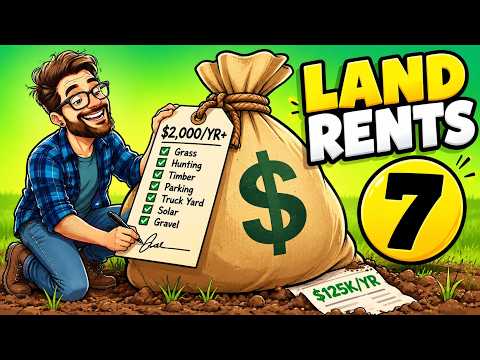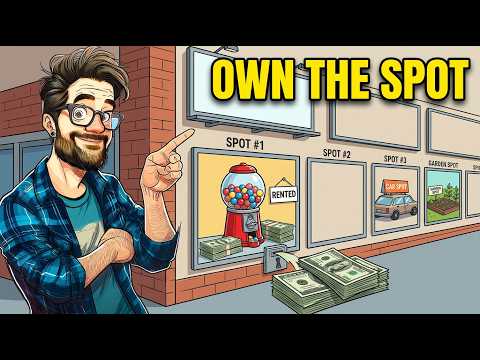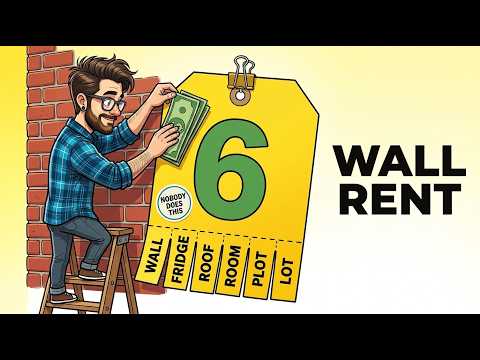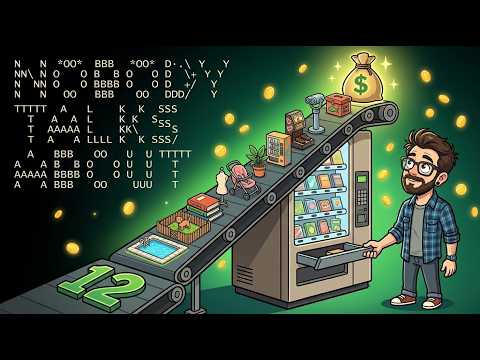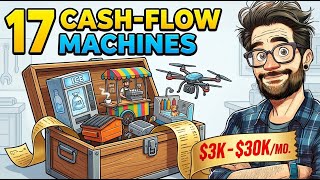
A man named Steve Slagle owns a box on a Florida sidewalk that sells frozen water. No employees. No website. No customer service department. He drives out once a week to restock it — and it pays him more per month than most people earn at a full-time job. That is not a side hustle. That is a machine. The seventeen plays below follow that same logic: you buy or list an asset once, and the asset generates recurring cash flow without requiring your daily time.
This is the opposite of service-based income. Services stop paying when you stop working. The businesses on this list — five $20,000 vending machines, six rental assets you can list this weekend, and six already-operating businesses available for $5,000–$30,000 — keep producing whether or not you show up. Every income figure comes from real operator reports, not projections.
Key Takeaways
- All 17 businesses are asset-based: the machine or listed space does the work, not the owner.
- Five machines in the $20,000 range produce $3,000–$15,000 per month with near-zero staffing.
- Six rental assets — including driveways, drones, and bikes — can be listed this weekend for little to no startup cost.
- Six already-running cash-flow businesses are available to purchase outright for $5,000–$30,000.
- Every income figure is sourced from real Reddit operators and industry forums — not projections.
- The three filters for inclusion: recurring revenue, low staff load, and realistic replacement-income potential.
What Separates a Cash-Flow Machine From a Side Hustle
A side hustle is a job you give yourself. A cash-flow machine is an asset you acquire. The distinction shapes everything that follows: your time commitment, your income ceiling, and your ability to stack multiple income sources without burning out. The seventeen plays below were selected against three criteria: they must produce recurring monthly revenue (not one-time income), require minimal staffing (ideally zero employees), and generate enough cash flow to credibly replace a salaried income over time.
If you are working with a smaller budget and want to understand the foundational concept before committing capital, the guide to boring businesses that make money for under $500 covers the same asset-first philosophy at a lower entry point. The plays below scale that concept up into the $5,000–$30,000 capital tier — with proportionally larger monthly returns.
5 Boring $20,000 Machines That Print Cash on Autopilot
These five machines share a common trait: a meaningful upfront investment that unlocks recurring income most service businesses cannot match on an hourly basis. Each operates with minimal human intervention after initial setup.
1. Ice Vending Machine
Standalone ice vending units sit outside convenience stores, gas stations, and grocery-anchored strip malls and sell bags of ice 24 hours a day with no staff. Steve Slagle's Florida unit is among the most widely cited operator stories in vending communities — one machine, one weekly service visit, and monthly income above a full-time salary. New machines typically cost $20,000–$30,000. Single-unit operators report monthly revenue between $1,500 and $6,000, with location quality as the primary variable. High-traffic sites near water, outdoor recreation, and summer tourism corridors consistently outperform.
2. Water Refill Station
Water refill kiosks dispense filtered or alkaline water at per-gallon pricing and follow the same model as ice vending: the machine collects revenue continuously while the owner services it periodically. Placement in high-foot-traffic locations — gyms, health food retailers, grocery stores — drives the economics. Single-unit monthly income of $1,000–$4,000 is common. Growing consumer preference for filtered water over single-use plastic bottles gives this asset a structural demand tailwind that makes it defensible long-term.
3. Billboard
One operator built a chain link fence, installed a few posts, and now clears $15,000 per month from a single billboard. No product. No service. Just controlled ad space in a high-visibility location. Traditional static billboard installation runs $5,000–$25,000 depending on structure and zoning. Digital billboards cost more but command significantly higher advertising rates from local and national buyers. Monthly income ranges from $1,500 on secondary roads to $15,000+ on major highway frontage with strong vehicle counts. Ground lease structures allow operators to capture the income without owning the underlying land.
4. RV and Boat Storage Lot
Most residential communities prohibit outdoor storage of RVs and large boats — creating consistent, year-round demand for off-site storage. A gravel lot surrounded by a chain link fence solves that problem. A 50-space lot charging an average of $100 per vehicle per month generates $5,000 monthly from a largely passive asset. The main barrier is zoning approval; once cleared, ongoing operations require only occasional lot maintenance and basic perimeter security. This is among the highest-margin, lowest-labor storage formats available at under $30,000 to develop.
5. Air Filter Subscription Brand
HVAC filters must be replaced on a regular schedule — but most homeowners forget, delay, or buy the wrong size. Air filter subscription services deliver the correct filters on a preset schedule, eliminating the friction that causes most people to defer maintenance. The recurring subscription model produces predictable monthly revenue with high retention, since customers rarely cancel a service that prevents expensive HVAC failures. Operators focused on a single metro area or commercial HVAC clients report $3,000–$10,000 monthly. Entry cost is lower than physical vending, consisting primarily of inventory and a basic e-commerce setup.
6 Rental Assets You Can List This Weekend
None of the following require a purchase. They require assets you may already own or spaces you are currently not monetizing. Rental income of $100–$4,000 per month per asset is achievable through existing platforms that handle payment processing, basic insurance, and customer matching. For a detailed platform-by-platform guide to this category, the full breakdown of rental businesses that make money without doing the work covers each listing service in depth.
Peer-to-Peer Storage (Neighbor.com)
Neighbor.com functions as Airbnb for storage space. Garage corners, spare bedrooms, empty sheds, and driveways become listed storage units accessible to local renters who need space. Urban hosts and those near universities report $100–$800 per month per space depending on size and local demand. The platform handles payments and provides basic protection — the host simply provides the square footage.
Parking Space Rental
A single off-street parking space in a dense urban area rents for $150–$500 per month through platforms like SpotHero or ParkWhiz, or through a direct listing. Event-adjacent locations near stadiums and convention centers can charge daily rates during high-demand periods that far exceed the monthly average. This is arguably the most liquid and lowest-effort asset on the entire list: no physical product, no service delivery, no staffing whatsoever.
Bike and E-Bike Rental
Tourist corridors, college campuses, and waterfront areas sustain strong demand for short-term bike and e-bike rentals. A single quality e-bike purchased for $1,500–$2,500 generates $50–$200 per day in peak season when listed through rental platforms or managed directly. Operators with fleets of 10–20 bikes report $3,000–$8,000 monthly during high-season months. Battery management and periodic maintenance are the primary recurring time costs.
Photo and Video Drone Rental (ShareGrid)
Camera drones depreciate rapidly and are used infrequently by most of their owners. ShareGrid and comparable peer-to-peer equipment rental platforms allow owners to rent to production companies and freelance videographers who need the equipment for a single shoot. Daily rental rates of $75–$300 are common for mid-range professional drones. An operator with two or three current-model units can generate $500–$2,000 per month with minimal active management between rentals.
Wedding Decor Rental
Wedding arches, candle holders, centerpiece collections, and decorative backdrops are purchased once and rented dozens of times. Items acquired for $200–$500 rent for $50–$150 per event. A coordinated inventory representing $5,000–$10,000 in acquisition cost can generate $2,000–$5,000 monthly during peak wedding season. Geographic clustering of events keeps marketing costs low — referrals and local vendor networks drive most bookings without paid advertising.
Shipping Container Rental
Used 20-foot ISO shipping containers can be purchased for $1,500–$4,000 and rented for $150–$400 per month as on-site storage for construction companies, farms, and expanding businesses. Containers are highly durable, require almost no maintenance, and rental contracts tend toward multi-month or annual terms. Operators with 5–10 containers report $1,500–$4,000 monthly in recurring income once the fleet is placed with tenants.
6 Cash-Flow Machines You Can Buy for $5K–$30K
These six plays are existing operations — not concepts to build from scratch. Acquiring a running business eliminates the hardest phase of any venture: proving the concept and building an initial customer base. The income is already flowing on day one of ownership.
One Reddit operator purchased a mall cell phone repair kiosk for $19,000. The following month, the kiosk cleared $30,000 in revenue — an established customer base, trained workflow, and a proven foot-traffic location, all bundled into a sub-$20,000 acquisition.
Coffee carts and mobile espresso operations follow similar logic. A fully equipped cart purchased used runs $5,000–$15,000. Positioned at office parks, farmers markets, or recurring weekend events, they generate $1,500–$6,000 monthly. Owner-operator involvement is often limited to a few hours per day, or a single part-time hire handles operations entirely.
Tool and equipment rental businesses serve contractors and DIYers who need a specific piece of equipment once and have no interest in buying it outright. A $15,000–$25,000 inventory of high-demand tools — tile saws, generators, concrete mixers, pressure washers — rented at $50–$150 per day produces steady, predictable revenue. Self-service dog wash stations, installed within existing pet-adjacent retail spaces, generate $3,000–$8,000 monthly from a single multi-bay unit with near-zero labor input after installation.
Box trucks and dumpster rental businesses round out the list. Both require $15,000–$30,000 for an entry-level unit and both address recurring, durable demand. Box trucks rented through platforms like Fluid Truck or operated as local moving rentals generate $1,500–$5,000 per truck per month. A single 10-yard dumpster cycled through contractors and homeowners generates $800–$2,500 monthly depending on local market pricing and utilization. Operators who expand to a fleet of three to five units can approach or exceed replacement-income levels from these assets alone.
Matching the Right Asset to Your Budget
The seventeen plays above span a capital range from $0 — listing an asset you already own — to $30,000 for acquiring a running business. Someone starting with under $1,000 should look first at listing an existing asset: a parking space, a storage corner on Neighbor.com, or a drone sitting in a case. Someone with $10,000–$20,000 has access to ice vending, water refill, or a shipping container fleet. At $20,000–$30,000, acquiring an already-operating kiosk, coffee cart, or dumpster business becomes viable — with income potential that can credibly substitute for a salaried income within the first month of ownership.
The common thread across all seventeen is the same: the asset works, the owner manages. Building a portfolio of assets that collectively pay $3,000–$10,000 monthly is slower and less dramatic than launching a service business — but the compounding effect of owning machines that pay every single month, year after year, is exactly how the wealthiest boring operators build lasting net worth quietly.
Watch the Full Video Walkthrough
The video version of this compilation covers every one of the 17 plays in detail — real operator income figures, startup cost breakdowns, platform-by-platform guidance for listing rental assets, and acquisition advice for the buyable businesses. If you are narrowing down which machine or rental asset fits your current budget and schedule, the visual format makes it significantly easier to compare across all three categories. Watch 17 BORING Machines & Rental Assets That Quietly Pay $3K–$30K/Month on the Harry's Stash YouTube channel for the complete walkthrough and timestamped chapter navigation.