- Key Takeaways
- Why Boring Businesses Beat Sexy Startups
- Machine #1: Ice Vending — The $2,500/Month Box on a Sidewalk
- Machine #2: Water Refill Stations — Double the Revenue, Same Concrete Pad
- Machine #3: Billboard Land Leases — Collect a Check for Owning Dirt
- Machine #4: RV and Boat Storage — The Laziest Real Estate Play
- Machine #5: Air Filter Subscriptions — The $260M Proof That Boring Wins
- Three Filters to Apply Before Buying Any Cash-Flow Machine
- Watch the Full Breakdown on YouTube
The most consistently profitable businesses of 2026 aren't software platforms or viral product launches. They're boring, physical, recurring-revenue machines that most entrepreneurs walk right past. Ice vending units. Water refill kiosks. Billboard land leases. RV storage lots. Air filter subscriptions. These five cash-flow machines share one defining trait: once installed, they generate monthly income with minimal ongoing labor — and most can be acquired for around $20,000.
Key Takeaways
- A single ice vending machine can generate $1,200–$3,500/month net, with profit margins around 86% per bag sold
- Water refill stations produce $1,500–$4,000/month per location and can co-locate with ice machines on the same concrete pad
- Billboard land leases pay landowners 10–18% of gross ad revenue — prime locations near LAX reportedly generate $250,000/year
- RV and boat storage lots require operating costs as low as $83–$250/month for insurance, with 100 outdoor spots at $300/month generating $30,000 in monthly rent
- David Heacock turned a "boring" air filter company into a $260 million/year business (Filterbuy) — proving the boring-business thesis at scale
- Three filters for any machine purchase: recurring need, 72-hour autonomy, and partner delegation
Why Boring Businesses Beat Sexy Startups
The concept of boring business investing has been gaining serious traction for a straightforward reason: businesses that sell dull, recurring necessities — ice, clean water, filtered air, vehicle storage — tend to outlast trendy startups because the underlying demand never disappears. Nobody stops needing ice or air filters because a new app launched.
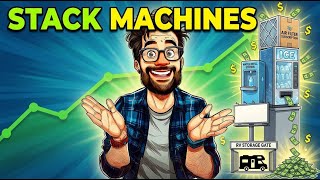
The strategic framework behind this approach treats cash-flow machines as stackable assets. Each income-producing unit funds the next acquisition. One ice machine covers its operating costs and generates surplus capital. That capital deploys into a water refill station. That station begins funding a storage lot. The stack compounds because each machine carries its own weight from day one.
Joe Saul-Sehy, author of Stacked, articulates this as wealth being assembled rather than built — a framework that maps directly onto physical cash-flow machines. The goal isn't one massive business; it's a collection of independent machines, each producing reliably on its own.
Machine #1: Ice Vending — The $2,500/Month Box on a Sidewalk
An ice vending machine is a self-service unit installed on a concrete pad at a gas station, marina, bait shop, or RV park. Customers pull up, tap a touchscreen, pay, and receive a bag of ice. The owner is never required to be present.
The entry-level unit from Naixer runs approximately $20,000. Ice House America sells larger branded units up to $115,000 installed. For a $20,000 budget, the lean Naixer-style setup is the natural entry point into this category of boring businesses that make money.
The Unit Economics of Ice Vending
A 10-pound bag of ice costs roughly $0.30 to produce and retails for approximately $2.50 — an 86% profit margin per unit sold. Steve Slagle, operator of Beachside Ice in Florida, nets approximately $2,500/month from a single machine. Naixer's 2026 profit and ROI guide places well-positioned machines at $1,200–$3,500/month net.
A 10-pound bag of ice costs $0.30 to produce. It sells for $2.50. That's an 86% margin per bag — and the machine sells them around the clock without an operator present.
Placement is the single most important variable in this business. High-traffic, high-impulse locations — gas stations, bait shops, RV parks, marinas — outperform by wide margins. The standard arrangement involves renting a concrete pad from a gas station owner, paying a $50–$150/month kickback in exchange for electricity access. The operator collects machine revenue on a fixed weekly schedule. That is the full operational workflow.
Machine #2: Water Refill Stations — Double the Revenue, Same Concrete Pad
A water refill station operates on the same model as ice vending but dispenses purified water by the gallon. Customers bring their own jugs and pay $0.25–$1.00 per gallon. Purification costs are measured in pennies per gallon, keeping margins extremely wide throughout.
Entry costs range from $15,000 to $100,000 depending on whether the operator installs a single kiosk or opens a full storefront. The Financial Models Lab operating-cost guide places monthly net income at approximately $1,500–$4,000 per location.
Demand is geographically concentrated in states with documented tap water quality issues: Arizona, Nevada, New Mexico, parts of Texas, parts of California, Florida, and Louisiana. In these markets, customers arrive with jugs daily without any active marketing effort required from the operator.
The strategic advantage: a water refill kiosk can be co-located with an ice vending machine at the same gas station, under the same land-use agreement with the station owner. One kickback payment. Two income streams. The operational overhead doesn't double — it barely changes.
Machine #3: Billboard Land Leases — Collect a Check for Owning Dirt
Billboards represent one of the most passive cash-flow vehicles available to private investors. When a landowner holds property near a high-traffic highway, companies like Lamar Advertising and Clear Channel Outdoor will actively pursue long-term lease agreements. The operator handles permits, structure construction, ad sales, and ongoing maintenance. The landowner signs a multi-decade lease and receives a monthly check. The standard landowner cut is 10–18% of gross sign rental revenue, per the IncomeCraze billboard passive income analysis.
For operators building their own structures on leased land, startup costs range from $5,000 to $50,000 per sign. Monthly net returns on standard highway billboards range from $1,000 to $5,000/month.
A single billboard near LAX airport reportedly generates $250,000 per year. One sign. One location. No employees. No inventory.
Once a billboard structure is properly permitted and installed, ad contracts typically auto-renew. The structure can generate income for decades without additional capital investment.
The Critical Risk: Zoning and Permit Verification
Billboards carry one serious, specific risk: permits and zoning. Every county operates under its own outdoor advertising ordinance. Some counties have prohibited new sign construction entirely. A billboard structure installed without verified permits — or placed on county right-of-way — can be ordered demolished at the owner's expense.
The guidance from experienced outdoor advertising operators is unambiguous: either own the land outright, or hold a written, recorded, long-term lease. A verbal or informal arrangement provides no legal protection. If the underlying land rights are not properly secured, the cash-flow machine isn't actually owned — it's borrowed from someone who can reclaim it at any time. Skipping zoning research is the single most costly mistake in this business category.
Machine #4: RV and Boat Storage — The Laziest Real Estate Play
RV and boat storage combines the simplicity of parking with the recurring-revenue structure of a subscription business. The setup: lease or purchase one acre of land on the suburban fringe, gravel the surface, install a chain-link fence and a coded gate, and rent spots to boat and RV owners whose HOAs prohibit these vehicles at home.
The Storeganise RV storage operator guide places hard fixed startup costs at approximately $42,000, plus $150,000–$300,000 for land acquisition — financeable with 25% down as a commercial real estate deal. Operating costs are minimal: $83–$250/month for property insurance, $42/month for liability coverage, and a security camera system. There are no employees, no inventory, and no active customer service requirements beyond managing gate codes.
The revenue math is direct. Fifty outdoor spots at $300/month generates $15,000/month. One hundred spots generates $30,000/month. In Florida, outdoor spots rent for $80–$180/month. In the Bay Area, enclosed spots exceed $600/month. CEDCO, the storage industry group, pegs average annual profit for a storage operation at $184,500.
Site selection follows one rule: locate within 15 minutes of neighborhoods with median home values above $400,000. That's where the RVs, boats, and jet skis are concentrated — and where HOA restrictions are strictest, meaning demand is structurally guaranteed by the neighborhood covenants themselves.
For additional cash-flow businesses in this investment range, see 6 Boring Cash-Flow Machines to Buy With $30,000 (No Skills Needed).
Machine #5: Air Filter Subscriptions — The $260M Proof That Boring Wins
David Heacock was a Goldman Sachs trader in 2012. He left Wall Street to take over a struggling family business in Alabama — one that sold residential air filters. He sourced product, boxed it, and shipped it himself from a garage, pivoting the company to a direct-to-consumer subscription model targeting the residential HVAC market.
Today, Filterbuy generates approximately $23 million/month in revenue — roughly $260 million per year. The company has served over 7 million customers and operates four manufacturing plants, all built on a product most homeowners forget they need every 90 days.
Filterbuy generates approximately $260 million per year in revenue, built on residential air filters shipped direct to consumer on a subscription that auto-renews every 90 days. — Fortune, February 2026
The business logic behind this outcome has three components. First, air filters are a true recurring purchase: every home requires a replacement every 90 days, indefinitely. Second, air filters exist in over 200 size variants, creating a logistical complexity that deters amateur competitors and makes full retail shelf coverage impossible. Third, because major retailers can't stock all 200 sizes, the direct-to-consumer subscription model owns the long tail of that market entirely.
A micro version of this business can be launched for $5,000–$50,000 by drop-shipping from an existing manufacturer, targeting a single filter size, and building a subscription customer base. The model scales because product replenishment is built into the operating requirements of every home's HVAC system.
Three Filters to Apply Before Buying Any Cash-Flow Machine
Before committing capital to any of these machines, three criteria should be evaluated against every candidate.
Filter 1 — Recurring need: Does the machine sell a consumable or recurring service? Ice, purified water, ad space, parking, and air filters all generate repeat revenue without active selling. If the machine requires active sales effort to generate each transaction, it is a job — not a machine.
Filter 2 — 72-hour autonomy: Can the machine operate without active management for 72 hours? A true cash-flow machine should run while the owner sleeps, travels, or focuses on acquiring the next asset. If the answer is no, the business requires an operator, not a passive owner.
Filter 3 — Partner delegation: Can someone else handle the most labor-intensive component in exchange for a revenue share? Lamar Advertising sells billboard ad space. Gas station owners host ice machines for a monthly kickback. Storage management software handles gate access for $50/month. The most durable machines in this category delegate the hard work while the owner retains the cash flow.
Watch the Full Breakdown on YouTube
The video version of this analysis covers all five machines with complete financial models, real operator numbers, and the full ice vending placement playbook. Watch the full breakdown on the HS YouTube channel at