- Key Takeaways
- Cash-Flow Machine #1: Cell Phone Repair Kiosk
- Cash-Flow Machine #2: Coffee Cart and Mobile Espresso
- Cash-Flow Machine #3: Tool and Equipment Rental
- Cash-Flow Machine #4: Self-Service Dog Wash Station
- The Maintenance Reserve Reset: The Failure Mode Every New Operator Faces
- Cash-Flow Machine #5: Box Truck Business
- Cash-Flow Machine #6: Dumpster Rental
- The Three Filters: How to Evaluate Any Cash-Flow Machine
- Watch the Full Video Walkthrough
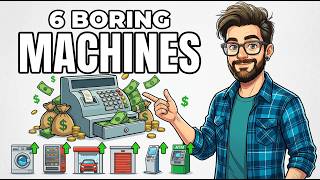
A Reddit operator recently posted that his cell phone repair kiosk generates $30,000 a month in revenue after just eight months of operation — total startup investment under $5,000. That is the premise behind every business covered here: these are assets you buy, not build from scratch, and every one was already producing income before the current owner stepped in. With $30,000 or less, any of the six options below can be acquired and put to work generating monthly cash flow.
The framework behind this approach comes from Walker Deibel's book Buy Then Build. The entire strategy is one sentence: acquire the engine first, then improve it. Unlike side hustle content aimed at people starting from zero, these six cash-flow machines assume you have between $5,000 and $30,000 saved and want to own an income-producing asset — not learn a new trade from scratch.
Key Takeaways
- All six businesses can be acquired for under $30,000 and were already generating revenue before a new owner stepped in.
- A Reddit operator running a cell phone repair kiosk clears $30,000 per month by month eight; the iFixit Pro Tech Toolkit costs as little as $59.95 refurbished.
- Brad Jacobs built United Rentals from a tool rental roll-up strategy into $15.3 billion in annual revenue across 1,768 locations.
- Mary Ellen Sheets turned a $350 box truck into Two Men and a Truck — a $442 million moving company by 2016.
- Bin There Dump That grew to 200+ franchises by targeting residential dumpster customers ignored by commercial competitors.
- Walker Deibel's three filters — repeat demand, utilization leverage, and systems over vibes — separate cash-flow machines from money pits.
Cash-Flow Machine #1: Cell Phone Repair Kiosk
The Bureau of Labor Statistics tracks telecommunications equipment installers and repairers at a median of $5,106 per month, with the top 10% reaching $7,645. Those are employee wages. The operator model scales substantially higher. A verified post on the Sweaty Startup subreddit reported one kiosk operator clearing $30,000 per month by month eight of operation.
The startup floor is genuinely low. An iFixit Pro Tech Toolkit runs $74.95 new or $59.95 refurbished. Beyond the toolkit, entry costs cover a small kiosk lease and an initial parts inventory — often under $5,000 total. The counterintuitive strategy is treating repairs as a loss leader. The real revenue engine is the accessory annuity: screen protectors, cases, charging cables, and B2B contracts with property managers and small companies needing fleet device support. Adding a Google review request to every completed repair builds a flywheel of social proof that compounds month over month.
Cash-Flow Machine #2: Coffee Cart and Mobile Espresso
Bureau of Labor Statistics data puts fast food worker wages at a median of $2,462 per month. A real mobile coffee operator on the food trucks subreddit reported gross revenue of $20,000 to $25,000 per month. The equipment entry point is a Blue Bottle Coffee Premium Performance Mobile Coffee Cart Equipment Package at $5,716.39 — covering the cart, espresso machine, grinder, and water system in a single turnkey package.
The insight that separates profitable coffee cart businesses from those that burn out by month four: stop chasing weekend events and farmers markets. Instead, secure a single weekday location adjacent to a warehouse, industrial park, or hospital. Recurring B2B morning service with the same regulars creates predictable, scalable volume. One fixed commercial location will consistently outperform a scattered event schedule — and pay for the equipment in roughly twelve months.
Cash-Flow Machine #3: Tool and Equipment Rental
This category has the most dramatic proof-of-concept in recent business history. Brad Jacobs founded United Rentals in September 1997 with $45 million from his United Waste team plus another $65 million in equity and credit. His strategy was simple: acquire small tool rental shops one at a time and consolidate them under a single national brand. By December 1997 — just three months later — United Rentals went public and raised approximately $100 million more. Today, United Rentals operates 1,768 rental locations across North America, employs 28,500 people, and generates $15.3 billion in annual revenue.
Brad Jacobs' roll-up strategy turned six small acquisitions in October 1997 into the largest equipment rental company in the world — $15.3 billion in annual revenue from a standing start.
You do not need $45 million to replicate the core insight. Bureau of Labor Statistics data puts counter and rental clerk wages at a median of $3,117 per month. The startup floor for a single rental tool is a Yardmax plate compactor at $407 from Home Depot, or a Wen 7-horsepower compactor at $657. The scaling playbook mirrors Jacobs' approach: buy one high-turnover, high-margin machine, walk job sites to sign contractor accounts, and reinvest revenue into the next machine. Jacobs called it utilization over variety — a focused set of tools with fast turnover, plus delivery and contractor accounts that keep utilization high. New equipment is purchased only after pre-booked demand justifies the cost.
Cash-Flow Machine #4: Self-Service Dog Wash Station
Bureau of Labor Statistics animal care worker wages sit at a median of $2,600 per month. The self-service dog wash model removes labor from the equation entirely — you own the machine, not the payroll. A reference operator on the dogs subreddit reported that a single self-service station generates roughly $35,000 to $40,000 per year. For context, Petco charges $20 per self-serve wash at retail.
The Evolution Dog Wash Mini Self Serve unit costs $11,500 and carries an operational lifespan of approximately ten years. At normal utilization, the unit pays for itself in roughly 18 months. Location is the single most important variable: the station should be placed where dog owners already travel weekly — inside a laundromat, adjacent to a car wash, at a pet store, or near a dog park. Revenue predictability improves significantly by layering in a monthly membership at $15 per month. One hundred members on that plan alone generates $18,000 in recurring annual revenue before a single one-off wash transaction is counted.
The Maintenance Reserve Reset: The Failure Mode Every New Operator Faces
Every cash-flow machine in this list carries a version of the same early failure mode — experienced operators call it the Maintenance Reserve Reset. The pattern is consistent: an operator buys an income-producing asset, early months show positive cash flow, then an unexpected equipment failure or quality issue causes chargebacks, lost revenue, and reputation damage simultaneously. In one documented kiosk case, months one and two cleared $1,800 and $2,200 respectively. Month three produced $600 in chargebacks after cheap aftermarket screens failed under heat — plus three negative Google reviews. The fix cost $120 in better parts and four weeks of reputation recovery.
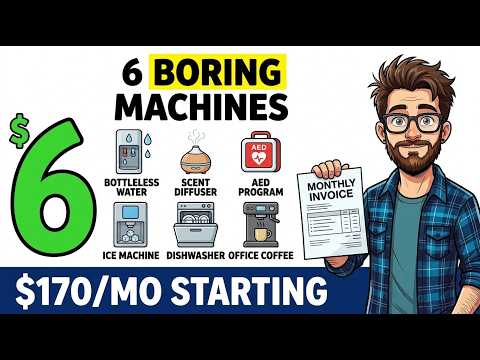
The operators who fail blame the asset category. The operators who survive build a maintenance and downtime reserve from day one: cash equal to one to three months of fixed costs plus one major repair event. The business model was not the problem. The missing reserve was. If you are interested in other physical asset businesses at a lower price point, the breakdown in 6 Boring Businesses That Make Money (Under $500 to Start) covers entry-level options that require almost no upfront capital.
Cash-Flow Machine #5: Box Truck Business
Mary Ellen Sheets was a single mother in Lansing, Michigan in 1985 who purchased a 14-foot truck for $350 so her two teenage sons could earn spending money. Year one profit: $1,000. Year two revenue: $180,000. By 1989, annual revenue reached $560,000. By 2015, Two Men and a Truck had 2,100 trucks and 9,000 employees. By 2016, annual revenue hit $442 million — all from a $350 truck.
Bureau of Labor Statistics data tracks light truck drivers at a median of $3,678 per month, with the top 10% at $6,636. At the operator level, an Amazon delivery service partner discussion on Reddit reported that owners with the right route can clear $20,000 per month. Sheets' competitive edge was systemization and a single anchor customer — not volume hustle. The scalable box truck strategy follows the same logic: sign one anchor account — a warehouse, appliance store, or moving leads provider — and build dense routes within that contract. Low deadhead miles and predictable weekly cash flow are what transform one box truck into a fleet over time.
Cash-Flow Machine #6: Dumpster Rental
Mark Crossett and Mike Kernaghan founded Bin There Dump That in 2002 in Toronto, Canada, after Kernaghan delivered dumpsters for a flood cleanup and recognized the model could be systematized and franchised. They began franchising in 2004, entered the U.S. market in 2011, and today operate with 200+ franchisees. Their decisive competitive positioning: while most dumpster rental companies competed on price for commercial demolition contracts, Bin There Dump That targeted residential customers with clean, driveway-sized bins, simplified booking, and a customer experience free of commercial-site chaos.
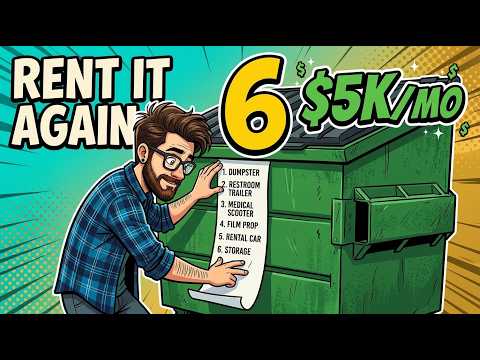
Bureau of Labor Statistics heavy truck driver wages sit at a median of $4,787 per month, with the top 10% at $6,567. The equipment startup floor is an Iron Bull 7-by-14, 14,000-pound dump trailer at $11,699. A Sweaty Startup operator reported starting with three dumpsters and a roll-off trailer, then scaling to 90 dumpsters and three trucks. The operational lever is route density: sign ten contractors who need weekly swaps within the same zip code rather than chasing a thousand scattered homeowners. Standardized drop-and-pick windows, clear overage pricing rules, and high asset utilization define a profitable dumpster rental operation. For a detailed look at how physical collection businesses monetize recurring pickup routes, the 30-hour deep dive on donation bin economics breaks down the model in granular detail.
The Three Filters: How to Evaluate Any Cash-Flow Machine
Walker Deibel's Buy Then Build framework distills acquisition analysis into three filters that reliably separate cash-flow machines from money pits.
Filter 1: Repeat Demand. Broken phones, morning coffee, contractor tools, dirty dogs, deliveries, and debris removal are all recurring needs — not one-time purchases. When customers return without being re-acquired through paid marketing, the business has a built-in revenue floor that compounds with time.
Filter 2: Utilization Leverage. The same physical asset can produce $3,000 per month or $30,000 per month depending entirely on whether dense routes and recurring accounts are in place. The gap between those two numbers is not additional skill — it is utilization. Contractor accounts and recurring service routes are the specific mechanism that closes the gap.
Filter 3: Systems Over Vibes. The best operators buy on cash flow records, maintenance logs, existing contracts, and standardized pricing — not excitement about a category. Deibel's framework is direct: acquire the engine first, verify it runs, then improve it. Excitement is not a due-diligence process.
Watch the Full Video Walkthrough
For a visual walkthrough of all six cash-flow machines — including exact equipment sourcing links, real operator revenue numbers, and the complete Maintenance Reserve Reset story — watch 6 BORING Cash-Flow Machines You Can BUY With $30,000 (No Skill Needed) on the Harry's Stash YouTube channel. The video includes a community challenge: drop the number (1 through 6) of the cash-flow machine you would buy first in the comments. The business with the most replies receives a full deep-dive the following week covering how to evaluate one currently for sale, what a healthy maintenance reserve should look like, and real first-month numbers from a real operator.