- Key Takeaways
- What the Average U.S. Airbnb Host Actually Earns
- The Three Airbnb Business Models
- City Regulations That Can Stop Your Airbnb Business
- The Hidden Room Dollar: Why Empty Space Costs You Money
- Who Should — and Should Not — Start an Airbnb Business
- The 30-Day Spare Room Action Plan
- Watch the Full Video Walkthrough
The average U.S. Airbnb host earns $4,300 a month in gross revenue, according to AirDNA's 2024 analysis cited by LocalBird. That figure covers active listings across all formats — spare bedrooms, dedicated vacation properties, and rental arbitrage operations. The gap between those three models, in both startup cost and net income after expenses, is wider than most introductory guides acknowledge. This article breaks down each path with real numbers, flags the city regulations that stop most new hosts before they launch, and closes with a 30-day action plan to take a spare room from empty to booked.
Key Takeaways
- AirDNA's 2024 data puts the national average at $14,000 per year ($4,300/month) in gross revenue per active listing.
- Three distinct business models exist: spare room ($500–$1,200 to start), dedicated property ($65K–$140K), and rental arbitrage ($12K–$30K).
- Spare room hosts frequently net more per dollar invested than dedicated property owners after mortgages, insurance, and management fees are subtracted.
- New York City, most of Miami Beach, Honolulu residential neighborhoods, and Santa Monica have banned or severely restricted short-term rentals.
- The Gatlinburg/Smoky Mountains market reported 62% occupancy and $4,685/month average revenue per listing as of March 2026 (StaySTRA).
- A 30-day spare room launch plan requires no second property and no new mortgage.
What the Average U.S. Airbnb Host Actually Earns
The verified national benchmark from AirDNA's 2024 US Host Income Analysis is $14,000 per year in supplemental income — roughly $4,300 per month in gross monthly revenue across active listings. The national average daily rate sits at $158, with occupancy around 50% and trending toward 55% by late 2025. According to AirDNA's 2025 Outlook Report, healthy performance now starts at 55% occupancy; strong operators consistently reach 65% or higher.
The average U.S. Airbnb host earns $14,000 per year in supplemental income — roughly $4,300 per month in gross monthly revenue across active listings. — AirDNA 2024 US Host Income Analysis
The Gatlinburg and Smoky Mountains market illustrates what a high-demand tourist corridor looks like. StaySTRA's March 2026 data shows 62% occupancy, a $282 nightly rate, and average monthly revenue of $4,685 per listing. These numbers reflect year-round tourist demand — the kind of market that separates steady income from volatile seasonal performance.
The Three Airbnb Business Models
Most short-term rental content defaults to one model: purchase a property, furnish it, and list it. In reality, there are three structurally different ways to run an Airbnb business, each with distinct capital requirements, risk profiles, and legal considerations. Selecting the right model before spending a dollar is the single most consequential decision a new host makes.
Path 1: Spare Room in Your Primary Residence
The spare room model involves listing a bedroom or finished basement in a home where the owner or renter already lives. Because the host is the primary resident, this configuration is legal in most U.S. cities — many municipalities that restrict dedicated vacation rentals explicitly permit hosted home sharing. No second mortgage, no investment property loan, no property management company required.
Startup cost runs $500 to $1,200 all in. A representative breakdown: linens, towels, and a mattress protector ($200), guest supplies ($100), a smart lock such as the August Smart Lock Pro or Schlage Encode ($150), a Minut noise sensor ($99), a short-term rental rider on the homeowner's insurance policy ($100–$300 per year), and a hosted permit if the local municipality requires one ($50–$200).
Schedule C data from spare room operators shows net monthly income between $1,800 and $3,000 on a single bedroom. That range frequently exceeds what dedicated property owners net after subtracting mortgage payments, insurance premiums, furniture depreciation, cleaning costs, and property management fees.
Path 2: Dedicated Investment Property
The dedicated property path means purchasing a second home or investment house, furnishing it fully, and operating it as a vacation rental. This is the highest-capital model with the highest income ceiling. Cash requirements are substantial: a down payment of $35,000–$70,000 on a $350,000 home, $7,000–$14,000 in closing costs, $15,000–$35,000 in furniture and staging, an operating reserve, and dedicated short-term rental insurance from providers such as Proper, Steadily, or CBIZ at $1,500–$5,000 per year. Total cash to close and launch: $65,000 to $140,000.
Rob Abasolo (Robuilt) has publicly disclosed over $1.5 million in cumulative booked reservations. On the Tax Smart Real Estate Investors Podcast, Episode 316, he described pushing a single property from approximately $46,000 to $60,000 per year in bookings through renovation, calling the incremental spend 98% profit. That is a ceiling case built on an established operator's track record, not a starting benchmark for a first-time host.
Avery Carl of The Short Term Shop — ranked by The Wall Street Journal among the top 100 agents nationally — has publicly disclosed a portfolio of more than 100 doors and over $3.5 billion in short-term rental real estate transactions. Her team specializes in Smoky Mountain acquisitions, where tourist demand supports the occupancy benchmarks noted above.
Path 3: Rental Arbitrage
Rental arbitrage eliminates property ownership entirely. An operator signs a long-term residential lease, furnishes the unit, lists it on Airbnb and other platforms, and keeps the spread between nightly income and monthly rent. Startup cost falls in the $12,000–$30,000 range: first and last month's rent plus security deposit, furniture, a smart lock, operator liability insurance, and supplies.
The Ten Times BNB team documented one operator who scaled from a $65/night spare bedroom to $175,000 per month across 24 arbitrage units. Realistic net income on a single well-run arbitrage unit in a mid-tier market is $400 to $1,000 per month. Booking dry spells mean carrying rent with no offsetting income — the primary risk this model introduces. The arbitrage path suits operators with strong sales skills who can consistently secure landlord consent and fill vacancies.
City Regulations That Can Stop Your Airbnb Business
Regulatory research is not optional. Several major real estate markets have enacted outright bans or near-bans on short-term rentals. New York City's Local Law 18 requires hosts to register and remain physically present during guest stays, effectively eliminating unhosted rentals. Most of Miami Beach prohibits STRs outside designated resort districts. Honolulu residential neighborhoods enforce a 90-day minimum rental term. Santa Monica bans unhosted rentals entirely.
A 15-minute ordinance check — searching the city name plus "short term rental ordinance" and reviewing the resulting municipal page — is the correct first step before any other expense. Most U.S. cities permit hosted home sharing; requirements for dedicated investment properties vary by jurisdiction. HOA bylaws operate as a second, independent layer of restriction. A city may allow short-term rentals while a homeowners association prohibits them. Both documents require review before committing to any path.
The Hidden Room Dollar: Why Empty Space Costs You Money
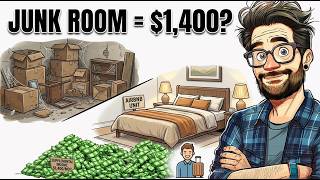
The core financial argument for the spare room path draws on a principle from Bill Perkins's book Die With Zero: an unused asset is a silent tax on the future. A spare room in a mortgaged or paid-off home is not neutral. The owner pays to heat it, cool it, insure it, and pay property tax on its square footage every month. At $30–$60 per month in carrying cost on a typical U.S. home, an empty spare room costs $400 or more per year while generating zero income. Airbnb hosting converts that sunk cost into a revenue stream without adding significant new overhead.
This dynamic explains why spare room operators frequently outperform dedicated property owners on a net-per-dollar-invested basis. The dedicated property host pays a full mortgage, a full insurance premium, and full operating costs before earning the first dollar of profit. The spare room host is already paying most of those costs regardless — Airbnb income becomes incremental revenue against a fixed base expense.
For a broader view of assets that generate monthly cash flow without a property purchase, the 6 Rental Business Ideas That Make Money Without Doing the Work article covers complementary approaches worth comparing before committing to a single model. If capital is a primary constraint, 6 Boring Businesses That Make Money (Under $500 to Start) benchmarks the Airbnb spare room path against other low-capital alternatives.
Who Should — and Should Not — Start an Airbnb Business
The spare room path is accessible to anyone who owns or rents with written landlord permission, lives in a city that allows hosted home sharing, and has one usable extra bedroom. The dedicated property path is appropriate only for operators with $65,000–$140,000 in liquid capital, qualifying credit for a second home or DSCR loan, and a realistic understanding of the hospitality workload. The arbitrage path suits operators with sales skills, $12,000–$30,000 in startup capital, and written landlord consent in a permissive market.
The business is not appropriate for anyone in the restricted jurisdictions listed above, anyone whose HOA prohibits short-term rentals, anyone expecting passive income from day one, or anyone unwilling to handle operational issues on short notice. The first 90 days require active management: guest communication, turnover coordination, review monitoring, and price adjustment. Operators who build simple systems — a backup cleaner on call, a guest screening checklist, a welcome message template sent within the first hour after check-in — typically have most of the operational playbook established by the fourth booking.
The 30-Day Spare Room Action Plan
The following timeline applies specifically to the spare room path — no property purchase, no new mortgage required.
Day 1: Search the city's short-term rental ordinance and review HOA bylaws. If the activity is prohibited, stop here.
Day 3: Declutter the room completely and order the smart lock.
Day 7: Deep clean, stage the room, and call the homeowner's insurer to add a short-term rental rider.
Day 10: Write the listing description and photograph the room in bright daylight — minimum 20 photos.
Day 14: Create the host account, upload photos, set house rules, and install the Minut noise sensor in a common area.
Day 16: Research comparable listings within a half-mile radius. Set the initial rate 10–15% below the competitive set and apply a two-night minimum.
Day 17: Publish the listing and open the calendar for 60 nights.
Day 21: If no bookings have arrived, drop the price another 10% and replace the cover photo.
Day 30: Complete the first one to three bookings, request reviews, and configure PriceLabs or Wheelhouse for dynamic pricing going forward.
Once five reviews are on the profile, cross-listing on VRBO and Booking.com broadens reach. Hospitable or Hostfully can manage calendars and messaging across platforms. Furnished Finder adds an option for traveling nurse and corporate bookings, which carry lower turnover and more predictable demand.
Watch the Full Video Walkthrough
The research behind this article — 30 hours of AirDNA data, operator case studies, and city regulation review — is covered in full visual detail in the video The Airbnb Business Math: $4,300 a Month After Taxes on the HS YouTube channel. The video walks through the Schedule C patterns from spare room versus dedicated property operators, the complete path selection framework, and the full mechanism behind the hidden room dollar. Watch it before choosing a path.