- Key Takeaways
- What Is the Core Satellite Strategy?
- Why SCHD Is the Right Core Holding
- Why SCHG Is the Right Satellite — Not Another Dividend Fund
- The Ten-Year Math: 70/30 vs. All-In
- The Rebalancing Rule That Keeps the Framework Intact
- Why 70/30 Is Not an Arbitrary Number
- Adjusting the Ratio by Life Stage
- Fund Alternatives and Platform Considerations
- Watch the Full Breakdown
Owning a single dividend ETF feels disciplined — until the math shows otherwise. For midcareer investors who have built their portfolio around SCHD, there is often a quiet drag: steady income, but no growth sleeve working in parallel. The Core Satellite strategy, a framework used by large pension funds and endowments for roughly 40 years, resolves this with a precise two-fund structure: seventy percent SCHD, thirty percent SCHG, and one mechanical rule that decides where every new dollar goes. The ten-year projection makes a compelling case for rethinking the all-in dividend approach.
Key Takeaways
- SCHD at 70% provides a reliable income floor with a 3.4% trailing yield, a 0.06% expense ratio, and a rising dividend record every year since inception.
- SCHG at 30% delivers the growth upside SCHD cannot, with an approximately 17% annualized ten-year return and near-zero overlap with SCHD's holdings.
- A $100,000 Core Satellite portfolio could potentially reach approximately $308,000 over ten years, generating around $8,200 in annual dividends — compared to roughly $271,000 all-in on SCHD.
- The rebalancing rule is mechanical: whenever new capital is added, it goes to whichever sleeve is below its target weight, eliminating the temptation to chase performance.
- The 70/30 ratio mirrors the historical return sources of each asset class — approximately 70% of dividend ETF returns come from distributions, while approximately 90% of growth ETF returns come from price appreciation.
- Investors within three years of retirement should reduce the satellite to 15–20%; younger investors in their 20s and 30s may benefit from tilting the ratio toward growth.
What Is the Core Satellite Strategy?
The Core Satellite framework was developed by institutional investors — pension funds, endowments, and sovereign wealth funds — as a structured approach to balancing stability with growth across full market cycles. The logic is straightforward: a large anchor allocation, the core, holds a reliable income-generating asset, while a smaller allocation, the satellite, targets higher-growth opportunities that the core cannot access efficiently.
For dividend investors in 2026, this translates directly to a SCHD and SCHG portfolio. SCHD serves as the core — the income floor that pays quarterly, compounds distributions, and weathers market downturns. SCHG serves as the satellite — the growth engine that captures price appreciation when the broader market favors technology, innovation, and large-cap momentum. Together, the two funds cover ground that neither can cover alone, and they do so with minimal holdings overlap.
Why SCHD Is the Right Core Holding
Charles Schwab's Dividend Equity ETF sits at approximately $86 billion in assets under management, making it one of the most widely held dividend funds in the United States. Its expense ratio of 0.06% is among the lowest available for an actively screened dividend fund, and its trailing twelve-month yield sits at approximately 3.4% as of 2026.
What distinguishes SCHD from other dividend ETFs is its quality screen. The fund selects holdings based on dividend history, free cash flow to debt ratios, return on equity, and dividend growth consistency. After the March 2026 reconstitution, SCHD's free cash flow to debt ratio improved, and return on equity climbed to nearly 36%. Healthcare weighting increased while energy exposure declined — a net improvement in earnings quality.
SCHD has raised its dividend every year since inception and maintained distributions through the market dislocations of 2020, 2022, and the rate shock period that followed. That consistency is exactly what a core holding needs to deliver: predictable cash flow regardless of the macroeconomic environment. It is the floor. It shows up every quarter.
Why SCHG Is the Right Satellite — Not Another Dividend Fund
The most common mistake dividend investors make when trying to diversify is reaching for a second dividend fund. Stacking VYM or DGRO alongside SCHD creates an estimated 80% holdings overlap without adding meaningful growth exposure. The portfolio looks diversified on paper but behaves like a concentrated single-factor bet on dividend-paying equities. That is not diversification — it is duplication.
A true satellite must do something the core cannot. Schwab's US Large Cap Growth ETF (SCHG) meets that requirement. With an expense ratio of 0.04% and an approximately 17% annualized return over the past ten years, SCHG captures the price appreciation side of the large-cap market — the companies driving earnings growth, revenue acceleration, and forward momentum. Its screening criteria are nearly the inverse of SCHD's, which is why the two funds carry almost zero holdings overlap.
When value leads the market, SCHD carries the portfolio. When growth leads, SCHG carries it. A well-structured 70/30 blend means there is always a working sleeve.
For investors who have explored multi-fund income approaches — such as the 4-ETF Dividend Ladder combining VIG, DGRO, SCHD, and DIVO — the Core Satellite simplifies the structure while retaining the growth dimension that pure dividend stacking typically misses.
The Ten-Year Math: 70/30 vs. All-In
Consider an investor who is 45 years old with $100,000 ready to allocate. Under the Core Satellite framework, $70,000 goes into SCHD and $30,000 goes into SCHG.
In year one, the SCHD stake generates approximately $2,380 in dividends. The SCHG stake pays little in distributions but appreciates approximately 17% based on historical averages, growing from $30,000 to roughly $35,100. The SCHD sleeve, through price appreciation and reinvested dividends, grows to approximately $77,200. The combined portfolio ends year one at roughly $112,000, with approximately $2,400 in annual income.
Projecting forward ten years at those same historical rates — with the explicit caveat that past performance does not guarantee future results — the 70/30 Core Satellite could potentially reach approximately $308,000. Annual dividend income, assuming SCHD continues growing its distribution at roughly 9% per year, could potentially reach around $8,200 per year, or approximately $683 per month from the income sleeve alone.
Compare that to the all-in alternatives. An all-SCHD portfolio on the same $100,000 over ten years would likely reach approximately $271,000 — higher income proportionally, but lower total portfolio value. An all-SCHG portfolio could potentially reach approximately $482,000 — higher total value, but almost no income. The Core Satellite captures approximately 85% of SCHG's growth upside while preserving nearly all of the income that SCHD provides. That is the purpose of the split.
The cost of bypassing this structure compounds over time. As the analysis of pausing dividend ETF contributions for just six months illustrates, allocation decisions made today have consequences that stretch a decade forward.
The Rebalancing Rule That Keeps the Framework Intact
Building the 70/30 portfolio is only half the job. The other half is maintaining the ratio over time. The mechanics are simple: every time new money is added, it goes to whichever fund is currently below its target weight. If SCHG has appreciated to 38% of the portfolio after a strong growth year, every new contribution goes into SCHD until the allocation returns to 30%. If SCHD has appreciated to 76%, new contributions go into SCHG. No forecasting. No news reading. No timing decisions.
This rule has a significant behavioral advantage: it forces buying the underperforming sleeve on a mechanical schedule rather than on instinct. Investors who skip rebalancing tend to chase recent performance — adding to growth during growth years and adding to dividends during dividend years — which gradually erodes the 70/30 structure and increases concentration risk in whichever asset class recently outperformed.
Without rebalancing, a portfolio that starts at 70/30 can drift to 55/45 within two to three years during a sustained growth run. When a downturn hits, a larger share of the portfolio declines than the investor intended — not because the fund selections were wrong, but because the ratio was quietly abandoned. Annual rebalancing in December is a practical approach that removes month-to-month noise from the decision entirely.
Why 70/30 Is Not an Arbitrary Number
The 70/30 split reflects the historical return composition of each asset class. Dividend ETFs have historically delivered approximately 70% of their long-term total return through distributions. Growth ETFs have delivered approximately 90% of their long-term total return through price appreciation. By allocating 70% of capital to the income channel and 30% to the appreciation channel, the portfolio structure mirrors where the actual returns in each fund type come from.
A 60/40 split tilts the portfolio toward growth. An 80/20 split tilts it toward income. Both are valid depending on the investor's stage of life and income needs. The 70/30 ratio is the neutral Core Satellite — the version that pulls both engines at roughly equal strength relative to their natural contribution. It is not optimized for maximum income or maximum growth. It is optimized for balance across a full market cycle.
Adjusting the Ratio by Life Stage
The 70/30 income-heavy split is the midcareer allocation. It is designed for investors roughly in the 35–55 age range who need income growth but still have a decade or more of compounding ahead of them. Adjustments at either end of the investing timeline are appropriate.
Investors within three years of retirement should reduce the satellite allocation to 15–20%. Growth funds can decline 40% or more in a severe bear market, and a portfolio close to the distribution phase may not have sufficient time to recover. Reducing SCHG exposure narrows downside risk without abandoning growth entirely.
Investors in their 20s or early 30s, by contrast, have the runway to tilt the ratio aggressively toward growth. A structure of 60% SCHG and 40% SCHD — or even 70/30 in favor of growth — extracts more long-term price appreciation during the decades when compounding has the most time to work. The income-to-growth ratio should evolve as the investor moves through life stages, not remain fixed indefinitely.
Fund Alternatives and Platform Considerations
The Core Satellite framework is not exclusive to Schwab funds. Investors using Vanguard or Fidelity can substitute VIG (Vanguard Dividend Appreciation ETF) for the core and VUG (Vanguard Growth ETF) for the satellite, with comparable structural results. The underlying logic — a quality dividend screen paired with a large-cap growth screen, low expenses, and transparent index rules — is what drives the outcome. For investors on the Schwab platform, SCHD and SCHG offer commission-free trading in addition to their sub-0.1% expense ratios, making them among the most cost-efficient implementations of this framework available in 2026.
Watch the Full Breakdown
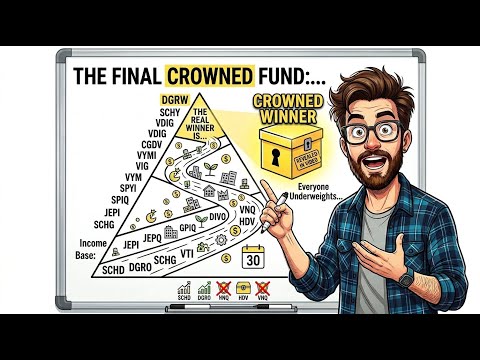
For a visual walkthrough of the ten-year projection math, the rebalancing mechanics, and the full explanation of how the 70/30 ratio maps to historical return sources, watch The 70/30 Core Satellite: Two ETFs That Quietly Out-Earn Going All In on the Harry's Financial Fitness YouTube channel. The video covers each component step by step, including the specific numbers behind the all-SCHD, all-SCHG, and Core Satellite ten-year comparisons.
The SCHD and SCHG Core Satellite is not a complex portfolio — it is a disciplined one. Two low-cost ETFs, a fixed ratio, a mechanical rebalancing rule, and a clear understanding of what each fund is designed to do. SCHD is an income tool. SCHG is a growth tool. Neither is the whole portfolio. The ratio is the portfolio — and that distinction, maintained consistently over a decade, is what separates a dividend portfolio that merely pays from one that also compounds.