- Key Takeaways
- Why a Single Dividend ETF Leaves Money on the Table
- Rung 1: VIG — The Foundation (1.56% Yield, 7% Dividend Growth)
- Rung 2: DGRO — The Total Return Engine (2% Yield, 14.6% 10-Year Return)
- Rung 3: SCHD — The Income Sweet Spot (3.46% Yield, 9.4% Dividend Growth)
- Rung 4: DIVO — The Monthly Paycheck Generator (5–6% Yield)
- What the Full Ladder Actually Pays: Real Portfolio Math
- Tax Placement: Where Each ETF Should Live
- How to Start Building the Ladder
- Watch the Full Video Walkthrough
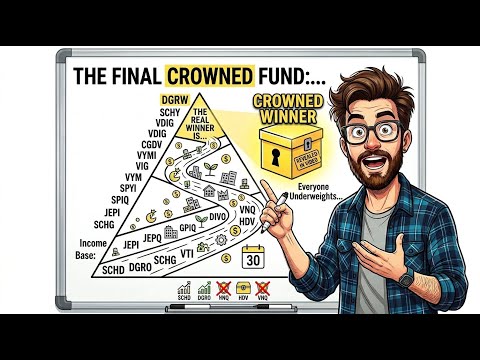
Most dividend investors settle on a single ETF and one yield — collect their 3%, and call it a strategy. But a four-rung dividend income ladder built with VIG, DGRO, SCHD, and DIVO offers something fundamentally different: a portfolio engineered to deliver both growing income and long-term compounding at the same time. Each ETF serves a distinct purpose, and together they create a structure capable of generating anywhere from $281 to $613 per month on $100,000 to $200,000 invested — with the lower rungs quietly compounding for decades.
Key Takeaways
- A 4-ETF dividend income ladder spans yields from 1.56% (VIG) to over 5% (DIVO), balancing dividend growth with current income in a single portfolio.
- $100,000 split equally across all four ETFs produces a blended 3.37% yield — approximately $3,368/year or $281/month.
- A tilted $200,000 allocation (20% VIG / 20% DGRO / 30% SCHD / 30% DIVO) generates roughly $7,360/year ($613/month).
- Reaching $1,000/month in dividends requires approximately $326,000–$356,000 depending on the allocation split.
- DIVO pays monthly distributions — critical for retirees whose bills don't wait for quarterly payouts.
- DIVO's covered call income is taxed as ordinary income; holding it inside a Roth IRA eliminates that drag entirely.
Why a Single Dividend ETF Leaves Money on the Table
The core tension in dividend investing is a familiar one: low-yield funds offer strong long-term growth but minimal income today, while high-yield funds generate cash now but can sacrifice the compounding that matters over a 20-year horizon. Choosing one forces a trade-off that isn't actually necessary.
The dividend income ladder resolves this by spreading capital across four yield levels — from roughly 2% up to 6% — where each rung has a specific job. The lower rungs grow dividends aggressively over time. The upper rungs put cash in your account today. Together, the portfolio generates meaningful passive income while still compounding for the future. As a prior analysis on this site explored in detail, pausing dividend ETFs for just 6 months cost one investor $13,900 — underscoring how much value consistent compounding creates over time.
Rung 1: VIG — The Foundation (1.56% Yield, 7% Dividend Growth)
The Vanguard Dividend Appreciation ETF (VIG) sits at the base of the ladder with a 1.56% yield — a number that raises eyebrows on first glance. But VIG's role isn't to generate income today. Its job is to ensure this ladder is still paying more, every single year, decades from now.
VIG's eligibility filter is strict: the fund holds only companies that have raised their dividend for at least 10 consecutive years. That screen produces a portfolio of 347 of the most reliable dividend growers in the United States — names like Broadcom, Apple, Eli Lilly, Microsoft, and JPMorgan, with the top 10 holdings representing roughly 33% of the fund. The expense ratio is just 0.04% ($4 per year on a $10,000 investment), and the 5-year annualized dividend growth rate is approximately 7%. VIG has raised its dividend every single year since its 2006 inception, and total return has averaged around 10% annualized over the past five years. Think of it as the long-term foundation of the ladder: slow, reliable, and compounding quietly beneath everything else.
Rung 2: DGRO — The Total Return Engine (2% Yield, 14.6% 10-Year Return)
The iShares Core Dividend Growth ETF (DGRO) moves the yield up to approximately 2% and adds something no other ETF on this ladder can claim: the highest 10-year annualized total return of the group at 14.6%. That figure outpaces VIG, SCHD, and DIVO over the same period.
DGRO holds 403 companies — the broadest diversification on the ladder — and charges just 0.08% in annual fees. Its 5-year dividend growth rate is close to 9%. Like VIG, it holds mega-caps such as JPMorgan, Exxon, Apple, and Microsoft, but DGRO also extends into mid-cap territory, which is a meaningful source of its long-term return advantage. Morningstar awarded DGRO its Gold Medal rating — the firm's highest conviction designation for fund quality.
Together, VIG and DGRO form the compounding base of the ladder. A hypothetical $50,000 invested equally between them a year ago — $25,000 each — would have grown to approximately $61,300, with roughly $900 in dividends collected along the way. VIG returned approximately 20.7% over that period; DGRO returned approximately 24.5%. Neither rung is designed primarily for current income, but both are engineered to produce significantly more of it over time.
Rung 3: SCHD — The Income Sweet Spot (3.46% Yield, 9.4% Dividend Growth)
The Schwab U.S. Dividend Equity ETF (SCHD) is where the ladder transitions from a growth-first to an income-first posture — and it's the rung that drives much of the portfolio's current yield. With $85 billion in assets, a 0.06% expense ratio, and a yield of 3.46%, SCHD is among the most widely held dividend ETFs in the country for good reason.
After the 2026 reconstitution, SCHD holds 104 positions screened for dividend consistency and financial strength. On a $50,000 position, that 3.46% yield delivers approximately $1,730/year in dividend income without any active management or trading. The 5-year dividend growth rate sits at 9.43%, meaning today's income level will approximately double in 7.5 years if that rate holds.
98% of SCHD's dividends are classified as qualified, meaning most investors pay 0–15% tax on that income rather than their full ordinary income rate.
Top holdings include Texas Instruments, UnitedHealth Group, Chevron, Coca-Cola, Pepsi, and Procter & Gamble — defensive, cash flow-generating businesses that continue paying dividends in virtually all market conditions. Among the four ETFs, SCHD delivers the most compelling combination of current yield, dividend growth, low cost, and tax efficiency.
Rung 4: DIVO — The Monthly Paycheck Generator (5–6% Yield)
The Amplify CWP Enhanced Dividend Income ETF (DIVO) solves a problem the other three rungs cannot: it generates substantial income right now, and it pays distributions monthly rather than quarterly.
DIVO's yield ranges from approximately 4.7% to 6.4% depending on the measurement period, and payments arrive every month — 12 times a year rather than four. For anyone in or approaching retirement, that distinction is meaningful. Monthly bills — rent, insurance, utilities — don't adjust for quarterly payment schedules. A monthly dividend does.
DIVO runs two income streams simultaneously. The fund holds approximately 20–25 blue-chip dividend payers — Caterpillar, Goldman Sachs, JPMorgan, Microsoft, Apple, and Home Depot among them — generating a base dividend yield of roughly 2–3%. Fund managers then selectively sell covered call options on those positions when premiums are attractive, adding an income layer that pushes total yield to 4.5–6%. The word "selectively" carries real weight here: unlike covered call funds that mechanically write options on every holding, DIVO's managers choose their spots, preserving more upside capture when markets rally.
Over the past five years, DIVO has returned 13.3% annualized — the highest 5-year total return of the four ETFs on this ladder. Morningstar rates it five stars. The primary trade-offs: the expense ratio is 0.56% (roughly 10 times VIG's cost), and covered call premiums are taxed as ordinary income rather than at qualified dividend rates. Both considerations inform where DIVO should sit in a tax-advantaged account structure.
What the Full Ladder Actually Pays: Real Portfolio Math
The figures below are based on current yields and the two primary allocation approaches.
Equal split — $100,000 total ($25,000 per ETF):
- Blended yield: 3.37%
- Annual dividend income: approximately $3,368
- Monthly dividend income: approximately $281
Tilted split — $200,000 total (20% VIG / 20% DGRO / 30% SCHD / 30% DIVO):
- Blended yield: 3.68%
- Annual dividend income: approximately $7,360
- Monthly dividend income: approximately $613
For investors targeting specific monthly income milestones:
- $1,000/month: Requires approximately $326,000 (tilted allocation) or $356,000 (equal split)
- $2,000/month: Requires approximately $652,000 (tilted allocation) or $712,000 (equal split)
One additional data point worth noting: over the past year, all four ETFs delivered remarkably similar total returns — VIG at 20.7%, DGRO at 24.5%, SCHD at 22.7%, and DIVO at 22.9%. The difference isn't in what they returned; it's in how. VIG and DGRO deliver return primarily through price appreciation. SCHD balances price gains and dividends. DIVO leans heavily on monthly cash distributions. Same ballpark total return — entirely different delivery mechanism.
Tax Placement: Where Each ETF Should Live
Where each ETF sits in your account structure matters almost as much as which ETFs you select.
VIG, DGRO, and SCHD all pay predominantly qualified dividends, taxed at 0–15% for most investors. These three ETFs are well-suited for a standard taxable brokerage account. DIVO is different. Its covered call premium income is classified as ordinary income, taxed at 22–37% depending on your bracket. In a taxable account, that tax treatment can reduce an effective 6% yield down to approximately 4.7% — leaving real money behind.
The solution: hold DIVO inside a Roth IRA. Monthly distributions compound entirely tax-free, and qualified withdrawals in retirement face no tax at all. If Roth space is limited, a Traditional IRA still defers the ordinary income tax. This single account placement decision can preserve thousands of dollars over a decade of compounding.
How to Start Building the Ladder
Investors don't need to buy all four ETFs at once. A practical approach is to start with DGRO and SCHD — rungs two and three — which offer the strongest combination of growth and income at the lowest combined cost. Once a solid base is established, add VIG below for long-term compounding stability and DIVO above for monthly cash flow. Build the middle of the ladder first, then extend in both directions.
Investors in their 30s may choose to hold only VIG and DGRO initially, prioritizing compounding over current income. Those in their 50s or 60s who need their portfolio to replace or supplement earned income should weight SCHD and DIVO more heavily. The ladder is designed to be adjusted as income needs evolve — that flexibility is part of what makes the structure work across different life stages.
Watch the Full Video Walkthrough
For a complete visual breakdown of the 4-ETF dividend income ladder — including live portfolio math, side-by-side ETF comparisons, and the full SCHD reconstitution data — watch the original video on the HF YouTube channel. It covers every rung in detail, including the exact allocation math behind the $1,000/month and $2,000/month targets, and provides a visual comparison of how each ETF's return is delivered differently over time.