- Key Takeaways
- Which Five Vanguard ETFs Split on April 21, 2026?
- Why Dividend ETFs Like VIG, VYM, VOO, and VTI Were Not Affected
- The Cosmetic Split Test: Three Questions to Run Before You Act
- How Brokerages Handled the Split — and Why Some Accounts Appeared Wrong
- ETF Stock Split Tax Rules: No Capital Gains, No Taxable Event
- Why Vanguard Split These ETFs Now
- Watch the Full Video Breakdown
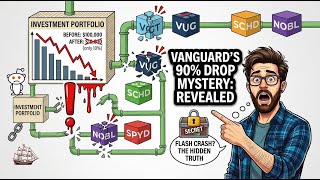
On the morning of April 21, 2026, thousands of investors opened their brokerage apps to find account balances that appeared to have collapsed by as much as 87 percent overnight. Portfolios showing $7,000 the previous day displayed figures below $1,000. The cause was not a market crash, a brokerage error, or a fund liquidation — Vanguard had executed forward stock splits on five of its largest equity ETFs, and the resulting price adjustments caught a significant number of retail investors completely off guard.
Key Takeaways
- Vanguard split five ETFs on April 21, 2026: VGT (8-for-1), VUG (6-for-1), MGK (5-for-1), VOOG (6-for-1), and VO (4-for-1)
- Dividend ETFs including VIG, VYM, VOO, VTI, and SCHD were not included in the split and were completely unaffected
- A forward stock split is not a taxable event under IRS rules — total portfolio value and cost basis remain unchanged
- Share prices declined in proportion to the split ratio, but total share count increased by the same multiple, leaving total investment value identical
- Some Schwab customers saw delayed fractional share counts on April 21 due to batch processing — the shares were not lost
- Vanguard stated the primary rationale was making high-priced ETFs more accessible to new investors with limited monthly savings
Which Five Vanguard ETFs Split on April 21, 2026?
Vanguard announced the splits on March 24, 2026, with a record date of April 17 and a payable date of April 20 after market close. Shares began trading at split-adjusted prices on the morning of April 21. The announcement covered exactly five funds, each carrying a different split ratio.
- VGT (Vanguard Information Technology ETF): 8-for-1 split. Pre-split price approximately $712 per share; post-split approximately $89. Top holdings include Nvidia, Apple, and Microsoft.
- VUG (Vanguard Growth ETF): 6-for-1 split. Pre-split approximately $442; post-split approximately $74. Assets under management at the time were just under $200 billion. Top holdings: Nvidia at 12.73%, Apple at 11.88%, Microsoft at 10.63%.
- MGK (Vanguard Mega Cap Growth ETF): 5-for-1 split. Pre-split approximately $371; post-split approximately $74. Similar mega-cap growth exposure to VUG with higher concentration.
- VOOG (Vanguard S&P 500 Growth ETF): 6-for-1 split. Pre-split approximately $413; post-split approximately $69.
- VO (Vanguard Mid-Cap ETF): 4-for-1 split. Pre-split approximately $290; post-split approximately $72.
These five funds share a defining characteristic: they are growth-oriented equity ETFs with minimal dividend yields. VGT yields 0.44%, VUG yields 0.46%, MGK yields 0.39%, VOOG yields 0.54%, and VO yields 1.51%. None qualify as income or dividend-focused funds by any standard definition. The April 21 event marked the first time Vanguard had split a domestic-listed ETF in over twenty years.
Why Dividend ETFs Like VIG, VYM, VOO, and VTI Were Not Affected
The official Vanguard press release named exactly five tickers: VGT, VUG, MGK, VOOG, and VO. No dividend ETF appeared on that list. Despite this, concern on April 21 spread well beyond holders of those five funds, reaching dividend ETF investors who had no reason to be alarmed. Most retail investors do not monitor fund announcements proactively — they open the app, see a red number, and assume the worst.
As of April 24, 2026 — three trading days after the split — dividend-focused Vanguard ETFs were posting normal prices with no structural changes:
- VYM (Vanguard High Dividend Yield ETF): $154.95 per share, yield of 2.66%, year-to-date return of +6.35%
- VOO (Vanguard S&P 500 ETF): yield approximately 1.19%, no split
- VTI (Vanguard Total Stock Market ETF): year-to-date return +3.15%, no split
- VXUS (Vanguard Total International Stock ETF): year-to-date return +7.20%, no split
SCHD and DGRO, managed by Charles Schwab and BlackRock respectively, were never part of the Vanguard announcement and were entirely unaffected. The press release named exactly five tickers — if a fund's ticker does not appear on that release, it did not split. Reacting emotionally to a corporate action that does not affect your holdings is one of the most avoidable and costly mistakes in long-term investing. The compounding cost of that kind of panic is illustrated directly in Pausing Dividend ETFs for 6 Months: The $13,900 Mistake.
The Cosmetic Split Test: Three Questions to Run Before You Act
The mechanics of a forward stock split can produce visually alarming signals in a brokerage app — particularly for accounts that display individual share counts and per-share prices prominently. The following three-question framework provides a structured way to evaluate any ETF or stock split before taking action.
Question 1: Was Your Exact Ticker Named in the Official Press Release?
Not the fund family — the specific ticker symbol, confirmed in writing in the issuer's announcement. If VIG does not appear in Vanguard's March 24, 2026 press release, VIG did not split, regardless of what the brokerage display appears to show. The five tickers named in the April 2026 announcement were VGT, VUG, MGK, VOOG, and VO. Every other Vanguard ETF was untouched.
Question 2: Did Your Total Dollar Value Change Overnight?
Run the arithmetic before drawing any conclusion. If VGT held 10 shares at $712 before the split, the total position value was $7,120. After the 8-for-1 split, the account should reflect 80 shares at approximately $89 each — still $7,120. If the math holds within a normal daily market variance range, no value was lost. The total dollar amount is the only figure that matters; per-share price is meaningless in isolation.
Question 3: Did the Fund's Dividend Yield, Holdings, or Expense Ratio Change?
In a forward stock split, none of these metrics change. Vanguard confirmed in writing that splits are purely administrative actions. The fund continues to hold the same companies in the same proportions, and the expense ratio is unchanged. If all three questions point toward no real change, the split was cosmetic. The total investment value, the income stream, and the fund's strategy are identical to the prior trading day. The only irreversible mistake available in this situation is an unnecessary sell triggered by a misread display.
How Brokerages Handled the Split — and Why Some Accounts Appeared Wrong
Processing mechanics varied between brokerages on April 21, generating additional confusion beyond the split itself. Several patterns were documented in real time across Reddit threads.
On r/Bogleheads, one investor posted at dawn reporting that VUG had dropped sharply, believing the event was a flash crash. The most-upvoted response was a direct link to the Vanguard press release published 28 days earlier — which the original poster had never read.
On r/ETFs, a user reported that a VGT fractional position worth approximately $125 appeared to show only $11 after the split. His reasoning: if he owned one-eighth of a share before an 8-for-1 split, he now owned one sixty-fourth. The dollar value had been preserved, but the fractional share display created the visual appearance of a major loss when nothing had actually changed.
On r/Schwab, a thread emerged because Schwab's transfer agent posted whole shares in one batch in the morning and fractional shares from dividend reinvestment positions in a separate batch later in the day. For several hours on April 21, Schwab investors holding fractional positions through DRIP were seeing incomplete share counts. The shares were not gone — they posted later that afternoon. Investors who hold fractional shares through dividend reinvestment should verify their final post-split share count has been reconciled before drawing any conclusions about position value.
ETF Stock Split Tax Rules: No Capital Gains, No Taxable Event
A forward stock split does not trigger a taxable event under IRS rules. There is no capital gain and no capital loss at the moment the split executes. What changes is the per-share cost basis, which is divided by the split ratio while the total cost basis stays constant.
Example: An investor who purchased 10 shares of VGT at $500 per share holds a total cost basis of $5,000. After the 8-for-1 split, the account reflects 80 shares with a per-share basis of $62.50. Total basis remains $5,000.
Whether a brokerage automatically adjusts the per-share basis depends on whether the shares are classified as covered or non-covered. Covered shares are those for which the brokerage holds full purchase records and will auto-adjust the cost basis following a split. Non-covered shares — which may include positions transferred from another institution prior to current reporting requirements — may require manual maintenance. Most positions at major brokerages are covered, but investors who transferred shares between institutions should verify their cost basis page following any split event.
One point deserves specific emphasis: some investors chose to sell on April 21 in direct response to seeing the split-adjusted prices. That decision may itself constitute a taxable event if those positions carried unrealized gains. The split was not taxable. The panic-driven sale was.
Why Vanguard Split These ETFs Now
Vanguard's stated rationale was to widen availability for investors by keeping share prices within accessible trading ranges. At $712 per share, VGT was out of reach for a new investor with $300 or $500 in monthly savings who wanted to purchase a whole share. After the 8-for-1 split, that same investor can buy more than five whole shares of VGT with $500. Vanguard manages over $12 trillion in assets globally, and splitting five of its largest equity ETFs to lower the per-share entry point is a deliberate move to reduce friction at the earliest stage of the investor relationship.
There is also an options market dimension worth noting. Selling a covered call or purchasing a cash-secured put requires 100 shares of the underlying. At $712 per share, 100 shares of VGT required $71,200 in capital. After the split, the same 100-share block costs approximately $8,900. Options strategies previously limited to well-capitalized accounts became accessible to a significantly broader investor base following the split.
For investors building a dividend-oriented portfolio, the five split ETFs and core dividend ETFs serve fundamentally different roles. VGT, VUG, MGK, VOOG, and VO are growth and sector-tilt instruments — not income vehicles. If you are evaluating how dividend-focused funds compare on long-term payout trajectory, the deep dive in DGRO vs SCHD: The Dividend Growth Stall Investors Need to See covers that distinction in detail.
Watch the Full Video Breakdown
For a complete visual walkthrough of the April 2026 Vanguard ETF split — including the math behind each split ratio, real brokerage account examples, and a look at the Reddit threads from April 21 — watch the full breakdown on YouTube. The video covers VGT, VUG, MGK, VOOG, and VO individually, demonstrates the Cosmetic Split Test with worked examples, and addresses every common investor mistake documented that morning. Watch: Vanguard Just Split 5 ETFs in April — Here's What Actually Changed.