- Key Takeaways
- What Is Sequence of Returns Risk?
- The 3-Bucket Framework: A Proven Retirement Blueprint
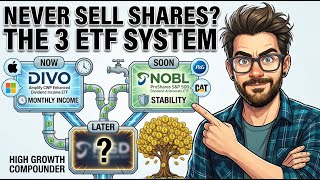
- Bucket 1 (NOW): DIVO ETF — Monthly Income at 5–6% Yield
- Bucket 2 (SOON): NOBL ETF — Dividend Aristocrats and Downside Protection
- Bucket 3 (LATER): SCHD ETF — The Dividend Growth Compounding Engine
- Real Numbers: What the 3-Bucket System Generates
- How to Maintain and Rebalance Your Buckets
- Tax Placement: Why DIVO Goes in the Roth IRA First
- Watch the Full Video Walkthrough
- A Retirement System That Gets Better Over Time
A one-million-dollar retirement portfolio sounds sufficient — until the math turns against you. Withdraw $50,000 per year and face a 15% market decline in your first two years, and according to Schwab's retirement research, that portfolio can run dry in less than twenty years. The problem is not overspending. The problem is being forced to sell shares at the worst possible moment. The three-bucket dividend strategy was designed to eliminate that risk entirely.
Key Takeaways
- Sequence of returns risk — not overspending — is the primary threat to early retirees.
- The 3-bucket strategy, developed by Harold Evensky and expanded by Christine Benz of Morningstar, divides retirement assets into three time horizons: now (0–3 years), soon (3–7 years), and later (7+ years).
- DIVO (Amplify CWP Enhanced Dividend Income ETF) delivers 5–6% monthly income for Bucket 1.
- NOBL (ProShares S&P 500 Dividend Aristocrats ETF) dropped just 6.5% in 2022 versus 18% for the S&P 500 — ideal stability for Bucket 2.
- SCHD's 10.7% annual dividend growth CAGR means income roughly doubles every seven years in Bucket 3.
- A $1M three-bucket portfolio generates approximately $35,580 per year in dividends — 89% of the standard 4% rule withdrawal — without selling a single share.
What Is Sequence of Returns Risk?
Sequence of returns risk refers to the danger of experiencing significant portfolio losses early in retirement, precisely when withdrawals begin. Even if long-term average returns are acceptable, a bad sequence — major losses in years one through five — can permanently impair a portfolio's recovery. Unlike workers still in the accumulation phase, retirees who are withdrawing funds lock in losses by selling shares at depressed prices. The impact compounds negatively over time.
The traditional solution has been the 4% rule, introduced by William Bengen in 1994 and later revised upward to 4.7%. Morningstar's 2026 estimate places the safe withdrawal rate at 3.9% for a 30-year retirement. These frameworks are valid, but they all assume selling shares to fund living expenses. The 3-bucket dividend strategy takes a different approach: replace selling with dividend income so that market downturns become irrelevant to monthly cash flow.
The 3-Bucket Framework: A Proven Retirement Blueprint
Harold Evensky, a financial planning pioneer, developed the bucket approach in the 1980s. Christine Benz of Morningstar later expanded it into the most widely recommended retirement framework in personal finance. The concept is straightforward: divide your retirement assets into three buckets based on when you will need the money.
- Bucket 1 (NOW): Years 0–3. Immediate income. Safety is paramount.
- Bucket 2 (SOON): Years 3–7. Stability with modest growth. Refills Bucket 1.
- Bucket 3 (LATER): Year 7 and beyond. Maximum growth. The compounding engine.
Each bucket holds a different type of investment matched to its time horizon. By filling all three with carefully selected dividend ETFs, retirees can generate income in every market condition without ever being forced to sell at a loss.
Bucket 1 (NOW): DIVO ETF — Monthly Income at 5–6% Yield
Bucket 1 covers the next three years of living expenses. It needs to be stable and it must deliver consistent, predictable income. The Amplify CWP Enhanced Dividend Income ETF (DIVO) fills this role because it pays dividends every single month — not quarterly like most funds.
DIVO holds approximately 35 high-quality large-cap companies: Caterpillar, Goldman Sachs, JPMorgan, Microsoft, Apple, and Home Depot among others. What distinguishes it from standard dividend ETFs is a second income layer: the fund managers tactically sell covered call options on select positions when premiums are attractive. This generates additional cash flow on top of regular dividends, producing a total yield between 5% and 6%.
DIVO manages $6.8 billion in assets, charges a 0.56% expense ratio, and has returned approximately 11% annualized over the last five years and 12.6% since inception in 2016. Morningstar rates it five stars.
The covered call approach differentiates DIVO from systematic option strategies like QYLD, which mechanically writes options on all positions and caps upside entirely. DIVO's managers are selective — they only write covered calls when premiums are favorable, allowing positions to retain full upside during strong rallies. In 2024, DIVO returned over 28%.
For practical context: $150,000 invested in DIVO at a 5% yield generates approximately $7,500 per year, or $625 per month. Bills are paid from dividends alone, regardless of what the market does. One important tax consideration: DIVO's covered call income is taxed as ordinary income, not at the lower qualified dividend rate. Holding DIVO inside a Roth IRA eliminates this tax drag entirely. In a 22% bracket taxable account, the effective yield drops from approximately 6% to roughly 4.7% after taxes — still workable, but the Roth placement is clearly superior.
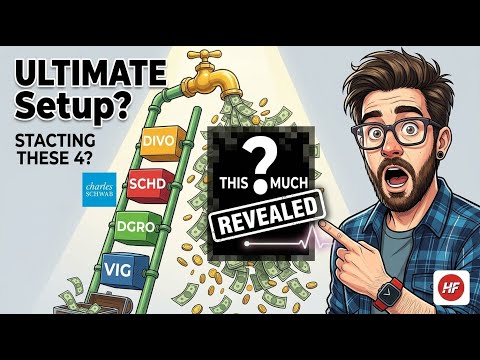
For a look at how DIVO performs alongside other income ETFs, see 4-ETF Dividend Ladder: How VIG, DGRO, SCHD & DIVO Pay $613/Month.
Bucket 2 (SOON): NOBL ETF — Dividend Aristocrats and Downside Protection
Bucket 2 covers years three through seven. This money does not need to pay today's bills, but it will be needed relatively soon — which means it cannot absorb a catastrophic loss. It needs stability, modest growth, and consistent dividend income. The ProShares S&P 500 Dividend Aristocrats ETF (NOBL) was designed for exactly this profile.
NOBL's entry requirement is strict: each holding must have increased its dividend for at least 25 consecutive years. The fund currently holds approximately 69 of these Dividend Aristocrats — companies that raised their payout through every recession, financial crisis, and pandemic of the past quarter century. The current yield is approximately 2.1%, with a ten-year dividend growth rate of 8.5%.
In 2022, when the S&P 500 fell approximately 18%, NOBL declined just 6.5%. Its beta of 0.77 confirms it moves less than the market in both directions — essential protection for money needed in 3 to 7 years.
NOBL manages $11.2 billion in assets and charges 0.35% in fees. Over the last decade it has returned approximately 10 to 10.5% annualized. Because NOBL's dividends are qualified, the fund can be held in a taxable account without significant tax drag — making it a flexible fit for investors with limited tax-advantaged space. The equal-weighted construction ensures no single company dominates performance, and a 30% sector cap prevents concentration risk.
Bucket 3 (LATER): SCHD ETF — The Dividend Growth Compounding Engine
Bucket 3 is money that will not be touched for at least seven years. It can accept more volatility because it has time to recover, and it must generate the strongest long-term growth because it is the source from which Bucket 2 will eventually be refilled. SCHD — the Schwab U.S. Dividend Equity ETF — powers this bucket.
SCHD manages $85 billion in assets and charges just 0.06% in fees. The current yield is approximately 3.45%. The real advantage is the dividend growth rate: over the last ten years, SCHD's dividends have grown at 10.7% per year compounded. At that rate, income roughly doubles every seven years without adding a single new dollar to the position.
If SCHD generates $30,000 in annual dividends today, that same position could yield $60,000 by year seven and $120,000 by year fourteen — driven entirely by dividend growth, not new contributions.
After the 2026 reconstitution, SCHD added UnitedHealth Group, Abbott Laboratories, Procter & Gamble, and Qualcomm while removing AbbVie, Cisco, and several energy names. Healthcare allocation increased 3.6%, technology rose 3.4%, and energy dropped 7.1% — a deliberate shift toward quality and away from cyclical exposure. Over the last decade, SCHD has returned approximately 12.75% annualized, with a five-year return of roughly 9% and a year-to-date return of over 12% in 2026.
If you have ever been tempted to pause contributions to a dividend ETF, the compounding cost of that decision may surprise you.
Real Numbers: What the 3-Bucket System Generates
The standard allocation splits assets 30% to Bucket 1, 30% to Bucket 2, and 40% to Bucket 3. Here is what three common portfolio sizes generate in annual dividend income:
- $500,000 portfolio: $150K in DIVO + $150K in NOBL + $200K in SCHD = approximately $17,790 per year (~$1,483/month). The 4% rule allows $20,000/year; dividends cover 89% of that.
- $750,000 portfolio: $225K in DIVO + $225K in NOBL + $300K in SCHD = approximately $26,685 per year (~$2,224/month). The 4% rule allows $30,000; dividends cover 89%.
- $1,000,000 portfolio: $300K in DIVO + $300K in NOBL + $400K in SCHD = approximately $35,580 per year (~$2,965/month). The 4% rule allows $40,000; dividends cover 89%. Only approximately $4,400 in shares needs to be sold annually to close the gap — a figure that price appreciation typically covers in most market environments.
These figures hold across all three portfolio sizes because the math is proportional. The system scales cleanly from $500K to $1M and beyond. And as time passes, the numbers improve on their own. SCHD's 10.7% dividend growth rate means Bucket 3 income doubles every seven years. NOBL's 8.5% growth rate means Bucket 2 is also expanding. Only DIVO is relatively static — by design, since its job is current cash flow, not long-term growth.
How to Maintain and Rebalance Your Buckets
Annual maintenance follows a simple rule: assess each bucket once per year. If Bucket 1 is running low from DIVO spending, sell gains from Bucket 2 to refill it. If Bucket 2 needs topping up, transfer growth from Bucket 3. The cardinal rule is this: only sell from a bucket that is performing well. Never liquidate a bucket that is down.
This rule is the operational core of why the strategy works. Traditional portfolio withdrawals force retirees to sell whatever is available, often at depressed prices. The 3-bucket system decouples spending from market performance. Bucket 1 provides income for three years without any selling. By the time Bucket 1 needs refilling, markets have historically recovered and the other buckets are positioned to transfer rather than absorb losses.
Tax Placement: Why DIVO Goes in the Roth IRA First
Tax placement meaningfully amplifies the system's efficiency. DIVO's covered call income is taxed as ordinary income — placing it inside a Roth IRA eliminates that tax burden entirely. NOBL and SCHD generate qualified dividends taxed at lower capital gains rates, making them suitable for taxable brokerage accounts without excessive drag.
If Roth IRA space is limited, prioritize DIVO first. The savings from sheltering ordinary income typically outweigh the benefit of sheltering qualified dividend income. For investors with both traditional IRA and Roth accounts, this placement hierarchy delivers meaningful optimization without added complexity.
Watch the Full Video Walkthrough
For a complete visual breakdown of the 3-bucket dividend strategy — including step-by-step bucket construction, portfolio scenario walkthroughs across $500K, $750K, and $1M, and a deeper dive into each ETF's income mechanics — watch the full video on the Harry's Financial Fitness YouTube channel. The video covers why sequence of returns risk is more dangerous than most retirees realize, and exactly how this system keeps retirement income flowing regardless of what markets do.
A Retirement System That Gets Better Over Time
Most retirement strategies focus on how much you can safely withdraw without depleting your portfolio. The 4% rule, Bengen's revised 4.7%, and Morningstar's 2026 estimate of 3.9% are all valid frameworks. But every one of them assumes you are selling shares to fund retirement. The 3-bucket dividend strategy changes that assumption entirely.
By living primarily off dividend income rather than capital liquidation, retirees keep shares intact, allow compounding to continue, and eliminate the forced-selling dynamic that makes sequence of returns risk so destructive. In most years, dividends cover 89% of a standard 4% withdrawal. The shares stay in the portfolio. The income grows. And the system becomes more self-sufficient every year it runs.
Three ETFs. Three time horizons. One system that keeps your retirement funded regardless of what markets do.
Past performance does not guarantee future results. This article is for educational purposes only and does not constitute financial advice. Always conduct your own research before making investment decisions.