- Key Takeaways
- Why the Four Percent Rule Creates Sequence of Returns Risk
- The Three-ETF Structure of the Dividend Bridge
- Running the Numbers: A $500,000 Bridge From Age 57
- The 12- to 18-Month Cash Buffer
- The Tax Optimization Window
- The ACA Subsidy Cliff: A Trap That Can Cost $20,000 in a Single Year
- A Second Scenario: The 12-Year Bridge From Age 55
- Think in Three Sequential Bridges, Not One 30-Year Problem
- Watch the Full Dividend Bridge Breakdown
More than a third of Americans claim Social Security at 62—accepting a permanent 30% reduction in their monthly benefit—not because it is the optimal choice, but because they cannot afford to wait. The Dividend Bridge is a framework designed to solve that problem. Using three dividend ETFs, a cash buffer, and a tax optimization window that most working investors will never access, it covers the income gap between early retirement and full Social Security eligibility without liquidating a single share during a market downturn.
Key Takeaways
- SCHD, DIVO, and VIG each serve a distinct role across different phases of a 10-year retirement bridge
- A 12- to 18-month cash buffer held outside the portfolio is the single most effective defense against sequence of returns risk
- A married couple can receive up to $131,000 in qualified dividends annually at a federal tax rate of zero percent during the bridge years
- Exceeding the ACA subsidy cliff by even $1 can cost early retirees more than $20,000 in a single year
- Dividend income eliminates forced share liquidation during downturns, sidestepping sequence of returns risk entirely
- The framework scales from a 7-year bridge starting at 60 to a 12-year bridge starting at 55
Why the Four Percent Rule Creates Sequence of Returns Risk
The four percent rule dominates retirement planning: withdraw four percent of the portfolio annually, and historical back-tests show the money lasting 30 years. The math holds in most scenarios, but it contains a structural flaw that hits early retirees hardest. If the market drops 40% in the first year of retirement, those early withdrawals liquidate a disproportionately large portion of principal before any recovery can occur. This is sequence of returns risk, and it has ended more early retirements than poor stock selection ever has.
The Dividend Bridge operates on a different premise: never sell, only collect. By relying on dividend distributions rather than share liquidation, the portfolio generates income independent of short-term price movements. During COVID and the 2022 bear market, SCHD's distribution per share held steady even as the fund's price declined. That distinction—stable income from a declining portfolio—is the operational core of the entire framework.
The Three-ETF Structure of the Dividend Bridge
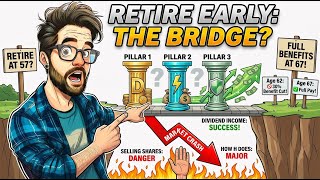
The Dividend Bridge uses three ETFs, each assigned to a specific phase of the retirement timeline. Each fund's yield, risk profile, and tax characteristics serve a different purpose depending on where the investor sits in the bridge window.
SCHD: The Core Anchor (45%–60% of Portfolio)
SCHD serves as the portfolio's foundation, typically representing 45% to 60% of total assets. Its trailing 12-month yield sits at approximately 3.5%, with an expense ratio of just 0.06%. The fund holds roughly 100 U.S. companies screened for cash flow, return on equity, and five or more consecutive years of rising dividends. Through every major market drawdown of the past decade—including COVID and the 2022 rate shock—SCHD's distribution per share remained stable even as its price fell. For a complementary view of how SCHD fits within a broader income portfolio, the 4-ETF Dividend Ladder framework covers its role alongside DIVO, VIG, and DGRO in generating consistent monthly income.
DIVO: The Early-Bridge Income Amplifier (20%–35% of Portfolio)
DIVO carries a yield of approximately 4.7%—meaningfully above SCHD—making it the income amplifier for the first five to six bridge years when cash flow is the priority. The fund writes selective covered calls on roughly 20 dividend-paying blue-chip stocks, generating additional income at the cost of some long-term price appreciation. For the early bridge years, that trade-off is appropriate: income matters more than upside participation. Because covered call distributions are classified as ordinary income, DIVO belongs inside a Roth IRA where that income is sheltered from taxes.
VIG: Appreciation Insurance for the Final Years (10%–20% of Portfolio)
VIG focuses on companies with 10 or more consecutive years of dividend growth. Its yield is lower—around 1.6%—but its role is different. VIG provides price appreciation and dividend growth that protect the final two to three bridge years, ensuring the portfolio retains meaningful value through the moment Social Security begins. An optional fourth position, SCHY at approximately 10%, adds international diversification using the same quality screening as SCHD. If the U.S. dollar weakens during the bridge window, SCHY provides purchasing-power protection. It is a useful complement rather than a requirement.
Running the Numbers: A $500,000 Bridge From Age 57
Consider a 57-year-old investor with $500,000 who needs $3,000 per month ($36,000 per year) to cover expenses through age 67. Allocation: 60% SCHD, 20% DIVO, 20% VIG. The blended portfolio yield works out to approximately 3.36%, producing $16,800 in annual dividend income—about $1,400 per month. That covers roughly half of the monthly requirement. The remaining $1,600 comes from a planned principal draw that the portfolio can absorb over 10 years because Social Security acts as the guaranteed backstop at the endpoint. The effective withdrawal rate sits around 7%, which looks aggressive in isolation but is manageable given the defined 10-year duration and fixed endpoint.
The bridge is not meant to fully replace income from dividends alone. Dividends cover roughly half. The rest comes from a modest principal draw the portfolio can absorb over ten years—because Social Security is backstopping the finish line.
The stress test matters more than the baseline scenario. A 40% crash in year two, combined with a 20% dividend cut, reduces monthly income to roughly $672 and drops portfolio value to approximately $300,000. That combination would end most early retirement plans. The Dividend Bridge handles it through the cash buffer.
The 12- to 18-Month Cash Buffer
The cash buffer is the most underappreciated piece of the Dividend Bridge—and the most consequential. It consists of 12 to 18 months of living expenses held entirely outside the investment portfolio in a high-yield savings account or short-term Treasuries. It is not part of the growth engine. It is the shock absorber.
When the market crashes, the investor draws from the buffer instead of the portfolio. The portfolio continues receiving dividends without forced liquidation. By year three or four, when prices have typically recovered, the buffer is reloaded from dividend income. The portfolio is preserved. The bridge holds. Most investors build the dividend portfolio and skip the buffer—then retire into a downturn, panic, and sell at the bottom. The cash buffer is the structural mechanism that prevents that sequence of events.
The Tax Optimization Window
The bridge years represent a tax opportunity unavailable to anyone still earning a salary. Because earned income has dropped to zero and Social Security has not yet begun, taxable income during this period is often remarkably low. The zero percent qualified dividend bracket applies up to approximately $49,000 in taxable income for single filers—or around $98,000 for married couples filing jointly. Adding the standard deduction, a married couple can realize up to roughly $131,000 in qualified dividends annually at a federal tax rate of zero percent.
A married couple can collect up to $131,000 in qualified dividends per year at a zero percent federal tax rate during the bridge years—a level of tax efficiency no working household will ever match.
SCHD, VIG, and the equity sleeve of DIVO all produce qualified dividends, making them well-suited to capture this bracket. The tax advantage compounds across the full 10-year window, and it is one reason the Dividend Bridge becomes easier to sustain over time rather than harder. The bridge years are also the optimal window for Roth conversions: with marginal tax brackets at their lowest point in a working lifetime, converting traditional IRA assets into the Roth structure fills low-rate brackets with converted income, allowing those dollars to grow and be withdrawn tax-free. Account placement reinforces this structure—SCHD and VIG belong in the taxable brokerage, DIVO inside the Roth, and SCHY in the traditional IRA for gradual conversion at the lowest available rates.
The ACA Subsidy Cliff: A Trap That Can Cost $20,000 in a Single Year
Early retirees who rely on Affordable Care Act marketplace coverage before Medicare begins at 65 face a specific structural risk. Dividend income counts toward modified adjusted gross income (MAGI). Exceeding the ACA subsidy cliff by even a single dollar can eliminate premium subsidies worth $20,000 or more in a single year. Managing MAGI is not optional—it must be designed into the portfolio architecture from the outset.
Two tools address this directly. First, Roth IRA distributions do not count toward MAGI, making them a clean income supplement that does not trigger subsidy clawbacks. Second, strategic Roth conversions sized to fill available headroom keep the investor below the cliff while still capturing the low-bracket opportunity. For a deeper look at how a multi-bucket dividend structure manages this kind of tax layering, the 3-Bucket Dividend Strategy covers related allocation principles in detail.
A Second Scenario: The 12-Year Bridge From Age 55
A longer bridge illustrates the framework's flexibility. An investor at 55 with $800,000 who needs $5,000 per month ($60,000 annually) and wants to leave corporate work 12 years before full retirement age faces a heavier load. Allocation shifts modestly: 50% SCHD, 30% DIVO, 10% SCHY, 10% VIG. The blended yield rises to approximately 3.67%, producing roughly $29,360 in annual dividend income—about $2,447 per month. The principal draw must cover the remaining $2,553 monthly, placing the effective withdrawal rate at approximately 7.5%.
The practical adjustment for a 12-year bridge is a part-time consulting arrangement generating approximately $20,000 annually for the first three years. That supplemental income reduces the effective withdrawal rate to roughly 4.5%—nearly identical to the traditional four percent rule—through the most vulnerable early years. By year four, the portfolio has had three years to grow, sequence of returns risk has passed, and full retirement is sustainable. A small work buffer in the early years is not a failure to retire—it is insurance against the worst market timing outcomes.
Think in Three Sequential Bridges, Not One 30-Year Problem
The dominant mental model in retirement planning treats the entire portfolio as a single 30-year problem. The Dividend Bridge replaces that model with three sequential 10-year phases, each carrying a different allocation, risk profile, and tax treatment. The first bridge (ages 57–67) uses dividend income to cover expenses while Social Security waits in reserve. The second bridge (ages 67–80) allows Social Security to cover baseline expenses while dividends become discretionary income. The third bridge (ages 80+) shifts focus toward legacy planning and long-term care funding. Building the first bridge correctly makes the subsequent phases far more manageable. Most early retirement failures trace back to treating the entire timeline as one undifferentiated problem rather than a sequence of discrete, solvable phases.
Watch the Full Dividend Bridge Breakdown
The visual walkthrough of this strategy—including the complete allocation map by fund, the account placement diagram, and the Roth conversion schedule used across the bridge years—is available in the full video on the Harry's Financial Fitness YouTube channel. Watching alongside this article provides the clearest picture of how each component interacts across the 10-year bridge. The video also covers the specific Roth conversion schedule referenced in the tax section above, which is the natural next implementation step for anyone building this framework.