- Key Takeaways
- Trick 1 — Price First, Cost Second (The IKEA Discipline)
- Trick 2 — Raise Prices Incrementally and Annually (The See's Candies Model)
- Trick 3 — Use Volume to Justify a Lower Price, Not an Excuse to Shrink Margin
- Trick 4 — Build Brand Equity That Holds Price Under Competitive Pressure
- Trick 5 — Protect Full-Price Customers From Discount Erosion
- The Three Pricing Traps That Undo All of the Above
- Watch the Full Breakdown
Most small business owners underestimate the single most powerful lever in their entire operation: the price tag. A 5% price increase on a $1 million business running at 36% gross margin produces roughly $50,000 in additional profit — without hiring anyone, without adding a product line, and without spending a dollar on advertising. Yet most owners either freeze their prices for years or discount their way into a cash flow crisis. The five disciplines below are drawn from some of the world's most studied pricing practitioners — IKEA, See's Candies, In-N-Out Burger, Sam Walton, and Warren Buffett — and from small businesses that quietly doubled their bottom line by applying the same logic.
Key Takeaways
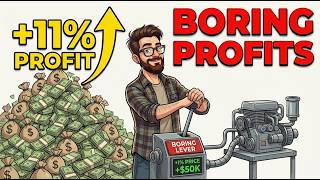
- A 1% price increase lifts operating profit approximately 8% — McKinsey research across 2,400 companies found the average lift is 11.1%.
- Price discipline is not about greed; it funds quality, staff wages, and long-term survival.
- Setting price before cost — the IKEA method — forces creative sourcing instead of lazy margin compression.
- Loyal customers absorb moderate annual increases far better than owners expect: stylists raising rates 10–20% retain 85–95% of clients.
- Discounting is mathematically brutal: a 20% discount on a 40% margin service cuts gross profit in half and requires 100% more volume to break even.
- Direct distribution and factory-direct sourcing can add 4–7 percentage points of gross margin without touching the retail price.
Trick 1 — Price First, Cost Second (The IKEA Discipline)
Ingvar Kamprad founded IKEA in 1948 with a principle that still governs every product the company launches: decide what the customer will pay, then engineer backward to hit that number. The Billy bookcase is the canonical example. IKEA's designers did not build a bookcase and then calculate a price — they fixed the price first and handed a cost target to the supply chain. When Swedish suppliers could not hit the number, Kamprad sourced production from Poland. The constraint forced innovation.
This reversal of the conventional cost-plus formula sounds simple but is radical in practice. Most small business owners calculate their cost of goods, add a markup percentage, and call it a price. The IKEA approach asks: what is the maximum amount the right customer will pay for exactly this outcome? Everything downstream — sourcing, packaging, labor allocation, delivery method — becomes a design problem rather than an accounting exercise.
Thursday Boot Company applies the same logic in footwear. Goodyear welted boots — the gold standard of construction — normally retail above $300 at traditional retailers. Thursday Boot targets $190 by cutting out the wholesale middleman and selling direct to consumer. The result is a factory-direct sourcing advantage of 4–7 percentage points of gross margin, and a price point that makes the premium product feel accessible without cheapening the brand.
Trick 2 — Raise Prices Incrementally and Annually (The See's Candies Model)
Warren Buffett purchased See's Candies in 1972. Over the following 30 years he raised prices approximately 10% annually. Customers grumbled briefly each Valentine's Day, then kept buying. The compounding effect on margins was extraordinary. Buffett has described See's as one of the best businesses he ever owned precisely because of its pricing power — the ability to raise prices without losing meaningful volume.
Small businesses rarely need 10% annually. But the lesson is in the discipline: regular, expected, modest increases maintain margin without shocking anyone. Hermann Simon, founder of Simon-Kucher and author of Confessions of the Pricing Man, has documented hundreds of companies that eroded their profitability not through bad strategy but through price inertia — they simply forgot to raise prices while costs climbed.
Tato Corcoran at Brandt Molded Marble in Milwaukee ran a four-employee, $400,000-revenue business that had gone a full decade without a price change. She raised prices approximately 40% over 18 months. She kept every major customer. Revenue passed $1 million. Physical output increased only 33%. The math is the story: the same team, the same equipment, nearly the same volume — and dramatically different economics.
McKinsey research found that a 1% price increase lifts operating profit approximately 8%. Across a study of 2,400 companies, the average operating profit improvement was 11.1%.
Trick 3 — Use Volume to Justify a Lower Price, Not an Excuse to Shrink Margin
Sam Walton's foundational insight came in Newport, Arkansas, where the prevailing wholesale arrangement allowed retailers a 45% markup on certain goods. Walton marked up only 25% and sold three times the pairs. He was not discounting — he was choosing a volume model with a structural cost advantage and passing the savings to customers in a disciplined way that still produced strong absolute profit dollars.
The distinction matters. Reactive discounting — cutting price to rescue a slow week — is economically destructive. The math is unforgiving: a 30% discount on a 40% margin product requires 300% more volume to break even. Walton's model worked because the lower price was set intentionally, supported by lower costs, and held consistently. Jeff Bezos formalized the same logic in his 2002 shareholder letter, describing the flywheel: lower prices drive volume, volume drives supplier leverage, leverage enables lower costs, lower costs enable lower prices.
Right Channel Radios, an e-commerce operator, applied a modest version of this principle in reverse: owner Andrew Youderian raised prices on his top 25–50 products by 5–15%. Total profit increased approximately 30%. The changes took less than a week to implement and generated enough margin to fund a full-time hire in year two. No flywheel required — just a willingness to test upward.
Trick 4 — Build Brand Equity That Holds Price Under Competitive Pressure
When California raised fast food minimum wage to $20 per hour in 2024, most chains responded by raising combo meal prices $2 or more — an 8–12% average increase across the category. In-N-Out Burger, under CEO Lynsi Snyder, raised the price of its Double-Double by $0.25. The restraint was not charity; it was brand strategy. In-N-Out's cult following is built on the perception that the company does right by customers and employees alike, and a modest increase preserved that perception while competitors handed In-N-Out a marketing gift.
Liquid Death demonstrates the same principle from a different angle. Water in a can is a commodity. But Liquid Death built a brand strong enough that 72% of surveyed consumers said they would pay $2.99 for it, versus 70% who would pay $1.99 for an unbranded equivalent. At a $4.99 price point, the branded product produced approximately 27% higher revenue than the unbranded version. The company scaled from roughly $45 million to over $330 million in revenue in three years. Margin came from brand, not from cost cuts.
Hims & Hers is a subscription-based example of the same logic applied to healthcare products. With approximately 1.7 million subscribers generating roughly $872 million in annual revenue, the company reports a customer lifetime value of approximately $338 against a customer acquisition cost of approximately $89, on gross margins of approximately 80%. The subscription model locks in the price relationship and makes churn — not price — the primary financial variable. Some subscription car wash operators report EBITDA of approximately $1 million on approximately $2 million in revenue, a margin profile that would be impossible in a transactional, discount-heavy model.
Trick 5 — Protect Full-Price Customers From Discount Erosion
Discounting is the most common pricing mistake and the least visible. Paddle's subscription research found that discount-acquired customers have a lifetime value approximately 32% lower than full-price customers. They churn faster, complain more, and refer fewer new customers. The short-term revenue bump from a promotional price masks a long-term customer quality problem.
A fulfillment company that raised prices 18% lost two accounts out of 47. The 45 remaining clients — the ones who stayed — were precisely the customers worth serving: less price-sensitive, more loyal, and more profitable. Losing two unprofitable or marginally profitable accounts is not a failure; it is a curation. The discipline of holding price is also a filter for customer quality.
For service businesses, the fear of losing clients after a price increase is almost always overstated. Professional beauty industry data shows that stylists who raise rates 10–20% retain 85–95% of their clients. The clients who leave were often the most demanding and least profitable. Those who stay self-select as the foundation of a sustainable business.
Software businesses operate at gross margins of 70–85%. Manufacturing runs 30–40%. Retail and e-commerce sit at 25–45%. Understanding where a business falls in that range is the starting point for any honest pricing conversation. A business operating below the midpoint of its industry's margin range is almost certainly leaving money on the table — through price inertia, excessive discounting, or distribution costs that a direct model would eliminate. If you are curious about the margin profiles of specific business types, the deep dive on 6 Boring Businesses That Make Money (Under $500 to Start) walks through several with the same level of financial detail.
The Three Pricing Traps That Undo All of the Above
Understanding the five disciplines is only half the work. Three traps consistently pull business owners backward.
Trap one: cost-plus pricing with no market anchor. Adding a fixed percentage to cost guarantees margin stability in theory but ignores what customers will actually pay. It also creates a perverse incentive: the more inefficient the operation, the higher the price, which punishes efficiency improvements.
Trap two: uniform pricing across a mixed customer base. Not every customer values the product equally. A fulfillment customer doing $500,000 in annual volume has different economics than one doing $50,000. Charging both the same rate subsidizes the smaller, costlier account at the expense of the larger one. Tiered pricing, minimum order requirements, and service-level differentiation are all legitimate tools.
Trap three: discounting as a sales strategy. Every percentage point of discount costs disproportionately more than the revenue it saves. The Paddle data on subscription LTV, the mathematical requirement for volume recovery after a 30% discount, and the real-world experience of businesses like Right Channel Radios and Brandt Molded Marble all point to the same conclusion: raising prices, even modestly, nearly always produces better outcomes than cutting them.
For business owners evaluating a new venture where pricing power is a central variable, the analysis in How to Buy a Laundromat: Real Costs, Returns, and Red Flags illustrates how pricing structure affects acquisition value and ongoing cash flow in a concrete, asset-heavy business.
Watch the Full Breakdown
The analysis above condenses a detailed video walkthrough that covers the math, the case studies, and the specific implementation steps in greater depth. Watch Pricing Wrong? 5 BORING Tricks IKEA, See's, and In-N-Out All Use on the HS channel for the full picture, including the exact questions to ask before the next price change and the sequence that minimizes customer pushback.