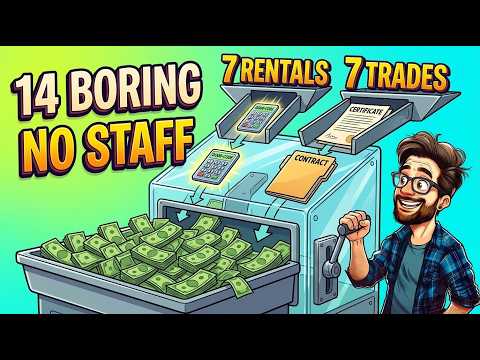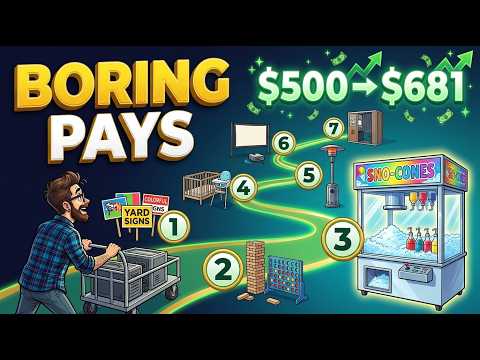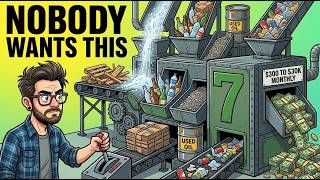
The most reliable income stream in your town may already be leaving through a back door. Every restaurant, retailer, and job site generates waste they pay someone to remove — cardboard, fryer oil, cull wood, empty containers. To the businesses producing it, waste is a cost. To the operator who builds one route or acquires one machine, that same stream becomes free inventory that pays on a predictable schedule.
This is the engine behind what experienced operators call the Free-Stream Payout model: the generator pays to remove the material, you acquire the processing asset once, and you collect from a stream that does not stop. Below are seven real routes, ranked from easiest to hardest to launch, each built on a waste stream that already moves through your market.
- Waste-stream businesses generate income from material that generators already pay to remove
- Each route requires a one-time asset purchase — a machine or a route — rather than ongoing inventory costs
- Recurring supplier contracts, not spot pickups, convert occasional hauls into dependable monthly income
- Maintaining at least three suppliers protects the route when any single source changes haulers
- A permit, registration, or exclusive agreement creates a legal moat that keeps casual competitors out
- Monthly income across these routes ranges from roughly $2,000 part-time to over $30,000 for a full commercial operation
The Free-Stream Payout: Why Waste Beats Conventional Products
The conventional business model involves inventing something, finding customers, and managing inventory risk. Waste-stream businesses invert that model. The raw material arrives free because the person generating it pays to have it removed. The buyer — a mill, a refinery, a recycling broker — already exists. The only capital decision is the processing machine or the route itself.
Think of it as a toll booth on a river. The river, the waste, never stops flowing. The generator has to pay for disposal one way or another. Once the toll booth is operational — the machine running, the contracts signed — the operator simply collects. Bo Burlingham documented exactly this kind of business in Small Giants, studying companies that chose to stay quietly profitable rather than chase disruptive scale. That is not the consolation prize in this model. It is the whole strategy.
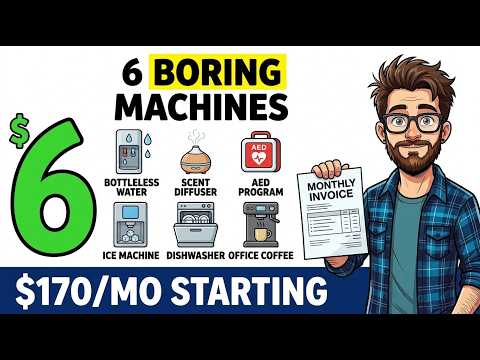
For a look at how this compares to lower-capital entry points, see 6 Boring Businesses That Make Money Under $500 to Start. The waste-stream routes below generally require more upfront capital but produce more durable, recurring income.
Seven Waste-Based Routes, Ranked Easiest to Hardest
1. Firewood Processing and Bundling
Tree services and land clearing contractors pay tipping fees to dump logs at landfills. An operator who offers to take those logs for free converts a competitor's disposal bill into free raw material. The output is bundled retail firewood for gas stations and corner stores, plus bulk cords sold to homes, campgrounds, and restaurants with wood-fired ovens.
One documented processor posted $26,000 in gross monthly sales and roughly $6,800 in net profit in a strong month. A steadier part-time bundler nets around $5,000 per month once the route is established. Entry-level processors start around $15,000 financed; commercial-grade machines run $40,000 to $60,000. Manufacturer models show a nine-month payback at modest operating hours, dropping to four months at higher volume. The machine is the moat — no competitor with a hand axe can match one that splits a cord in minutes. There is also a seasonal edge: processors who spend the slow spring stockpiling free logs arrive at autumn with dry, split, ready-to-sell inventory while everyone else scrambles. Smart operators maintain at least three log suppliers so no single dropout starves production mid-season.
2. Ice Block and Dry Ice Supply
Restaurants, fish markets, and event venues consistently overpay ice distributors or run critically short at the worst moments. A small dry ice pelletizer runs $3,000 to $12,000; block ice units start around $5,000 used. With ten active recurring accounts, a dry ice route bills $2,000 to $5,000 per month at margins above 80 percent. Documented payback lands under six months with ten clients.
The key insight is that this business is not selling ice — it is selling reliability. A standing weekly delivery slot the buyer never has to manage becomes the moat, because once you own their delivery day, a casual competitor cannot displace you. A practical launch looks like one used unit, three restaurant contracts, and the same delivery day every week without exception.
3. Reverse Vending and Bottle Deposit Machines
In states with a bottle deposit program, a machine hosted inside a supermarket earns $300 to over $1,000 per month combining container handling fees, advertising revenue, and retail partnerships. The program pays a per-container handling fee, so operators are not competing on price — they are collecting a fee stream that already exists inside the deposit system.
The competitive moat here is legally enforced: collecting those handling fees requires registration with the state deposit program. That registration is not bureaucratic friction — it is the wall that keeps unlicensed operators off the fee stream entirely. Machines run $5,000 to $25,000 and carry the slowest payback of the seven routes. Operators who build meaningful income in this category think in placements — three to five machines across high-traffic stores, each running as a small autonomous fee collector.
4. Cardboard Baling and Resale
Every retailer, warehouse, and distribution center pays a hauler to make cardboard disappear. An operator who offers to take it for free in exchange for exclusive pickup rights erases the retailer's disposal cost while securing free raw material. Paper mills and recycling brokers buy baled cardboard at $40 to $180 per ton, with coastal mills paying the premium.
A route servicing a few larger retailers pulls $800 to $2,500 per month in bale revenue. One solo operator reported roughly $500 net per haul after fuel, running several hauls per week. A baler costs $12,000 to $48,000 and is the essential moat: loose cardboard is nearly worthless per truckload; compressed bales are the entire business model. A competitor with a pickup truck cannot move enough loose material to make the economics work. The winning pitch to a retailer is a standing pickup schedule two or three times per week that earns an exclusive arrangement.
5. Sand, Gravel, and Topsoil Pit Royalties
This route differs from the others in that the asset is land or an existing royalty interest rather than a machine. A documented gravel pit lease pays a base royalty of $2,000 per month plus a per-ton rate on everything extracted and hauled. Larger leases with minimum tonnage guarantees can clear $16,000 to $20,000 per month at full production.
The moat is a signed multi-year lease with a minimum tonnage guarantee. That guarantee converts idle land into a recurring check regardless of seasonal variation. Entry typically means buying into a small producing pit rather than raw acreage, which raises both the capital requirement and the research burden. The payoff is that once the lease is signed, it is among the most passive income structures of the seven. An aggregate company handles all extraction and sales; the landowner collects the royalty check.
6. Used Cooking Oil Collection
Every restaurant with a fryer must have that oil removed legally and regularly, or face health code violations. Used cooking oil collection is one of the highest-margin recurring routes on the entire list. A single restaurant account is modest on its own, but a full route of 150 accounts can generate over $30,000 per month at healthy margins. One Filta franchise operator profiled in industry coverage was generating $2.5 million per year from this route alone.
The economic spread is straightforward: you collect the oil for free — or pay the restaurant a small rebate to win the account — then sell it filtered to a biodiesel refinery on a standing supply contract for significantly more per gallon than it cost to acquire. That margin, multiplied across every week the fryer runs, is the repeating profit engine. The moat is a grease hauler registration. Both restaurants and refineries require proof of that permit to do business, which means the permit keeps unlicensed competitors off the route entirely.
7. Recycling and Waste-to-Value Operations
This is the apex of the seven routes because it stacks multiple waste streams under a single commercial relationship. Construction sites produce scrap metal and wood. Retailers produce cardboard. Offices produce electronics and paper. A single conversation with a site manager or property manager can open three or four revenue streams simultaneously — not just one.
A solo operator with a small network of commercial pickups realistically earns $2,500 to $4,500 per month. Adding a second vehicle and locking recurring commercial contracts pushes that to $6,000 to $10,000 per month — $50,000 to $150,000 annually at small to medium scale. Big John's Junk Removal is a documented example: a debt-free operation grossing $20,000 to $25,000 per month, built from a $4,000 truck and trailer sourcing material directly from tree services and construction sites. For a deeper look at how the economics work in practice, see How to Start a Junk Removal Business: Real Costs, Margins and Income. The entry asset — a truck and trailer under $20,000 — scales naturally toward a small yard with a baler as volume grows. A recycler license plus established relationships with scrap yards and mills form the competitive moat.
Three Filters to Validate Any Route Before You Spend a Dollar
Every route can be evaluated through three questions before committing capital.
Filter one — the stream. Which waste do you already see every week? The fryer oil leaving the restaurant back door. The flattened cardboard outside the distribution center. The cull logs piling up at the tree service yard. Starting where you already have eyes on the supply reduces research time and lowers the barrier to that first call.
Filter two — the buyer. Is there a mill, a refinery, a scrap yard, or a retail shelf that will pay for the processed output in bulk? No established buyer means no business. This filter eliminates routes that sound clever but lack a downstream market before a single dollar is spent on equipment.
Filter three — the moat. Is there a permit, a registration, or an exclusive standing agreement that keeps casual competitors out once you are operating? A route that passes all three filters is a durable business. One that fails any of them will not hold long-term.
The Recurring Contract Is the Real Asset
Across all seven routes, one pattern holds without exception. Income does not scale with how much waste exists in the market. It scales with how many recurring accounts are under signed contract. A standing pickup schedule with a retailer, a supply contract with a refinery, a multi-year pit lease with a minimum tonnage guarantee — these are the toll booths. A spot transaction is a tip. The contract is the paycheck.
The same logic applies to supplier diversification. A route that depends on a single source is one hauler switch away from losing its supply overnight. The rule that holds across experienced operators: no single supplier should represent more than one-third of the input stream. That is not overcaution — it is basic route discipline once the operation reaches real volume.
Watch the Full Breakdown on YouTube
For a visual walkthrough of all seven routes — including specific setup costs, documented payback timelines, and the exact first calls to make to land your first account — watch the full video on YouTube. The breakdown covers the supplier diversification lesson in detail, the three-filter framework applied to each route, and the one zero-cost move you can make in the next 24 hours to test any of these businesses before spending a dollar.