- Key Takeaways
- The Hustler's Trap: Why More Hours Don't Build More Wealth
- The Decision-Removal Loop: The Engine Behind All Nine Habits
- Nine Habits Operators Run for Decades
- Real Operators Under $50M: The Same Engine at Smaller Scale
- Four Anti-Patterns That Kill Operator Momentum
- Watch the Full Breakdown
Charles Schulz drew the Peanuts comic strip at the same desk for fifty years — eight hours a day, same chair, same lamp, same yellow legal pad. By the time he passed in 2000, his estate was valued at over one billion dollars. That is not a story about extraordinary talent or relentless hustle. It is a story about structure. If you are working 50- to 60-hour weeks and your revenue line looks the same as it did three years ago, the problem is almost certainly not your effort. It is the absence of the boring, durable habits that real operators run quietly for decades.
Key Takeaways
- Operators build wealth through repeatable structure, not longer hours — a principle Cal Newport documents in Deep Work
- The Decision-Removal Loop eliminates daily re-decisions that accumulate into compounding drift over time
- Mohnish Pabrai's 168-hour rule shows you can build a second income engine without quitting your day job
- Irreversible decisions — hires, equity partners, long contracts — should never be made the same day you first hear about them
- Reputation deposits (honest communication, generous tips, on-time payments) act as invisible compound interest on trust
- Nick Huber, Neel Parekh, and Richard Behney all attribute their revenue scale to documented systems, not harder personal hustle
The Hustler's Trap: Why More Hours Don't Build More Wealth
Most small business owners are grinding 50 to 60 hours per week and watching their revenue stay roughly flat. Equity does not grow. Skills plateau. Energy declines. The operators who actually compound their way to lasting wealth are not working more hours — they are running structures that remove the daily friction hustlers absorb without noticing.
A Stanford analysis found that productivity per hour collapses after about 50 hours per week, and that total output at 70 hours barely exceeds output at 55. Research from UC Irvine's Gloria Mark found it takes approximately 23 minutes and 15 seconds for a worker to fully return to a task after an interruption. A 2026 analysis of software teams pegged the cost of excessive context-switching at roughly $21,000 per developer per year in lost productivity. The math on heroic hustle is unfavorable at every scale.
The Decision-Removal Loop: The Engine Behind All Nine Habits
The thread connecting all nine habits comes from Cal Newport's book Deep Work. Newport's key observation — the one almost no one discusses — is that consistent operators outproduce furious hustlers not because of superior willpower but because of superior structure. Every habit on this list is a structure that removes a daily re-decision from the operator's schedule.
Schulz did not decide each morning whether to draw. He simply sat down. Seinfeld did not decide each day whether to write. The yellow legal pad was already on the table. Pabrai did not decide each year whether to keep his day job while building his next venture. He decided once, built a rule around it, and let the rule run. Hustlers re-decide every single day. Operators decided once, built a structure around it, and let the structure do the repeating. Removed decisions remove drift. Removed drift compounds. Compounded structure eventually becomes a moat that raw hustle cannot cross.
Nine Habits Operators Run for Decades
Habit 1: Same Desk, Same Hours, Every Working Day
The most boring habit on this list is also the most foundational. Schulz sat down at nine in the morning, drew until lunch, drew until five, and went home — fifty straight years. Newport runs the modern version through time blocking: every working minute is pre-assigned to a task category before the day starts. Email has a fixed window. Deep work has a fixed window. Shallow tasks have a fixed window. Newport holds a full academic post and has shipped books that have sold around three million copies of Deep Work alone, while running a podcast past 400 episodes — all from the same structured machine.
The practical translation: pick one fixed production block, same room, same hours, five or six days a week. Inside that block, only work that drives revenue, equity, or durable skill happens — sales calls, estimates, fulfillment, system-building, training. When life disrupts the block, it gets rescheduled the same day rather than abandoned. Over time, customers, vendors, and team members feel the steadiness. You become an institution instead of a scrambling one-person fire department.
Habit 2: Build Daily Output as Routine, Not Inspiration
Jerry Seinfeld carried a yellow legal pad for forty years, writing 90 to 120 minutes every morning. His rule to a young comedian: do not break the chain. Each writing day got a mark on a wall calendar. After two weeks, the chain became the boss. After ten years, the chain became the career. James Clear ran an identical engine: two articles published every Monday and Thursday from 2012 to 2015, without exception. Three years later he had 200,000 email subscribers. His Three-Two-One newsletter — three ideas, two quotes, one question, every Thursday — now reaches over three million subscribers. Atomic Habits has sold over 25 million copies. Two creators, same engine.
Pick one daily output that visibly moves your business. For a service operation, it is one estimate sent and one job completed. For a sales-led business, it is ten outbound touches. Track the streak. On the worst day, do the floor version — two calls instead of ten — and never reach zero.
Habit 3: The 168-Hour Rule — Build Before You Quit
Mohnish Pabrai built multiple startups and compounding investment returns without ever quitting a paying job to fund the next venture. His logic is arithmetic. A week has 168 hours. Sleep takes roughly 49. A job and commute take roughly 50. That leaves close to 70 hours per week, of which 20 to 25 can be genuine builder work in evenings and weekends. The day job becomes an investor — it funds the cost of being wrong while the second venture matures.
The data supports the patience. An Institute for Fiscal Studies study found that workers who jumped into solo self-employment did not recover to pre-quit income levels even three full years later, with 26% exiting within twelve months and median solo income running close to 29% below comparable employment. But a 2025 National Bureau of Economic Research study found that persistent self-employed workers — those who stayed with it long-term — ended up earning roughly 70% more than wage employees by age 55. The exit point is when the side venture consistently covers at least half of personal expenses for six to twelve consecutive months and the only constraint on growth is time.
Habits 4 Through 7: Decisions, Inputs, and Closing the Action Gap
Yongpin Duan, the operator behind both Oppo and Vivo — both global top-five smartphone brands — gives his teams the same three-word annual address: fast is slow. Truly irreversible decisions deserve real deliberation time. The operator's rule: no big, irreversible decision — hires, equity partners, long contracts, major expansions — gets made the same day it is first heard. Run a paid trial project before any hire. Do a small joint deal before any partnership. The hustler says yes in the hallway. The operator sleeps on it.
On the input side, Pabrai outsources extraction to David Senra at the Founders Podcast, who reads hundreds of operator biographies per year and distills the practical lessons into 80-minute episodes. Outsource the extraction; keep the thinking. Ryan Holiday channels the same principle through 4x6 index cards: every useful line from every book gets its own card, and the shoeboxes of cards become the research pipeline behind his Stoic titles, which have crossed five million copies. Pick three or four high-signal sources for your industry and track ideas-per-hour. Cut anything that produces zero actionable output.
Both Munger and Pabrai force randomness into their inputs by listening to podcasts in sequential episode order — including episodes whose titles look uninteresting. The boring episodes are where genuinely new mental models hide. Pair this with the intention-to-action drill sharpened by Pabrai from Benjamin Franklin: what you will do tomorrow, do today; what you will do today, do now. Every "I should" thought gets processed one of three ways — act on it immediately if it takes under two minutes, schedule it with a clear next step if it matters, or delete it entirely.
Habits 8 and 9: Trust Compounds Silently
Pabrai talks openly about invisible reputation deposits: round up the tip, leave a handwritten thank-you on an invoice, tell a vendor specifically why their work last week mattered. The math is small — roughly $100 a month is sufficient — and the leverage is large. Pay hourly workers on time even when cash is tight. Send the holiday gift two weeks early. Cover dinner during a brutal install week. None of these moves appear on a marketing dashboard. All of them appear later as the supplier who saves you inventory during a shortage and the technician who stays one extra year instead of taking a competing offer.
David Hawkins argued in Power vs. Force that the trust ceiling on a person's life and business is set by the white lies they tolerate. Saying traffic was bad when you left late. Telling a customer next week when you know it is three weeks out. Each white lie sets a ceiling. The daily practice: at the end of every working day, find the one moment where you softened a number or padded a timeline, and decide how you would have phrased it honestly. Do this for 30 days and invoices get paid faster, customer no-shows fall, and your team starts giving you the unfiltered version of bad news instead of the polished one. Over years, the operator's edge stops being persuasion and becomes something simpler: a reputation for saying things that turn out to be true.
Real Operators Under $50M: The Same Engine at Smaller Scale
Nick Huber built Storage Squad from a college dorm operation to 30 locations and over $2M in annual sales before selling in the low seven figures. His crews ran off tablets with a 45-point checklist printed on the back for every single job. Huber has said that scaling from $1.5M to $2.2M in revenue caused profitability to triple and personal stress to fall by roughly 80% — once systems and roles replaced his memory as the operating mechanism.
Neel Parekh started MaidThis as a local cleaning service in 2013. A decade later, the business averages approximately $166,000 per month — close to $2M annually — and is run by a fully remote team across eight countries. The operator structure is not motivational. It is an automated scheduling system connected directly to Airbnb and Vrbo that routes jobs without ever touching Parekh's personal calendar.
Richard Behney, known as the Million Dollar Plumber, teaches that most plumbing owners stall between $300K and $500K in revenue for one reason: they stay in the truck and keep operational knowledge in their head rather than in documented systems. The seven-figure plumbing companies consistently share two boring moves — get the owner out of direct service delivery earlier than feels comfortable, and replace memory with written processes. This is the same logic that makes boring businesses that generate real cash flow compound faster than complex ones: the operator must be building the system, not being the system.
If you have ever wondered why effort alone stalls at a certain revenue level, the underlying dynamic mirrors what most wealth-builders hit at the $50K compounding wall — where savers and operators alike quit right before the curve bends. Structure has to be in place before compounding can do its work.
Four Anti-Patterns That Kill Operator Momentum
A large randomized trial tracking close to 5,000 employees across Illinois workplace wellness programs found no significant effect on health, medical spending, absenteeism, or productivity. Elaborate morning rituals are fine for personal wellbeing — they do not move revenue. The Stanford productivity data argues against adding hours past 50 per week. Gloria Mark's interruption research argues against unmanaged context-switching. And the fourth anti-pattern — heroic burnout — is illustrated by Buffer founder Joel Gascoigne, who ran every classic hustle move for years until his co-founder and CTO departed, layoffs hit, and his body forced a roughly six-week break from the CEO role. He came back and rebuilt the work design around structure. The nine habits above are what that rebuild looks like in practice.
Watch the Full Breakdown
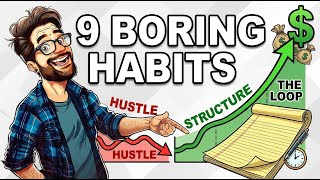
For a visual walkthrough of all nine habits — including the research data behind the anti-patterns, the operator case studies side by side, and a step-by-step illustration of the Decision-Removal Loop — watch the full video on YouTube. The 168-hour rule segment and the intention-to-action gap drill are especially useful when seen in the visual format alongside the timeline comparisons.
Watch: Working Hard But Not Building Wealth? 9 BORING Habits Operators Do — on YouTube