- Key Takeaways
- The Quiet Reason Customers Never Return
- Rule 1: Pick One Promise and Never Break It
- Rule 2: Never Take the Extra Margin Just Because You Can
- Rule 3: Spend on Customers Who Already Said Yes
- Charlie Munger's Underpromise and Overdeliver Rule
- How to Start Building Your Trust Account Tonight
- Watch the Full Breakdown
Most small business owners blame price when a customer disappears after one visit. The real culprit is almost always something quieter: a small crack in trust that the customer felt but never said out loud. Costco, a company that spends almost nothing on traditional advertising, has built one of the highest customer renewal rates in retail by solving exactly that problem. In its most recent fiscal year, more than 92 percent of members in the United States and Canada renewed their memberships — not because Costco ran a promotion, but because it has followed three rules consistently for decades. Those rules work in any business, regardless of size.
Key Takeaways
- Acquiring a new customer costs roughly five times more than keeping one you already have, according to Frederick Reichheld's research in The Loyalty Effect.
- A five percent increase in customer retention can raise profit by 25 to 95 percent, per Harvard Business Review research.
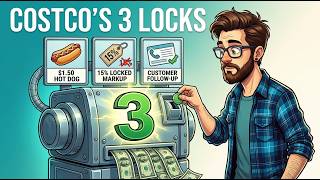
- Costco's $1.50 hot dog has not changed in price since 1985 — a deliberate, loss-making promise that signals trustworthiness on everything else the company sells.
- Costco caps markups at roughly 15 percent above cost, even when market conditions would allow far more.
- More than 92 percent of Costco's US and Canada members renewed in fiscal 2025, driven almost entirely by word of mouth rather than advertising spend.
- Charlie Munger's underpromise-and-overdeliver principle is the underlying engine that makes all three rules compound over time.
The Quiet Reason Customers Never Return
The conventional response to customer churn is to cut prices or run a coupon campaign. That response treats a trust problem like a price problem, and it keeps most business owners on a treadmill they never step off. Frederick Reichheld documented this dynamic in his landmark book The Loyalty Effect: landing a brand-new customer costs roughly five times what it costs to keep one who already knows where the door is. Harvard Business Review has supported that finding in multiple studies, adding that a mere five percent improvement in retention can push profit anywhere from 25 to 95 percent higher.
The math reframes the entire marketing conversation. Once a customer has already given a business a chance, the highest-return move is rarely another ad — it is giving that customer a compelling reason to come back. Trust is what brings them back. And trust, it turns out, is built through a small number of very boring and very consistent behaviors. The businesses that understand this shift their spending accordingly, and the results compound quietly for years before they become obvious.
Rule 1: Pick One Promise and Never Break It
Costco has sold a hot dog and a soda for $1.50 since 1985. Beef prices have risen. Bun costs have risen. Labor costs have risen. The price has not moved once in four decades. When an executive proposed raising it, Jim Sinegal — Costco's co-founder and longtime CEO — reportedly told him to find another solution, because the price was staying. Costco eventually built its own hot dog production facility just to protect that number. The item loses money on every sale, and Costco keeps selling it on purpose.
The reason Sinegal held the line has nothing to do with hot dogs. That $1.50 price is a public, visible, forty-year-old commitment that communicates something no marketing campaign can buy: if Costco refuses to break its promise on the small thing a customer can see, it is unlikely to break its promise on the expensive things a customer cannot see. The hot dog is not a food item. It is a standing handshake.
Applying This Rule in Any Trade
The practical version for a small operator does not require a factory. It requires one promise simple enough to keep on the worst day of the year. An auto repair shop might commit to a free 30-day re-check on any completed job, no questions asked. A hair salon might offer to redo any cut the customer is unhappy with at no charge. A house cleaner might promise to redo any room the client points to, same day, free. The scale of the promise matters far less than the consistency of keeping it — every single time, including the times it stings.
There is a compounding effect built into this structure. A free 30-day re-check gives every customer a built-in reason to return within a month — while the work is fresh and the relationship is still warm. If the re-check reveals nothing, the customer leaves reassured. If it surfaces a genuine issue, the business fixes it before a negative review can form. Either outcome strengthens the relationship. The re-check is free; the additional work it surfaces is not. One kept promise just converted a one-time transaction into a second visit.
The companion move to the standing promise is equally important: when something goes wrong, fix it before the customer has to ask. Costco's famous no-questions return policy is built on this instinct. Research and real-world experience point to the same counterintuitive result — a customer who watches a business make a mistake and then fix it without argument tends to trust that business more than a customer who never encountered a problem at all. The recovery is the deposit.
Rule 2: Never Take the Extra Margin Just Because You Can
As documented on the Acquired podcast and in widely reported accounts of Costco's history, Costco's buyers once secured a closeout batch of Levi's jeans at roughly $14 a pair. Retail on those jeans was running $50 to $60. The buying team wanted to price them at $30 — still a compelling deal for members and a healthy margin for the company. Sinegal refused. Costco's internal rule caps markups at approximately 15 percent above cost, regardless of how favorable the sourcing deal is. He told his team that breaking the rule once breaks it forever, because customers eventually learn which businesses give them the real price and which ones quietly extract what the market will bear.
Turning down easy money is the move that made Costco larger than the competitors who took it. The mechanism is straightforward: businesses that squeeze maximum margin from every transaction teach their customers to stay on guard. Those customers never fully relax. They comparison-shop every visit. They leave the moment a better deal appears. The business must spend continuously to replace them, which is exactly the treadmill most small operators are already running on.
Making Fairness Visible
For a small operator, the equivalent of Costco's markup rule is showing the work. Walk a customer to the car and show them the worn part next to the new one. Tell them a repair could wait another three months, even though the appointment slot is open today. That sentence — the one where a business owner talks a customer out of spending — is among the most profitable sentences in the business. The customer will not forget it. They will send the neighbor, the coworker, the family member who just bought a vehicle.
A normal suburban service area might contain 20,000 to 30,000 potential customers within a ten-minute drive. A business does not need to reach all of them. It needs a few hundred to trust it completely and tell their neighbors. A few hundred loyal advocates out of 30,000 potential customers is a rounding error of the available pool — and it is a full calendar for a small shop. The goal was never the entire ocean. It was one quiet corner of it that belongs entirely to the business that earned it.
Rule 3: Spend on Customers Who Already Said Yes
Costco runs almost no traditional advertising. No large television campaigns, no major coupon drops, no aggressive promotional calendar. The budget that most businesses pour into acquiring strangers goes, at Costco, back into the member experience: lower prices, a generous return policy, the consistently fair markup, and the unbroken hot dog promise. The result in fiscal 2025 was a membership renewal rate above 92 percent in the United States and Canada. The customers do the marketing. The trust does the selling.
For a small business, the reallocation does not need to be dramatic. A simple follow-up call three days after a completed job — not to upsell, but to ask whether everything is running correctly — costs almost nothing and communicates something most competitors never bother to say: that the business is still thinking about the customer after the invoice is paid. If the customer is satisfied, that call is a deposit. If something is off, the business learns about it before it becomes a public complaint. Both outcomes are wins, and the bar for standing out is remarkably low because almost nobody else in a given market does this.
If you are exploring other low-overhead models where repeat-customer loyalty is the primary growth engine, the breakdown of 6 boring businesses that make money under $500 to start covers several trades that scale on exactly this kind of trust flywheel rather than advertising spend.
Charlie Munger's Underpromise and Overdeliver Rule
Charlie Munger, who spent six decades studying what separates durable businesses from fragile ones, distilled the principle behind all three rules into four words: underpromise and overdeliver. Most businesses do the inverse — they sell aggressively, promise the moon, and then quietly deliver something smaller. Munger's formulation was to promise less than the business can actually do, and then beat its own quote every time. Quote five days; finish in three. Quote $400; charge $380. The gap between the expectation and the reality is where the trust is made.
Every time a business beats its own number, the customer experiences a moment of pleasant surprise. And every moment of pleasant surprise is a deposit in the Trust Account.
Reichheld's retention economics, Harvard Business Review's profit research, and Munger's deposit rule are all describing the same machine. A pleasantly surprised customer comes back. A returning customer costs one-fifth of what a new one costs. That ratio, compounding year after year, is the difference between a business that constantly scrambles and one that generates steady, predictable income. Trust is not a soft concept. It is the cheapest growth engine ever built — and almost nobody runs it systematically, because making deposits in the Trust Account does not feel like doing anything visible.
The compounding effect takes time to become apparent. For the first several months, the changes feel quiet, sometimes uncomfortably so. Then the pattern shifts: the same customers begin booking repeat work without shopping around first. They stop negotiating on price, because they already believe the number is fair. They send referrals without being asked. The advertising budget starts to shrink, because fewer new customers need to be found each month to fill the same schedule. The business that felt like a treadmill starts to feel like something the owner actually controls. Slowly — then all at once.
How to Start Building Your Trust Account Tonight
The three rules reduce to one action that can be taken before the end of the day. Write down the single promise that will never be broken — the one a first-time customer can see and feel on their very first visit. Make it simple enough to keep on the worst day of the year. Put it somewhere visible: on the wall, on the receipt, on the door. The simple promise kept for years outperforms the clever campaign run for a month, every time.
That is the first deposit. Everything else — the refused margin, the redirected ad budget, the follow-up call — builds on top of it. Businesses that run this system consistently tend to report the same gradual shift: more repeat work, more referrals, and less money spent recovering customers they never should have lost. Trust builds on itself, and once it is sold for a quick dollar, it cannot be bought back at the same price.
For a concrete example of how this principle plays out in a service-based trade with low startup costs, the analysis of mobile auto detailing costs, margins, and year-one income shows how a reputation-driven business scales when customer trust replaces ad spend as the primary growth driver.
Watch the Full Breakdown
The video version of this analysis walks through each rule with additional examples and the complete math behind the retention-to-profit figures. Watch Customers Try You Once, Then Vanish. Costco's 3 Customer Trust Rules on the Harry's Stash YouTube channel for the full visual walkthrough: