- Key Takeaways
- What Is a Ghost Kitchen?
- What It Actually Costs to Start
- The Delivery App Commission Problem
- Two Levers to Take Back Your Margin
- The Second Brand Multiplier
- The Hospitality Edge in an Invisible Business
- Real Operators: What Works and What Fails
- The Math Behind $20,000 Per Month
- Three Filters to Run Before Signing Anything
- Watch the Full Breakdown on YouTube
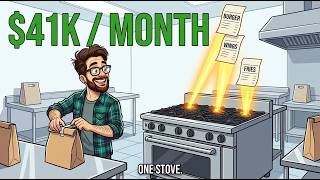
A small taco brand in Charlotte pulled in forty-one thousand dollars in a single strong month. No tables. No waiters. No dining room. Just a woman named Mariah, a rented kitchen, and a name her customers only ever see glowing on a delivery app. That is the ghost kitchen business model in one sentence — and the part that rewires how most people think about restaurants is this: that same kitchen, that same stove, that same cook can run three separate restaurants at once. Three storefronts. One rent check. Nobody ordering dinner ever knows the difference.
Key Takeaways
- Ghost kitchen startup costs run $4,000 to $10,000 — versus hundreds of thousands of dollars for a traditional restaurant with a dining room.
- Delivery apps like DoorDash and Uber Eats charge 25–30% commission per order, but a direct ordering channel collapses that fee to 2–5%.
- Adding a second virtual brand to the same kitchen costs only $300–$800 per month in extra food and packaging — with almost no new fixed costs.
- Three brands running off one kitchen can generate $60,000–$80,000 per month in combined sales.
- To hit $20,000 per month in sales, an operator needs roughly 33 orders per day — a small fraction of delivery volume in any dense zip code.
- Established ghost kitchens net between $5,000 and $45,000 per month in profit, according to restaurant data firm 7shifts.
What Is a Ghost Kitchen?
A ghost kitchen — also called a virtual restaurant or cloud kitchen — is a licensed, inspected commercial kitchen that cooks exclusively for delivery and pickup. There is no host stand, no servers, no lease on a corner storefront with big windows. The operator rents time or a small unit inside a shared commissary kitchen, prepares each order, hands the bag to a delivery driver, and the customer never sees the building.
Some operators rent dedicated units inside purpose-built facilities like CloudKitchens. Others book off-hours slots inside existing restaurants that sit idle during slow periods. Either way, the address is invisible — and invisible is cheap. To DoorDash or Uber Eats, a smash burger brand and a wing brand and a loaded fries concept appear as three separate restaurants competing in three separate searches. The fact that all three share one stove and one rent check is entirely the operator's advantage.
What It Actually Costs to Start
A traditional restaurant with a dining room can cost hundreds of thousands of dollars before it sells a single plate — tables, chairs, a guest bathroom, a host stand, a sign, a multi-year lease, servers, and decor all arrive before any revenue does. A ghost kitchen eliminates every one of those line items.
A shoestring launch through a shared commissary kitchen, with a self-built brand, can start around $4,000. A realistic solo first launch — built around a focused eight-to-twelve-item menu — lands somewhere between $6,000 and $10,000. That figure typically covers roughly $800 per month in commissary kitchen rental, an initial supply of branded bags and containers (around $1,000), and a food handler certification earned online in about ninety minutes for fifteen dollars.
The permit, the business license, the food safety card — none of it is glamorous, and that is exactly the point. Food permit rules vary city to city, so fifteen minutes of research in your own county tells you which path applies. Beyond the local specifics, the boring paperwork is the entry barrier that filters out underprepared competitors before they ever reach your zip code.
The Delivery App Commission Problem
The delivery platforms are the most important partner in this business — and the most expensive one. DoorDash and Uber Eats are free to list on, which sounds straightforward until the orders begin. In 2026, platform commissions typically run 25 to 30 percent of the order total.
Run the numbers on a single twenty-dollar order and the picture becomes clear immediately.
On a $20 order: the platform keeps roughly $5.00 in commission, card processing takes $0.40, and packaging runs $1.00. Before covering a single ingredient, gross revenue is already down to $13.60. Food cost on that order runs about $6.40, leaving $7.20 in gross profit — on a $20 sale. Scale that to $20,000 in monthly revenue and the platform quietly keeps $5,000 of it just for the privilege of appearing in its search results.
This is the figure that stops new operators cold. It is also why the profitable ones build a secondary revenue path before they need it.
Two Levers to Take Back Your Margin
Lever one is direct ordering. Tools like Square or ChowNow allow operators to build a standalone ordering link where the effective commission drops from 25 percent to 2–5 percent — essentially just the card processing fee. A small insert card in every delivery bag encourages customers to order directly next time in exchange for a discount. The customer saves money. The operator keeps an additional twenty percent of the sale. Over a year, a growing share of orders migrates to the direct channel and margin climbs without changing a single recipe.
Lever two is pickup. For customers within two or three miles of the kitchen, a small pickup discount eliminates the driver, the delivery fee, and the platform commission entirely. No commission, no tip calculation — straight margin. Neither lever requires significant capital. Both require being built before they are urgently needed, which is the lesson the Cali BBQ ghost kitchen experiment made expensive.
This same margin-first thinking shows up across the low-overhead business world. If you are exploring other models alongside this one, the breakdown of six boring businesses that make money under $500 to start covers several that follow the same logic: minimal fixed costs, a clear path to direct customer relationships, and margin that improves as the business matures.
The Second Brand Multiplier
This is the structural advantage that separates a ghost kitchen from nearly every other food business. Delivery apps see brand names, not physical addresses. A smash burger brand and a wing brand and a late-night loaded fries concept are three separate restaurants as far as any algorithm is concerned — competing in three separate searches, appearing on three separate browsing sessions.
From the operator's side, the picture is completely different. The kitchen slot is already paid. The equipment is already there. The labor is already clocked in. One food permit covers the address, not the name on the menu. Adding a second brand to the same fryer costs only $300 to $800 per month in incremental food and packaging. That second brand can add $8,000 to $15,000 per month in sales on near-pure profit, because every fixed cost was already covered by the first brand.
Three brands running off one kitchen can pull $60,000–$80,000 per month in sales. After platforms, food, a dedicated unit, and part-time labor, operators in this structure can net $12,000–$25,000 per month. According to 7shifts, the industry-wide range for established ghost kitchens runs $5,000–$45,000 per month in profit.
Stack a third concept — a late-night loaded fries brand riding the same fryer — and the rent check still does not change. This is the structural reason the ghost kitchen model earns more per square foot than most traditional food operations.
The Hospitality Edge in an Invisible Business
Will Guidara, who ran the number one restaurant in the world, argues in Unreasonable Hospitality that the feeling created around a meal is the real product — even for a fifteen-dollar delivery order. In a ghost kitchen, the customer never sees a face. So the hospitality has to live inside the bag: a handwritten thank-you note, an unexpected free cookie, the discount card pointing toward the direct ordering link. That is how a faceless brand earns a regular customer.
Mariah understood this from the beginning. Every customer at her pickup window walked away feeling like a friend — which is exactly why a corporate sneaker launch called her to cater rather than any other local food operator. The food was the product. The feeling was the brand.
Real Operators: What Works and What Fails
Mariah's taco brand in Charlotte is the clearest proof of concept for this model. She started on a twenty-dollar griddle after losing a bartending job, built her audience on Instagram without paid ads, moved into a shared commissary kitchen, and grew into one of the most recognized food brands in her city. Her best months reached $41,000 in sales. Her best years approached half a million dollars. A sneaker company eventually hired her to cater a launch event — $20,000 in two days — no storefront required.
In Austin, Robert Meyer opened Keto Kitchen inside a CloudKitchens unit and reached profitability within sixty days. His edge was sequencing: he built a community of keto dieters before opening, then ran tightly targeted ads to exactly those people. His average order landed around $33 — well above the typical $20–$25 range — because he sold to the right customer rather than the broadest one.
The cautionary case comes from Shawn Walchef, who operated the well-known Cali BBQ brand in San Diego. During the delivery boom, he opened three ghost kitchen locations — real brand, real audience, real team — and all three struggled. His post-mortem identified three culprits: high rent, crushing third-party commissions, and not owning the customer relationship. The apps did. Volume arrived, but volume without margin bleeds an operation slowly.
His conclusion is the clearest framework in this space: delivery platforms are a marketing channel, not a business model. An operator who builds direct ordering from day one starts exactly where Walchef ended up — without paying the tuition to get there.
The same operational discipline — low fixed costs, direct customer ownership, careful margin management — separates lasting boring businesses from ones that only look good on paper. For a parallel example in a different industry, the junk removal business breakdown covers the same core pattern: low startup cost, no storefront, and a margin structure that rewards repeat customers over platform dependency.
The Math Behind $20,000 Per Month
A single well-run delivery brand can generate $15,000 to $50,000 per month in gross sales. After platform commissions, food cost, kitchen rent, and labor, a solo operator typically nets around 8 to 15 percent. That is a modest margin — but it applies to a business that cost $6,000–$10,000 to launch, not $300,000.
To reach $20,000 per month in sales, an operator needs approximately 1,000 orders per month — roughly 33 orders per day. In any delivery-dense zip code, the apps route tens of thousands of food orders every month. Thirty-three dinners sent to people living within a two-mile radius of one kitchen is a small fraction of that volume. The business does not require becoming the most popular restaurant in the city. It requires becoming the right option for a consistent local slice.
Three Filters to Run Before Signing Anything
- Kitchen cost: Can you find a commissary slot under $2,000 per month? If the cheapest available unit in your market sits well above that threshold, the startup math becomes difficult for a first-time operator. Keep looking before committing.
- Local delivery demand: Open DoorDash or Uber Eats as a customer and set the delivery address to your target zip code. Count the restaurants actively taking orders within two miles. A thin result set suggests weak demand. A crowded, competitive field confirms real delivery volume exists and that customers in the area already order regularly.
- Menu stackability: Can a second virtual brand run off the same core ingredients and equipment? A first menu requiring twenty items and three different proteins leaves no room to multiply. Keep the initial concept lean enough that a second brand can ride the same fryer without requiring a second cook or a second permit.
Watch the Full Breakdown on YouTube
The numbers above cover the framework, but the video walks through the commission math in real time — including how Harry, a closing-shift line cook with $7,000 in savings, builds his ghost kitchen from zero through the full three-brand stack. If you want to see the Second Brand Multiplier play out through a real operator scenario rather than read through it, the complete deep dive is available on the Harry's Stash YouTube channel.