- Key Takeaways
- Two Operators, One Engine
- Sizing the Pond: The Two Percent Rule
- The Four Revenue Streams on Every Lawn Customer
- Running the Route Math
- Three Challenges and the Fix for Each
- The Honest Startup Picture
- The 80-Account Ceiling and the First Hire Decision
- A 30-Day Launch Playbook
- Watch the Full Deep Dive
Most people driving past a lawn crew on a Tuesday morning assume the operator is grinding just to get by. They miss the math. A solo operator running a tight residential mowing route, layered with a fertilization program and a mosquito spray add-on, can quietly net somewhere between nine and twelve thousand dollars a month — more than most six-figure salaried jobs, at roughly half the hours. This is how the Weekly Route Engine works, and why density plus stacking is the mechanism that separates operators who struggle from the ones who quietly print income.
Key Takeaways
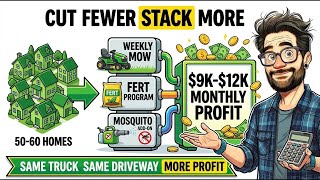
- A solo operator with 50 weekly accounts in a tight 3-mile radius can net $9,000–$12,000 per month by stacking mowing, fertilization, and mosquito spray on the same customers.
- Four revenue streams stack on each lawn customer: weekly mowing, fertilization program, mosquito spray, and seasonal cleanups — with the first three providing locked-in recurring contract income.
- Route density — keeping drive time under 3 minutes between stops — is the single biggest profitability lever, per the NALP route density brief.
- A lean startup using a used walk-behind mower and an existing truck costs $3,000–$6,000 to launch. A realistic one-truck setup runs $10,000–$20,000.
- The pesticide applicator license ($50–$200 through your state department of agriculture) is the unlock for fertilization and mosquito spray — the two highest-margin recurring revenue streams in the business.
- The solo ceiling sits around 80–100 weekly accounts, which already produces a low six-figure annual take-home before any crew hire.
Two Operators, One Engine
The residential lawn care model is best understood through two real operators at opposite ends of the scale. The first is Andrew at the Lawn Squad, documented on the sweaty startup forum with year-over-year revenue receipts. In 2017, Andrew ran sixteen recurring lawn customers off a push mower, earning $11,638 in revenue and keeping roughly $7,000 as profit. He returned to class, doubled the route the following summer, and finished with $39,253 in revenue — $32,942 kept, working out to approximately $41 per hour in pure profit. On a push mower, while completing college coursework.
At the other end of the scale is Jonathan Pototschnik, known in the sweaty startup community as the Lawn Care Millionaire. Pototschnik built CitiTurf, a residential lawn care company in Texas, into a multi-million dollar operation. He then converted its operating playbook into Service Autopilot — software that many of his former competitors now pay him to use every month. Same kind of trailer, same kind of mower, same neighborhoods. A different ceiling, but the same underlying engine.
That engine has three layers: a dense recurring weekly mow, a fertilization and weed control program stacked on top, and a mosquito spray add-on on top of that. Same truck. Same driveway. Same address already driven to. The power is not in doing more — it is in stacking more value onto work already being done.
Sizing the Pond: The Two Percent Rule
Before running revenue numbers, a lawn care business operator needs to understand the real size of the local market. The average mid-sized American zip code holds between 5,000 and 15,000 single-family homes. Of those, the share that pays someone else to cut the grass — rather than doing it themselves — is roughly 1,500 to 4,000 homes. That is the real addressable market, not the whole zip code.
The target route is just two percent of that hiring pool: fifty homes, maybe sixty in a slower market, sitting inside a three-mile radius. Two out of every hundred homes that already hire lawn care. That is the pond. It is achievable in nearly every American suburb, and it requires capturing only a tiny fraction of a demand base that already exists and is already spending.
The Four Revenue Streams on Every Lawn Customer
Most lawn care operators only ever see the first revenue stream. The operators who quietly out-earn the salary class see all four — and they stack them on the same customer without spending a dollar on new customer acquisition.
Stream 1 — Weekly recurring mowing. A quarter-acre standard lot runs $45–$65 per visit. A half-acre runs $50–$75, according to Landscape Atlas pricing data and confirmed by real operators on sweaty startup forum threads. The contract renews every Tuesday whether the customer thinks about it or not. This is the engine — the door key that puts a truck in the driveway on a predictable weekly schedule.
Stream 2 — Fertilization and weed control program. Four to six visits per year, priced at roughly $50–$100 per round. Chemical cost is low, labor is fast, and margin is heavy. One signed contract at the start of the season covers the full year. The customer never has to think about it again.
Stream 3 — Mosquito and pest spray add-on. Monthly sprays from April through October. Operators on the sweaty startup forum and the Real Green sales playbook routinely report 90% or higher margins on these services. It is the highest dollar-per-minute work in the entire business — performed in a yard that is already being cut weekly at no additional travel cost.
Stream 4 — One-off seasonal cleanups. Spring cleanup, fall leaf removal, aeration, gutter cleaning. Aeration runs $80–$200 per visit per Lawn.best pricing data. Strong revenue in the moment, but with no recurring lock-in, making it the lowest-stickiness stream. It fills shoulder-season gaps effectively but should not be confused with the compounding value of the first three streams.
The mow is just the door key. The upsell conversation — the spray, the fertilizer, the aeration — costs zero dollars of new customer acquisition. You are already in the driveway.
Running the Route Math
With 50 weekly accounts averaging a $55 ticket, at ten stops per day across a five-day week, gross revenue works out to $550 per day, $2,750 per week, and $11,825 per month. Subtract $1,000 for fuel, $500 for blade and trimmer maintenance, and $1,000 for overhead and software, and the net from mowing alone sits around $9,300 per month.
Layer the fertilization program on those same 50 homes at $60 per round, four rounds per year, and that adds $6,000 more in annual margin. Add mosquito spray on just 20 of the same accounts at $60 per treatment for seven months, and that is another $8,400 per year. A tight solo route, fully stacked, lands in the $11,000–$13,000 monthly net range — without a single employee on the payroll.
Fifty homes is not an impressive-sounding number. Fifty homes inside the same three square miles, with the full upsell stack on top, quietly out-earns most salaried jobs on the same street. This is the same recurring-revenue compounding principle behind other boring businesses that generate consistent cash flow. For a side-by-side look at another service business with comparable margin structures, the breakdown of how junk removal economics work is worth reviewing as a baseline.
Three Challenges and the Fix for Each
Year one in a residential lawn care route consistently produces three recurring problems. Each has a direct fix.
Challenge 1: Pricing too low to cover real costs. A $55-per-stop headline rate is a gross revenue figure, not a take-home number. Roughly 40% of that survives as net after fuel, blade wear, trimmer line, insurance, and overhead are paid. Operators who price to their headline rate without accounting for these costs can run themselves out of business in eight months while their schedule looks completely full. The fix is pricing every stop to absorb actual route costs from day one — not just the mowing time.
Challenge 2: Scattered accounts across a wide geography. A paying customer eight zip codes away is not a win — it is a margin leak. The National Association of Landscape Professionals (NALP) route density brief specifies that drive time between stops should sit under three minutes per transition. Every extra minute over that threshold is money burning through the exhaust pipe. The fix is turning down accounts outside the target radius and actively building density within it, even when it means saying no to paying work.
Challenge 3: Rain delays that compress the weekly schedule. A two-day weather delay in an overbooked schedule creates customer service problems and operational stress. The fix is building a sixth workday into the weekly plan on paper and only using it when weather forces the issue. The customer never feels skipped. The operator never feels chased. Every veteran operator on the sweaty startup forum runs this schedule buffer as standard practice.
The Honest Startup Picture
The actual cost to start a lawn care business in 2026 falls into three tiers depending on equipment choices at launch.
The lean version — a used commercial walk-behind mower in the 36-inch range at $1,500–$3,500, a string trimmer, backpack blower, and stick edger ($1,000–$3,000 for a full commercial kit per the Get Jobber startup guide), a used open trailer with ramp gate at $1,500–$3,500, and the truck already in the driveway — runs $3,000–$6,000 total. Add business registration ($50–$400 depending on state), general liability insurance ($500–$2,000 per year for a solo operator per the Join Homebase startup guide), and $200–$500 in door-hanger and yard-sign marketing.
The realistic one-truck operator setup with a used zero-turn and full commercial kit lands at $10,000–$20,000. The premium enclosed-trailer build with new Stihl equipment runs $25,000 and up — appropriate for operators who have already proven their route, not for a first-season launch.
The pesticide applicator license deserves separate attention. It requires passing a core exam plus a category exam through the state department of agriculture, costing $50–$200 in fees with a two-to-eight-week exam window. Most states do not require any landscape contractor license for basic mowing — Nebraska, Washington, Iowa, Kansas, and Virginia among them. Nevada requires a C-10 license on jobs over $1,000. Utah requires the S-330 landscape contractor license. Ten minutes on the state department of agriculture website clarifies the rules for any specific zip code. This license is the unlock for fertilization and mosquito spray — the two highest-margin recurring streams in the entire business model.
The 80-Account Ceiling and the First Hire Decision
Mike Andes, who runs Augusta Lawn Care and has documented the solo operator framework extensively, has identified the ceiling explicitly: a single operator running tight routes hits a wall around 80–100 weekly accounts. That ceiling already represents a low six-figure annual take-home. At that point, two paths exist.
The first path is staying at the ceiling. Many operators run at 80–100 accounts for years and live extremely well doing it. The route becomes routine, the income is stable, and the hours are predictable.
The second path is the first crew hire, and this is where Dan Martell's Buy Back Your Time framework maps directly onto the lawn care model. The argument is that a founder's job is to continuously buy back the lowest dollar-per-hour task and reinvest that hour into the highest-leverage activity available. At 80 accounts, the lowest dollar-per-hour task is the actual mowing. The highest-leverage activities are route stacking, contract closing, HOA bidding, and upsell programming. The first hire is therefore not a manager — it is a second mower operator. The owner steps off the equipment and onto the phone. That transition turns one truck into two, then three, then a fleet. Pototschnik built CitiTurf on exactly this pattern: cut services, tighten routes, buy back hours, scale.
A 30-Day Launch Playbook
Getting the first signed account on the books does not require months of planning. It requires four structured weeks.
Week 1: Register the LLC. Open a business checking account. Bind general liability insurance. Purchase one used commercial walk-behind mower, a trimmer, and a backpack blower. Set up a free Google Business Profile. Pick one three-to-five-block target neighborhood within a three-mile radius. Print 300 door hangers with a single clear message: "Weekly mowing. $55 flat. Spots open this week."
Week 2: Walk every door in the target radius and hand the hanger directly to the homeowner when possible. Post once on Nextdoor — local, weekly, spots open. Reply to any quote request within minutes. Schedule two free quote walks for Saturday morning. Confirm local zoning or fertilizer application rules with the public works department.
Week 3: Service the first three to five lawns. Photograph each before and after. Ask for a Google review immediately after completing each job. Knock on three to four neighbors of every signed customer the same afternoon. Adjacent-block stacking is the only growth strategy that compounds without adding drive time.
Week 4: Offer every signed customer a fertilization program. Map all accounts inside Jobber or the free tier of Yardbook. Calculate actual time per stop. Plan the route with adjacent-block stacking as the only growth filter. The goal at 30 days is 20 signed weekly accounts — the floor where a solo operator stops running errands and starts running a proper recurring route.
Watch the Full Deep Dive
The numbers above lay out the framework, but the full video walks through the Weekly Route Engine in detail — including the real operator case studies, the complete upsell stack breakdown, and the Buy Back Your Time framework mapped onto the first crew hire transition. Watch it on the Harry's Stash YouTube channel for the complete visual walkthrough, and drop your local zip code account count in the comments to benchmark your pond against others.
This article is for educational purposes only and is not financial, legal, or tax advice. Licensing requirements — particularly for pesticide application — vary by state. Income figures are sourced from public data including the NALP route density brief and benchmark study, Landscape Atlas pricing data, the Get Jobber startup academy, the Join Homebase startup guide, Real Green's mosquito sales playbook, and operator threads on r/sweatystartup. Verify all requirements with your state department of agriculture before applying any chemicals to a customer's property.