Three men. One truck. A sealcoat crew rolled into a college parking lot at nine in the morning and were gone before lunch. The invoice on the desk read $2,400. The groundskeeper standing there watching them cleared $4,540 — for the entire month. That gap is not skill. It is not licensing. It is route density, and ten outdoor businesses operate entirely on that logic.
This breakdown covers two stacks: five boring cleaning routes that pay more than most licensed trades, and five outdoor routes that almost nobody starts — all opening for under $5,000. Income figures are drawn from named Reddit operators and industry sources including zeorouteplanner, Asphalt Kingdom, Southeast Softwash, Upper Inc, Durable, and Financial Models Lab, using 2025 and 2026 market data.
Key Takeaways
- All ten routes open for under $5,000; several require under $500 to start
- No license, trade school, or apprenticeship required for most routes
- Gutter cleaning tickets run $150–$300, with 3–5 jobs possible per day
- One solo Reddit operator documented $920,000 from house painting in three years
- Driveway sealing breaks even after roughly 25 working hours at ~$125 per hour effective rate
- The Recurring Route Window separates the $3K/month operator from the $10K/month operator running identical equipment
Why Route Businesses Out-Earn the Trades
A licensed electrician earns well. But that electrician starts fresh on every project, quotes one scope at a time, and carries two years of trade school plus a licensing exam as the cost of entry. A soft-washing operator with four clients inside a three-mile radius turns the same weekly loop into a recurring subscription line. The service is less glamorous. The income math often is not.
Route density is the underlying lever. When jobs cluster geographically, drive time compresses, callbacks layer naturally, and word-of-mouth spreads block by block. That structural advantage explains why boring businesses consistently out-earn more complex alternatives when the operator focuses on density over raw volume.
Stack 1: Five Boring Cleaning Routes That Pay More Than Most Trades
1. Gutter Cleaning
Startup cost: $500–$2,000 (a ladder, a leaf blower, and basic safety gear). Ticket size: $150–$300. A disciplined operator runs three to five jobs per day — at four jobs averaging $200, that is $800 in a single day with zero licensing requirements and no trade school. Gutter cleaning also creates a natural seasonal anchor: spring and fall bookings allow pre-season contract pitches before competitors begin advertising.
2. Carpet Cleaning
Carpet cleaning sits at the crossover between residential and commercial demand. Residential tickets average $100–$250 per visit; commercial contracts with offices, gyms, or property management companies push monthly recurring revenue significantly higher. Entry-level portable carpet extractors run $300–$800 used. The commercial pitch — walk in and offer a free demo room — closes faster than most operators expect, because property managers actively avoid vetting new vendors every quarter.
3. Roof Cleaning
Black streaking from algae affects most asphalt shingle roofs within five to seven years. Homeowners often mistake it for aging and begin budgeting for a full replacement — which creates the operator's easiest objection: a cleaning at $400–$800 versus a roof at $12,000. Roof cleaning also pairs naturally with soft washing equipment, allowing operators to cross-sell rather than invest in a separate rig.
4. Graffiti Removal
Graffiti removal operates almost exclusively in the commercial lane — municipalities, restaurant chains, retail strips, and property management companies all maintain standing contracts to address tagging within 48 hours of discovery. That urgency translates into premium pricing, and the commercial buyer does not negotiate the way a homeowner does. Entry cost is low: a pressure washer plus chemical-grade degreasers covers most surfaces without a license.
5. Full-House Soft Washing
Soft washing replaces high pressure with low-pressure chemical application — safer on siding, paint, and rooflines, and the results last longer because the chemistry kills the organism rather than blasting surface residue away. Operators who build a dense residential route report net income of up to $30,000 per month for six months of the year in active markets, according to Southeast Softwash operator breakdowns. No license, no apprenticeship, and no two-year trade school stands between the first job and that ceiling.
The Recurring Route Engine
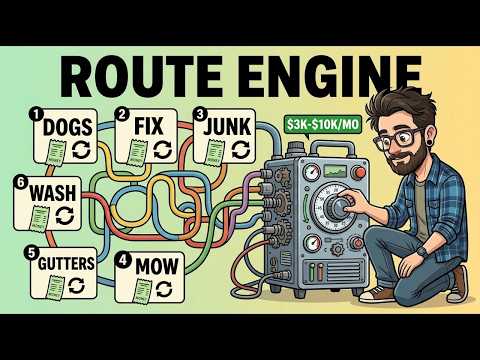
The separation between a string of one-off cleanings and a subscription business is the Recurring Route Engine. Four jobs inside a three-mile radius shifts the economics of every subsequent job: drive time approaches zero, referrals cluster naturally, and a single Nextdoor post or door-hanger run becomes self-reinforcing rather than a one-time acquisition event.
First-customer channels differ by route. Gutter cleaning converts well from Nextdoor posts and five-around door hangers — leave a flyer at the five houses adjacent to every completed job. HOA contract pitches work for soft washing and roof cleaning because one decision-maker controls dozens of units. Graffiti removal closes fastest via a cold walk-in to a restaurant manager: a three-minute conversation with a visible problem on the wall directly behind them. The same density principle drives results in mobile detailing operations, where geographic clustering turns a $500 kit into a high-four-figure monthly income by year one.
Stack 2: Five Profitable Outdoor Routes Almost Nobody Starts
6. Driveway Sealing
Startup cost: approximately $3,206 in supplies. Effective hourly rate once routes are established: ~$125 per working hour. Break-even point: roughly 25 working hours. A sealcoat crew running dense commercial stops — parking lots, apartment complexes, HOA-managed driveways — can close a $2,400 invoice before noon. The single July mistake that kills most new operators: applying sealer within 48 hours of rain or before temperatures stabilize. A failed cure means redoing the job at the operator's cost, erasing the margin on two or three surrounding stops to cover it.
7. Fleet Washing
Trucking companies, delivery fleets, and construction firms require regular exterior washing for DOT compliance and brand standards. Fleet washing is a recurring B2B contract by nature — the client does not disappear after one job. Operators who land a contract with a regional carrier or a national franchise location establish monthly recurring revenue that is nearly immune to seasonal swings, because commercial vehicles operate year-round regardless of weather.
8. House Painting
One Reddit operator documented $920,000 in revenue from a solo house painting operation across three years — starting without employees.
Exterior painting is one of the highest-ticket services a solo operator can deliver without a license in most states. Interior painting adds a year-round revenue layer. The operator cited above scaled by staying solo longer than most — avoiding payroll complexity while reinvesting margins into marketing. Painting also benefits from the pre-season contract play: homeowners book exterior painting in spring, creating a predictable forward pipeline when quotes land in February and March.
9. Tile and Grout Cleaning
Tile and grout cleaning sits alongside carpet cleaning in the professional services category but carries higher average ticket values in the commercial lane — restaurants, hotels, and medical facilities pay premium rates for sanitation compliance documentation. The equipment — a rotary tile cleaning attachment mounted to a standard carpet extractor — runs $400–$900 used and converts an existing carpet cleaning operation into a dual-service route without adding a second vehicle.
10. Snow Removal
Snow removal is the seasonal stack that turns a summer cleaning route into year-round cash flow from a single truck. Pre-season contracts signed in October — before the first storm — lock in recurring revenue per event or per season. Insurance functions as a competitive moat in snow removal more than in almost any other route on this list: commercial properties require a certificate of insurance before signing, which automatically eliminates every competitor who has not set up properly. That barrier is free to cross and eliminates most of the field.
The Recurring Route Window
The second stack introduces a framework called the Recurring Route Window, built on three filters: route density, pre-season contracts, and insurance as a moat. These three filters explain why two operators running identical equipment and targeting the same service produce wildly different outcomes — one clearing $3,000 per month, the other clearing $10,000.
Route density means jobs cluster geographically so drive time is negligible and referrals compound over time. Pre-season contracts lock revenue before the season opens, preventing the income valleys that kill new operators in months two and three when lead flow stalls. Insurance as a moat turns a compliance requirement into a competitive filter — commercial clients mandate it, and most one-truck operators skip it, handing the contract to whoever shows up with a certificate.
How to Choose Your First Route
The practical filter is what you already own. A ladder and a leaf blower make gutter cleaning the zero-friction start — under $500 to supply up and $150 tickets from day one. A pickup truck opens driveway sealing and fleet washing under $3,500, with established commercial demand in nearly every market. An existing pressure washer puts soft washing and roof cleaning one equipment upgrade away rather than a full new investment.
Seasonal stacking becomes the compounding move as the operation grows. Soft washing in summer, roof cleaning in fall, snow removal in winter, and carpet or tile cleaning year-round means one truck producing income across all twelve months instead of six. That calendar discipline — not a better technique — is the structural shift that separates the $3K/month operator from the one clearing $10K on identical equipment.
Watch the Full Breakdown
The video walks through all ten routes with real income examples, startup cost bands, first-customer playbooks for each route, and the seasonal stacking sequences that keep a one-truck operation producing year-round. Watch 10 Boring Outdoor Routes That Pay More Than Most Trades on YouTube for the complete visual walkthrough, including the cold walk-in script that closes a restaurant manager on graffiti removal in under three minutes.
For educational purposes only. This is not personal financial advice. Income ranges referenced are reported by named operators on Reddit and by industry breakdowns from zeorouteplanner, Asphalt Kingdom, Southeast Softwash, Upper Inc, Durable, and Financial Models Lab, using 2025 and 2026 market data. Some figures are unverified estimates. Check your city and state licensing, permit, and insurance requirements before bidding on anything.