Fifteen years ago, the stock market delivered roughly ten percent annually to long-term investors. The average investor kept only about 4.2 percent of it. The gap was not caused by bad funds or market timing disasters — it was caused by behavior. This article distills fourteen hard-won lessons from fifteen years of real dividend investing: the mistakes made early, the behavior traps that quietly drained returns in the middle years, and the four principles that proved durable through every market cycle. None of these are theories. They are the moves, and the mistakes, that survived real decades.
Key Takeaways
- A very high yield is usually a warning sign, not a gift — always check whether the payout can realistically survive before committing capital.
- Dividend growth matters more than current yield: a 3.5% grower can quietly overtake a 9% high yielder within fifteen years on both total return and income.
- The behavior gap — buying high out of excitement and selling low out of fear — costs the average investor more than half of the market's available return.
- Holding the wrong fund in the wrong account silently bleeds compounding through avoidable taxes year after year.
- Selling during a market crash converts a temporary paper loss into a permanent, compounding one — illustrated by a roughly $108,000 gap on a $100,000 starting position over six years.
- A four-line written plan, created when calm, is the most effective defense against panic-driven mistakes when markets fall.
Chapter One: Five Beginner Mistakes
Lesson 1: Chasing the Highest Yield
The first instinct for most new dividend investors is to sort a fund list by yield and buy from the top. A fund paying nine percent looks like an obvious winner next to one paying three and a half percent. What that number rarely shows is what caused the yield to be that high. A very high yield most often signals that the price has already fallen sharply, that the payout is fragile and at risk of being cut, or both at once. Yield without verifying whether the payout can survive is not an income strategy — it is hope wearing the costume of a strategy. Before buying any dividend investment, answer one question with something concrete: can this payout actually survive?
Lesson 2: Mistaking a Falling Price for a Bargain
Every time a high-yield position falls, its yield climbs higher — because yield is simply the payout divided by the price. That rising yield can feel like the fund is becoming an even better bargain. It is often the opposite. A fund whose price falls steadily while its yield climbs is frequently not on sale — it is pricing in an upcoming payout cut. When the cut arrives and real income disappears overnight, the illusion becomes expensive. A falling price is a signal worth listening to, not a discount to chase.
Lesson 3: Expecting Fast Results and Nearly Quitting on Compounding
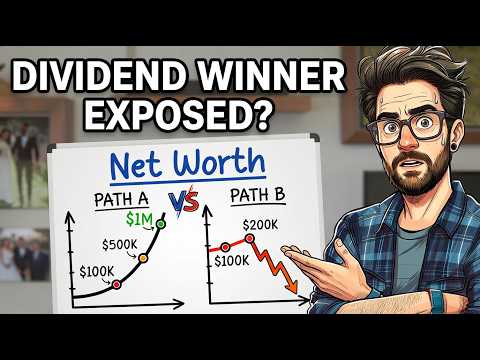
In the early years, reinvested dividends feel trivial: a few dollars here, one new share there. This is not a malfunction. Compounding's growth curve is not a straight diagonal line — it is a hockey stick. The first years are spent on the long, flat portion of the blade before the curve bends sharply upward. Most investors quit while they are still on the flat part, calling it slow and walking away right before it turns fast. Patience is not a personality trait; it is a strategy, and in dividend investing it is the cheapest competitive edge available.
Lesson 4: Buying for Today's Yield While Ignoring Dividend Growth
Focusing only on the yield printed on the screen today misses the far more important question: what will that payout look like in ten or twenty years? A fund yielding 3.5% that raises its dividend consistently will, given enough time, bury a 6% fund that never raises and slowly erodes underneath. The disciplined growers — funds built around companies with long histories of raising their payouts through every kind of market — earn their place as a portfolio foundation because of compounding growth, not just starting yield. The word that matters most in dividend investing is not yield. It is growth.
Lesson 5: Overconcentrating in One Sector
Chasing the highest yields naturally leads investors toward the same corners of the market — real estate, utilities, and high-payout specialty funds. Owning twenty different tickers in those sectors feels diversified. It is not. When they all share a sensitivity to the same underlying force — most often interest rates — they all decline at the same time, for the same reason, in the same quarter. Real diversification means owning positions that do not all fall on the same day for the same reason. Yield-chasing accidentally builds a portfolio that is one enormous concentrated bet on interest rate direction, disguised as an income plan.
Chapter Two: Five Mid-Game Lessons That Moved the Money
Lesson 6: Underestimating the Crossover Point
To illustrate how the lines actually cross, consider two hypothetical investors — a teaching example, not a forecast. Both start with $25,000. One buys a disciplined dividend grower: a 3.5% starting yield, with price and payout growing together for a total return near 11.5% annually. The other buys a high-yield trap: 9% yield, but with the price eroding roughly 3% per year for a real total return near 5.7%. After fifteen years, the high yielder grows to about $57,700, paying roughly $5,190 in income in year fifteen. The grower reaches roughly $128,000, paying about $4,480 in income — slightly less annual income, but on a base more than twice as large, with over $70,000 more in total value. The high yielder appeared to be winning every year — right up until it had quietly, permanently lost by a fortune. That crossover happens somewhere in the middle years, and once the lines cross, they never come back. For a deeper look at when passive income finally overtakes a paycheck, see Dividend Crossover Point: When Passive Income Replaces Your Salary.
Lesson 7: The Behavior Gap Is the Real Cost of Investing
Over a thirty-year window, the market returned close to ten percent annually. The average investor captured only about 4.2 percent. That gap was not created by high fees or inferior funds — it was created entirely by timing. Buying after prices rose because the news was positive. Selling after prices fell because fear took over. In 2024 alone, the average equity investor earned about 16.5 percent while the market returned roughly 25 percent — a gap of approximately 8.5 percentage points in a single year, one of the largest in a decade. The uncomfortable conclusion: the largest single drag on long-term returns is not the market itself. It is the behavior of the person holding the account.
The average investor kept only 4.2 percent of a ten percent annual market return over thirty years. The gap was not the fund. It was the behavior.
Lesson 8: The Tax Drag from Wrong Account Placement
Some dividend funds throw off income taxed as ordinary income, at rates that can reach 37 percent. Others pay qualified dividends at far lower rates — zero percent for taxable income up to roughly $47,000 for a single filer in 2026, 15 percent through a wide middle band, and 20 percent at the top, with an additional 3.8 percent surtax for high earners. Holding high ordinary-income funds inside a plain taxable brokerage account costs real money every year. On a $100,000 six-percent position over ten years: at a 24 percent tax rate in a taxable account, the position grows to roughly $156,200. The exact same position in a sheltered account like an IRA grows to approximately $179,100. That gap — about $22,900 — requires no better picks, no additional risk, and no extra capital. It requires only correct placement.
Lesson 9: Treating Low-Cost Dividend Growers as Optional
For years, a core low-cost dividend growth fund occupied one slice of the portfolio among many — a supporting player rather than the foundation. A classic low-cost grower in this category has charged around six basis points annually (0.06%) and paid an uninterrupted, rising stream of quarterly dividends for fifteen straight years, with an annualized return near 13 percent since 2011. An investor who bought near launch now earns a yield on original cost of roughly 12.5 percent — not through clever trading, but through holding, reinvesting, and not touching it. That kind of fund does not ask for smart moves. It asks only to be held and left alone. It is the fund that punished nobody for holding it.
Lesson 10: Underestimating the $100,000 Inflection Point
For years a dividend portfolio can feel like it is barely moving. Somewhere around the first $100,000, something shifts. Reinvested dividends begin buying meaningful new shares, those shares generate their own dividends, and those dividends buy even more shares. The machine starts compounding on its own without constant new capital feeding it. The first $100,000 is the slowest and hardest money in the entire journey — and it is supposed to feel that way. The reward sits just on the other side of the exact stretch where quitting feels most reasonable.
Chapter Three: The Four Principles That Stuck
Lesson 11: Reinvest Through Every Crash — No Exceptions
The temptation during a sharp market decline is to pause dividend reinvestment — to hold cash and wait for clarity. This does the opposite of what it intends. When the market drops 30 percent, every reinvested dollar buys meaningfully more shares than it did at the peak. Those discounted shares pay dividends forever after and raise them. Automatic dividend reinvestment, left on through every correction and every crash, is one of the highest-returning habits available precisely because it is the most uncomfortable one to maintain. Stopping reinvestment in a downturn protects feelings while quietly selling the future short.
Lesson 12: Boring and Automatic Beats Clever and Active
There is a well-known observation in personal finance that the investment accounts with the best long-term performance often belong to investors who forgot they had them. Fifteen years of active tinkering — rotating positions, reacting to headlines, making tactical adjustments — added up to roughly nothing, and in some stretches to considerably less than nothing. The plain, low-cost, set-it-and-forget-it core quietly won the race. The discipline in dividend growth investing is found in restraint, not action — in all the trades talked out of making when fear or excitement provided a seemingly compelling reason.
Lesson 13: The Single Most Expensive Mistake — Selling During a Crash
During one severe market decline — a drop of roughly 34 percent — the position was sold. The reasoning felt responsible: protect the capital, wait for clarity, buy back in once things stabilized. Here is what that decision actually cost, using a $100,000 illustrative example.
Path one — hold through the crash: The position falls 34 percent on paper. Reinvestment stays on. Over the following six years, the position compounds at roughly 14 percent average annual total return as markets recover and continue rising. Ending value: approximately $219,500.
Path two — sell near the bottom: The position is sold. Two years are spent in cash earning essentially nothing while waiting for a signal that never rings a bell. Re-entry happens once markets have obviously recovered and prices have risen. Four years of compounding remain. Ending value: approximately $111,500.
The gap between holding and selling: roughly $108,000 on a single $100,000 starting position, from one sequence of decisions that took ten seconds to make and six years to fully understand.
The problem was never the crash itself — crashes recover. The problem was converting a temporary paper loss into a permanent, compounding real loss by pressing sell. A decline on the screen is only a real loss if it is sold. The core grower from lesson nine protected no one who sold it during that crash. It only protected the people who held it. Same fund, same crash, completely different life outcome based entirely on one behavioral decision. For a concrete look at the real cost of stepping away from dividend investments during a downturn, see Pausing Dividend ETFs for 6 Months: The $13,900 Mistake.
Lesson 14: Write the Plan Down Before the Market Crashes
Every mistake across fifteen years, traced to its root, was the same mistake wearing different clothes: emotion overriding a plan that had never been written down. When no plan exists, the market writes one in real time using fear and greed as the ink — and it always writes a terrible one while making the investor feel smart in the process. The solution is to write the rules down when calm, before anything is on fire, somewhere they will actually be seen again. The four-line plan:
- Line 1: Dividend reinvestment stays on — always, no exceptions, through every correction.
- Line 2: The core is a boring, low-cost dividend grower, held as a permanent foundation and never traded around for excitement.
- Line 3: The right funds go in the right accounts — tax-efficient placement protects compounding every year.
- Line 4 (in bold at the top of the card): Do not sell in a drawdown.
Four lines. An investor who wrote those four lines fifteen years ago and opened that card when a 34 percent crash arrived did nothing — not because they knew the crash would recover, but because their calm self had already made the decision for their terrified self. The plan is not there to generate returns in easy markets. Any plan works in easy markets. The plan exists for the ten seconds when everything inside says to sell, and the only barrier between the investor and a six-figure mistake is a sentence written when thinking was still clear.
The Pattern Running Through All Fourteen Lessons
Look back across every lesson: chasing yield, mistaking a falling price for a sale, impatience, ignoring growth, overconcentration, the crossover, the behavior gap, tax drag, underrating the core, the $100,000 wall, reinvesting through fear, doing less, never selling the drop, writing it all down. Almost none of those required superior stock-picking intelligence. Every single one required being steadier than the next person. The market did not silently take 5.8 percentage points of return — behavior did. And every fix on this list is a different way of removing decisions from the hands of a scared, impatient self and placing them in a plan made when calm and clear. Compound interest does not need help. It needs to not be interrupted.
Watch the Full Video Breakdown
The complete video covers all fourteen lessons with illustrative charts, the full crossover point math built side by side, and a step-by-step breakdown of how the $108,000 behavior gap accumulates over six years. Watch 15 Years of Dividend Investing — The PROVEN Lessons I Wish I Knew on Harry's Financial Fitness for the full visual walkthrough, and subscribe for weekly dividend investing and retirement planning breakdowns.
Disclaimer: This article is for educational purposes only and does not constitute financial advice. All fund examples and calculations are illustrative only and are not investment recommendations. Past performance does not guarantee future results. Always conduct your own research before making any investment decision.