- Key Takeaways
- The Three Rules That Filtered 18 Funds Down to 6
- The Foundational Six: Well-Known and Rarely Owned
- The Hidden Six: Underrated Dividend ETFs Buried Under SCHD Comparisons
- The Specialty Six: Where Dividend Investing Gets Dangerous
- The Six Dividend ETFs That Survived — and the Final Verdict
- Watch the Full Video Breakdown
Most dividend investors spend their time on the same three or four tickers that dominate the conversation. Eighteen dividend ETFs sit largely off that radar — and the data inside them tells a very different story. After applying a strict three-rule ranking to all eighteen funds, only six survived. Understanding which funds passed, and why the other twelve failed, can meaningfully change how a long-term income portfolio is constructed.
Key Takeaways
- Only 6 of 18 quiet dividend ETFs passed a three-rule test covering 10-year total return, expense ratio, and assets under management.
- DGRW holds the highest confirmed 10-year annualized return in the entire ranking at approximately 13.94%.
- NOBL is the only fund in this group requiring every holding to have raised its dividend for 25 consecutive years — through every major market crash since 1987.
- VYM provides exposure to roughly 589 holdings at just six basis points — six cents on every $100 invested per year.
- Two specialty funds, KBWD and SPYI, carry structural risks that most investors miss in the headline numbers.
- International funds VYMI and SCHY offer global dividend diversification at expense ratios under 10 basis points.
The Three Rules That Filtered 18 Funds Down to 6
Every fund in this ranking was held to three non-negotiable standards. First, the 10-year annualized total return had to come within 200 basis points of SCHD or beat it outright — because the entire point of owning a low-profile fund is that it should reward the investor for sitting through the silence. Second, the expense ratio had to be 0.40% or lower, because compounding fees quietly drain portfolio value in ways a single-year chart never reveals. Third, assets under management had to exceed $200 million, because illiquid funds get delisted without ceremony, leaving investors in positions that are difficult to exit cleanly.
Four funds previously evaluated and found wanting — SPHD, FDVV, SDY, and IDVY — were excluded from the ranking. SCHD was excluded separately and will be the subject of a dedicated follow-up video.
The Foundational Six: Well-Known and Rarely Owned
The first group covers dividend ETFs with the longest histories, the largest asset bases, and the least marketing behind them. These are funds that experienced dividend investors have heard of but, based on the flow data, almost never actually hold.
VYM — Vanguard High Dividend Yield ETF
Launched in November 2006, VYM carries approximately $73 billion in assets and holds roughly 589 companies — nearly six times the diversification of SCHD. The expense ratio is six basis points. The trailing yield sits between 2.2% and 2.4%, and the 10-year annualized total return is approximately 10.9%, placing it roughly 150 basis points below SCHD over the same window while providing substantially broader exposure. Vanguard runs no paid advertising, which largely explains why a fund of this scale receives so little attention in dividend investing circles.
DGRO — iShares Core Dividend Growth ETF
DGRO launched in June 2014, holds approximately $38 billion in assets, and has historically returned about 13.01% annualized over the past decade — a figure that meaningfully exceeds SCHD over the same measurement window. The expense ratio is eight basis points. The fund's 445-company portfolio screens for companies that have grown their dividends for at least five consecutive years. In 2022, when the broader market fell roughly 18%, DGRO declined approximately 7.9% — a considerably shallower drawdown. A $25,000 investment placed at the start of 2015 could potentially have grown to roughly $76,000 by the end of 2024 based on historical compounding. For a detailed side-by-side comparison, the DGRO vs. SCHD analysis covers the methodology differences in depth.
HDV, PEY, FVD, and DJD
HDV (iShares Core High Dividend ETF), launched March 2011 with $12–13 billion in assets and a trailing yield near 3%, screens for companies with both an economic moat and the cash flow to sustain the dividend — tilting toward energy and defensive names. That tilt helped HDV hold up better than the broad market in 2022 while limiting upside during the 2019–2021 tech rally. PEY (Invesco High Yield Dividend Achievers ETF), launched December 2004, selects the 50 highest-yielding stocks from a universe of companies with at least 10 consecutive years of dividend increases — a powerful filter that can drift toward yield traps when interest rates spike sharply. FVD (First Trust Value Line Dividend ETF), launched August 2003 and one of the oldest surviving dividend ETFs, equal-weights stocks that earn the top two ranks on the Value Line Safety scale, reducing tech concentration and volatility at the cost of growth-rally participation. DJD (Invesco Dow Jones Industrial Average Dividend ETF), launched December 2015, holds exactly 30 Dow components weighted by dividend yield rather than share price — a level of concentration that limits its practicality as a core portfolio anchor.
The Hidden Six: Underrated Dividend ETFs Buried Under SCHD Comparisons
The second group shares a single defining characteristic: their asset managers have not made them flagship products, so marketing budgets went elsewhere while the funds compounded in relative obscurity. Two invest entirely outside the United States. Two are too young for a full 10-year track record but have already produced competitive results on shorter windows.
SDOG (ALPS Sector Dividend Dogs ETF), launched June 2012, applies the Dogs of the Dow strategy across all 10 S&P 500 sectors simultaneously, equal-weighting the five highest yielders per sector. The equal-sector construction prevents overconcentration in any single high-yield area — but by design, it always holds the most beaten-down names in every sector at once. RDIV (Invesco S&P Ultra Dividend Revenue ETF), launched September 2013, weights holdings by revenue rather than market cap, tilting the portfolio heavily toward legacy industrials, energy, and consumer staples while underweighting high-margin software and services.
DIVB (iShares U.S. Dividend and Buyback ETF), launched April 2017, is the only fund in this ranking that combines traditional dividend yield with share buyback yield. Because buybacks return capital without triggering a taxable event until shares are sold, DIVB offers a structurally tax-efficient alternative for investors holding taxable brokerage accounts — something SCHD, VYM, and DGRO do not replicate. CGDV (Capital Group Dividend Value ETF), launched February 2022 as an ETF, is backed by the engine that powers American Funds, which carries 76 years of mutual fund history. Over the three years through early 2025, CGDV returned approximately 12.1% annualized, placing it in the top 1% of Morningstar's U.S. Value category — though it remains too young to satisfy the 10-year rule.
The two international entries address a structural gap in most U.S. dividend portfolios. SCHY (Schwab International Dividend Equity ETF), launched October 2021, applies a SCHD-style quality screen to non-U.S. dividend growers at an expense ratio of eight basis points — identical to SCHD's. Since inception, SCHY has returned approximately 8.99% annualized. VYMI (Vanguard International High Dividend Yield ETF), launched March 2016 with approximately $19 billion in assets and a trailing yield near 3.5%, has historically returned around 10.95% annualized over the past decade — comparable to VYM but invested entirely outside the United States. Its five-year annualized return is even stronger, in the 12.6% to 12.8% range. Pairing VYM with VYMI produces a near-global high dividend portfolio at a blended expense ratio below 10 basis points.
The Specialty Six: Where Dividend Investing Gets Dangerous
The final group includes funds that operate differently enough from a standard dividend ETF to require separate treatment. Two generate income through options overlays. Two sit in WisdomTree's lineup. One carries structural risks that most investors overlook in the headline numbers. The last is the highest conviction pick in the entire ranking.
SPYI (NEOS S&P 500 High Income ETF), launched August 2022 with approximately $9.5 billion in assets, holds the S&P 500 index and writes options against it using FLEX options and equity-linked notes to generate monthly income. The expense ratio is 68 basis points — well above the 40-basis-point ceiling — and a meaningful portion of its distributed yield can be classified as return of capital depending on how the underlying contracts settle. DIVO (Amplify CWP Enhanced Dividend Income ETF), launched December 2016 with approximately $7 billion in assets and a trailing yield near 5%, holds roughly 34 large-cap dividend growers and selectively writes covered calls. Its 56-basis-point expense ratio also fails the cost threshold. Both funds are disqualified from the passing six on expense ratio alone.
KBWD — The Cautionary Fund on This List
KBWD (Invesco KBW High Dividend Yield Financial ETF) concentrates exclusively in the financial sector, with heavy allocations to business development companies (BDCs), mortgage REITs, banks, and insurance carriers. Under the Investment Company Act, BDCs can borrow up to 1:1 against their equity — a leverage ratio built into the holdings by regulatory design. This means KBWD carries structural leverage inside its underlying positions even though it is not classified as a leveraged ETF. When credit markets deteriorate, BDC distributions are frequently cut, and KBWD has historically experienced exactly those distribution reductions during credit stress windows. KBWD appears on this list as a cautionary example, not a recommendation.
DLN and DGRW — WisdomTree's Dividend Pair
DLN (WisdomTree LargeCap Dividend ETF), launched June 2006, weights holdings by the dollar value of dividends paid rather than market cap. The methodology produces returns that track a broad large-cap dividend index without a meaningful tilt that would justify selecting it over cheaper alternatives. DGRW (WisdomTree U.S. Quality Dividend Growth ETF), launched May 2013, tells a materially different story. DGRW has historically returned approximately 13.94% annualized over the past decade — the highest confirmed 10-year return in this entire ranking, including SCHD.
The DGRW methodology screens for high return on equity, high return on assets, and positive earnings growth forecasts, then weights holdings by dividend dollar value. That combination captures profitable technology dividend payers like Microsoft, Apple, and Visa alongside traditional consumer staples and industrial names. The five-year annualized return is approximately 11.92%; the three-year return is approximately 15.82%; the one-year return is approximately 22.63%.
A dollar invested in DGRW at the start of 2014 would historically have ended 2023 at roughly $3.70, against roughly $3.20 in SCHD — before any new contributions. Compounded over a working career, that gap becomes the entire story.
The trade-off is a lower current yield than income-focused alternatives and meaningful underperformance during deep value rotations like 2022. DGRW is most suitable for investors with a 15-year or longer horizon who do not rely on the dividend for current spending. For investors whose timeline is shorter, or who need dividends to cover living expenses, the higher current yield of SCHD or HDV provides something DGRW structurally cannot. It is the second highest conviction pick in this ranking.
NOBL — The Highest Conviction Pick
NOBL (ProShares S&P 500 Dividend Aristocrats ETF) launched October 2013, holds approximately $12 billion in assets, carries a trailing yield of approximately 1.94%, and charges 35 basis points — within the 40-basis-point ceiling. Its methodology is the strictest in this entire ranking: every holding must have raised its dividend for at least 25 consecutive years without interruption. That single rule required surviving the 1987 crash, the savings and loan crisis, the dot com bust, the 2008 financial crisis, the 2015 energy collapse, the 2020 pandemic shutdown, and the 2022 rate shock that broke half of the bond market.
In 2022, when the S&P 500 fell approximately 18.2%, NOBL outperformed the index by roughly 7 percentage points. On a $100,000 starting position, that divergence represents approximately $7,000 in preserved capital before dividends — a form of compounding advantage that accumulates across full market cycles. For investors building a retirement-stage income portfolio, the 3-Bucket Dividend Strategy provides a framework for pairing NOBL alongside complementary income-generating funds.
The low starting yield makes NOBL unattractive to income-focused investors in accumulation, and the 35-basis-point expense ratio looks expensive against VYM's six basis points. But NOBL's value lives in dividend discipline and downside protection — structural characteristics that do not generate compelling content during a bull market but determine whether a retirement portfolio reaches the finish line intact across multiple cycles.
The Six Dividend ETFs That Survived — and the Final Verdict
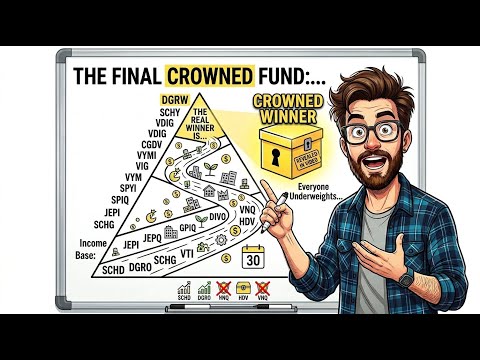
Of the 18 funds ranked, six passed all three rules cleanly: DGRO, DGRW, VYM, VYMI, NOBL, and HDV. Six failed on expense ratio, track record length, or assets under management: SCHY, CGDV, DIVO, SPYI, KBWD, and DLN — though SCHY and CGDV fail primarily because they are too young for a full 10-year window, not because their underlying strategies are flawed. The remaining six (PEY, FVD, DJD, SDOG, RDIV, and DIVB) remain pending full Morningstar data verification before a definitive call can be made.
The single highest conviction pick is NOBL — 25 consecutive years of uninterrupted dividend growth is the strictest filter in the ETF universe. The second highest conviction pick is DGRW — the highest confirmed 10-year total return in this entire ranking. Investors who need current income will find that VYM and HDV provide a higher starting yield that DGRW and NOBL cannot match in the short term. Investors building a global dividend portfolio at minimal cost can pair VYM with VYMI for near-total geographic coverage at a blended expense ratio below 10 basis points.
Watch the Full Video Breakdown
The video version of this analysis covers all 18 funds with the complete return data, methodology comparisons, and historical drawdown charts behind every ranking decision. If you currently own one of these funds and are evaluating what to add next, the full walkthrough provides the side-by-side math this article can only summarize. Watch the complete breakdown on YouTube — including the detailed case for the two funds that belong on a watch list rather than a buy list.