When Costco's buyers found a closeout shipment of Levi's jeans at $14 per pair — against a retail price of $60 — they brought a proposal to CEO Jim Sinegal: price them at $30. Still half of retail, still pure margin. Sinegal refused. His standing rule was firm: cap the markup at 15%, no exceptions. The buyers argued he was leaving millions on the table. Sinegal's response was more consequential — break that rule once, and customer trust breaks forever. That single decision captures everything worth understanding about long-term customer retention strategy, and why boring businesses like Costco and Patagonia keep customers for life while most operators burn cash chasing strangers.
Key Takeaways
- Acquiring a new customer costs 5 to 25 times more than keeping one, according to the Harvard Business Review.
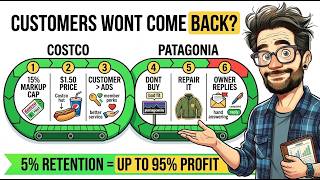
- A 5% increase in retention can lift profits by 25% to 95%, per Bain research.
- Costco's 15% markup cap is a trust policy — it fuels word-of-mouth that replaces paid acquisition entirely.
- The $1.50 hot dog combo, unchanged since 1985, represents an estimated $300 million per year in voluntarily forgone revenue — functioning as the cheapest billboard in retail.
- Patagonia's "Don't Buy This Jacket" ad caused sales to rise, proving honest positioning attracts higher-value, longer-staying customers.
- All six strategies below are accessible at small business scale without a large marketing budget.
The Math Most Operators Ignore
The Harvard Business Review has published the retention-versus-acquisition cost gap in plain numbers for four decades: bringing in a brand new customer costs 5 to 25 times more than keeping an existing one. Bain's research adds that a 5% improvement in customer retention can increase profits by 25% to 95%. That math has been available to every operator for a generation. Costco and Patagonia built entire enterprises around it. Most competitors ignored it because the alternative — maximizing margin on every transaction and spending heavily on advertising to chase new buyers — looks more impressive on a quarterly summary.
The result is a market where average customer acquisition costs have risen roughly 60% over the last five years, now sitting around $395 per new buyer for a typical American company. The businesses that refuse to play that game are the ones quietly compounding customer loyalty into a permanent competitive advantage.
Before going further: everything in this article is for educational purposes only. These are case studies of how real operators structured their pricing, service, and policies. How any of it applies to your specific business depends on your market and your margins.
6 Customer Retention Strategies That Compound Over Decades
1. Cap the Markup, Even When You Could Charge More
The Levi's story is the clearest expression of Costco's operating philosophy. Sinegal stated publicly for years that the moment a customer feels overcharged on a single item, they start questioning every other shelf in the store. The 15% markup ceiling was never about pricing strategy. It was a trust policy — a standing commitment that Costco would not test how much it could extract from any transaction, ever.
The downstream effect is measurable. With average customer acquisition costs now around $395 per buyer, any business that earns genuine word-of-mouth referrals holds an enormous structural advantage. That distribution channel is essentially free, and it only opens for businesses that refuse to squeeze margin at the expense of the customer relationship. These same boring business principles appear consistently in companies that build lasting customer bases without heavy advertising spend.
What to copy this week: List your top 20 products or services by revenue. Calculate the true landed cost on each. Set a maximum markup multiple you commit to never crossing on your core staples — then communicate it to regulars in plain language. That sentence becomes a brand asset.
2. Hold One Symbolic Price Forever — and Absorb the Cost
Costco has sold its hot dog and soda combo for $1.50 since 1985. CNN reported in 2024 that over 100 million of those combos sell each year. Adjusted for inflation, the combo should now cost around $4.50. By holding the price, Costco voluntarily forgoes an estimated $300 million per year in additional revenue — on hot dogs alone.
When a CFO once told Sinegal the combo was losing money and needed a price increase, Sinegal's reply entered company legend: "If you raise the price of the hot dog, I will kill you." The point was never the threat. The point was the principle. That $1.50 sign is the cheapest billboard in retail. Any member who walks past it concludes that if this price has not moved in 40 years, the rest of the store is probably not gouging them either.
Trader Joe's topped the 2025 and 2026 American Customer Satisfaction Index for grocery stores at 86 out of 100 — above Publix and H-E-B — running no traditional loyalty points program at all. Their consistent pricing and private-label stability make the store visit itself the loyalty program.
What to copy this week: Pick one high-visibility product or service — a basic consultation, a staple item, a small repair. Ask whether holding that price unchanged for ten years would make your regulars feel you were on their side. If the answer is yes, write it down, tell customers, and reference it whenever other prices have to move. It buys goodwill across every other line item.
3. Redirect the Ad Budget Toward Existing Customers
Walmart spends roughly half a percent of revenue on advertising. Target spends over 2%. Gartner and Deloitte CMO surveys show the average company allocating 7 to 9% of revenue to marketing. Costco spends close to nothing on conventional advertising. That budget goes instead toward member pricing, Kirkland product quality, a famously generous return policy, in-store sampling, and staffing — all directed at people who have already paid to be there.
Most operators treat marketing as a line item that points outward toward strangers. Costco redirected nearly all of it inward toward people who had already crossed the threshold. A no-expiration return policy is a marketing asset. So is a loyal member who recommends the store to five neighbors. Yeti reports roughly 45% of revenue from repeat buyers and an estimated 22% lift in customer lifetime value among loyalty members — driven not by points programs but by exclusive events and community experiences that deepen the relationship.
What to copy this week: Pause new paid campaigns for 30 days. Move one third of that budget into surprise-and-delight for existing buyers — handwritten notes, free upgrades for long-time clients. Invest another third in experience improvements: faster response times, better packaging, sampling. Use the last third on a basic post-purchase email sequence: a check-in message, a how-to guide, and a 30-to-60-day reactivation email that offers help rather than a discount.
4. Tell Customers When They Should Not Buy From You
On Black Friday 2011, Patagonia purchased a full-page ad in the New York Times with a single headline: DON'T BUY THIS JACKET. The image featured their best-selling fleece. The body copy explained the environmental cost of buying things you do not need — placed on one of the highest-pressure commercial shopping days of the year, at significant expense.
Sales went up. Not down, not flat — up. The ad was not actually discouraging purchases. It was communicating precisely who Patagonia was and who it was not for. Customers who matched that identity leaned in harder than ever. Glossier shows the same pattern at smaller scale: engaged community members generate a measured 96% higher lifetime value and three times the purchase frequency of non-members — because the brand's clear positioning causes the wrong customers to self-select out before they arrive.
What to copy this week: Identify the three most common situations where your product or service is a genuine bad fit. Write a short, candid paragraph on each. Train staff to say it out loud when relevant. Publish those paragraphs as a pinned social post or a "who we're not for" section on your website. The lost bad-fit sales are almost always smaller than the gain in high-fit customers who decide they have finally found someone honest.
5. Repair What You Sold — Free or Near Free, Even Years Later
Patagonia's Worn Wear program handles an estimated 50,000 to 100,000 repairs per year — often at no charge, regardless of when the product was purchased. A conventional financial analysis rejects this immediately: every repair represents revenue not collected on a new sale, plus labor, shipping, and parts costs, plus training customers to extend the life of existing products instead of buying new ones.
That is precisely the mechanism. Every repaired jacket worn in public proves that Patagonia stands behind its products for decades. That proof converts new customers at a rate no paid advertisement can match. HBR-linked surveys found that 71% of consumers say loyalty points programs do not actually make them more loyal. Points reward transaction frequency. A repair program demonstrates that the brand cares about the customer past the point of sale — something points cannot communicate.
What to copy this week: Divide your product or service issues into three tiers. Tier one: quick fixes your team resolves in 15 minutes. Tier two: issues covered by a basic time-bound guarantee. Tier three: larger repairs billed at a fair rate well below replacement cost. Advertise the program at the point of sale. At small scale, this kind of standing guarantee generates word-of-mouth for years.
6. Personally Answer Customer Complaints
Jim Sinegal ran Costco for decades while it was a $300 billion company. By every conventional standard, he should have been completely insulated from individual customer issues. Business journalism and the Founders Podcast have repeated the same account: Sinegal answered customer complaint emails himself, signed with his real name, right up to the end of his tenure.
The practice produced three outcomes simultaneously. The customer experienced the uncommon reality of reaching the person at the top. Internal teams understood that the CEO was monitoring how complaints were handled. And lessons from individual issues traveled upward through the organization rather than disappearing into a ticket queue. PwC's Experience is Everything survey found that two thirds of consumers believe companies are losing the human touch, and 75% want more human interaction, not less. Other research shows that 92% of customers will switch brands after three or fewer bad service experiences.
Chick-fil-A has led the American Customer Satisfaction Index for quick-service restaurants for 11 consecutive years. Average annual sales per freestanding unit are reported around $9.3 million — versus $3 to $5 million for many major fast-food competitors. The gap is not a secret formula. It is consistent service discipline and human contact at every customer touchpoint.
What to copy this week: For one month, have the owner or lead operator personally handle every incoming complaint — email, reviews, social messages — using a simple three-part format: identify yourself as the owner, state what you heard, state what you will do. Sign with your real name. As volume scales, document the best responses and train staff, but maintain one visible channel where customers can still reach you directly.
What Happens When You Stack All Six
Each of these six habits looks like leaving money on the table in the short term. None require a large budget. The compounding effect is where the real case is made.
A customer who trusts your pricing stops comparison shopping. One who sees a symbolic price held for years feels safe across everything else you sell. One who receives a genuine thank-you instead of another promotional email becomes a storyteller. One you honestly redirected away from a bad-fit purchase becomes a referral source for the next ten right-fit customers. One whose product you repaired tells that story for years. One whose complaint you personally resolved becomes loyal in a way no points program could replicate.
Stack even three of these six policies and the retention math compounds aggressively: a 5% retention lift can drive profits up by 25% to 95%, while reducing dependence on $395-per-head customer acquisition. Your existing customers quietly recruit the next generation of buyers at no cost. If you are looking to apply these principles to a new venture, the analysis of boring cash-flow businesses covers categories already structured around repeat customers and steady margin.
A coffee shop that personalized a small tiered loyalty program around birthdays and favorite drinks jumped retention from roughly 30% to 45% — a 50% lift. A regional auto parts chain that tied a basic 5% cash-back to vehicle profile reminders pushed average ticket up 28% and visit frequency up 40%. These outcomes do not require warehouse-club scale. They require one honest policy, written down, communicated to customers, and maintained long enough to compound into a story that gets told for years.
Where to Start This Week
Choose the strategy that fits your business right now. Service operators: start with trick six — personally handle the complaint inbox for 30 days. Sellers of physical products: start with trick five — publish a basic repair guarantee. Operators with a menu or price list: start with trick two — pick one symbolic price and freeze it. Anyone with paid ad spend: start with trick three — redirect one third of that budget inward toward existing buyers.
The businesses that quietly outlast the flashy ones are rarely doing anything complicated. They are doing one honest thing at a time, for long enough that it compounds into a customer base that does not leave.
Watch the Full Video Breakdown
For a visual walkthrough of all six strategies — including the real numbers behind Costco's hot dog economics, Patagonia's Worn Wear program, and step-by-step implementation guidance sized for small operators — watch the full breakdown on YouTube: Customers Won't Come Back? 6 BORING Tricks Costco and Patagonia Use. Drop a comment with the trick number you are testing first — the most-voted strategy gets a full deep-dive with real templates and rollout steps for small operators.