- Key Takeaways
- Level Zero: The Structure Comes Before the Purchase
- Level One: A Vending Route Teaches the Fundamentals
- Level Two: Buying a Laundromat on the Numbers, Not the Story
- Level Three: Surviving the Week Everything Tests You
- Level Four: Car Washes and the Private Equity Wave
- What a Twelve-Year Climb Adds Up To
- Watch the Full Walkthrough
Most people picture wealth as a logo, a storefront, or a name on a building. The quietest version of wealth looks nothing like that. It looks like a vending machine in a tire shop, a laundromat with a long lease, and a self-serve car wash on the highway, all owned by one person nobody connects to any of it. Building a boring business empire is not about a single lucky deal. It is about a repeatable structure, applied level by level, to businesses most investors overlook entirely: laundromats, vending routes, and car washes.
This breakdown walks through that climb in four levels, using real market data on laundromat valuations, SBA 7(a) loan terms, vending commissions, and car wash multiples, so the numbers reflect what buyers are actually seeing in today's market.
Key Takeaways
- A holding company structure with a separate LLC per business keeps problems in one business from spreading to the others.
- Across 855 laundromats sold on BizBuySell over five years, the median store earned about $220,000 a year and the owner kept roughly $76,000 — a 35% margin.
- Laundromats recently sold for around 3.5 to 4 times annual earnings; car washes have traded around 5 times earnings.
- Twenty-four months of water bills can verify a laundromat's claimed cash revenue, since gallons per cycle translate directly into load counts.
- A lease that outlasts the loan matters more than any single piece of equipment — a 10-year lease with two 5-year options protects the buyer when a building changes hands.
- Private equity firms like KKR and Whistle Express have bought car washes by the hundreds, but roughly 80% of car washes nationwide are still independently owned.
Level Zero: The Structure Comes Before the Purchase
The most common mistake at the start of a boring business empire is treating the first deal as the first move. It isn't. The actual first move is deciding who legally owns everything before a single dollar is spent on a route, a store, or a wash.
The structure that works is two layers deep: one plain holding company sits on top, and a separate LLC sits underneath for every individual business — one for the first vending route, one for each laundromat purchased later, each with its own bank account and its own books. If one entity has a bad year, the exposure stays inside that single box instead of spreading to the rest of the group. A registered agent handles the public-facing address on state filings, so a basic name search turns up an office building rather than a home address.
None of this is about hiding from anyone who matters. The IRS, the bank, and any lender on a personal guarantee all know exactly who owns what. The privacy this structure buys is from people who don't need the information in the first place — neighbors, competitors, and casual observers.
The cost is minimal. Forming an LLC in Wyoming runs about $100 plus $60 a year to maintain; New Mexico charges around $50 with no annual report at all. A registered agent typically costs about $125 a year per entity — a small, predictable cost relative to what it protects.
Level One: A Vending Route Teaches the Fundamentals
The entry point into this kind of portfolio is often a small vending machine business, not a storefront. A typical micro route of three to five machines — placed in locations like a tire shop, a dental office, or an apartment laundry room — grosses somewhere between $1,500 and $3,000 a month. After restocking costs and the location's cut, an owner typically keeps $500 to $1,200 a month.
These routes aren't bought for the income. They are bought to learn how to read a machine's performance: which products move, which locations underperform, and how collections reveal the health of a placement before a bigger purchase is on the table. Vending routes like this commonly sell for $5,000 to $20,000, and at a purchase price around $12,000, the route typically pays for itself in about a year and a half.
The first real test at this level usually isn't financial — it's competitive. A rival vendor offering a location better equipment or a bigger commission can pull a placement away fast. The standard fix is upgrading hardware (card readers run roughly $200 to $600 each plus a small monthly fee), offering a commission in the normal national range of 10% to 15% of sales, and locking in a multi-year location agreement. Paperwork, not negotiation, is usually what keeps the location.
Level Two: Buying a Laundromat on the Numbers, Not the Story
The jump from a vending route to owning a laundromat is the point where this kind of portfolio starts generating real cash flow. Across the 855 laundromats BizBuySell tracked as sold over a five-year window, the median store earned about $220,000 a year, with the owner keeping roughly $76,000 — a 35% margin in a cash-heavy business.
Laundromats run mostly on cash, which makes seller claims easy to overstate and hard to verify by eye alone.
The standard way to verify revenue is pulling 24 months of water bills. A front-load washer uses roughly 15 to 25 gallons per cycle, so dividing total gallons used by that range gives an estimated number of loads, and multiplying by the price per load produces a real revenue figure sourced directly from the utility, not the seller's spreadsheet. If that number comes in 15% to 20% below the seller's claim, it's a signal the numbers have been rounded up.
Why the Lease Matters More Than the Equipment
A lender's underwriter will almost always ask one question that determines whether a deal closes: how long is the lease? A short remaining lease term — three years is common on older stores — is a real risk, since a landlord can raise rent or decline to renew once it expires, and banks are reluctant to lend against that uncertainty. Making a longer lease, such as 10 years with two 5-year renewal options, a condition of the sale protects the buyer well beyond the purchase date.
On pricing, laundromats have recently sold for roughly 3.5 to 4 times annual earnings, which puts a $220,000-revenue store with a six-figure earnings base in a believable valuation range. Many of these deals are financed through an SBA 7(a) loan, where the bank typically requires 10% equity injection. Under current SBA rules, a seller can carry a note for half of that injection on standby until the primary loan is paid off, which can cut the buyer's actual cash requirement roughly in half. A typical structure runs the loan over 10 years, with the store's monthly cash flow comfortably covering the loan payment and leaving a margin on top.
Level Three: Surviving the Week Everything Tests You
Owning multiple laundromats eventually invites multiple problems at once: a building sale that puts the lease in question, new local competition with modern amenities, and the loss of a trusted manager. This is the point where the structure built back at Level Zero proves its value. A long lease negotiated as a condition of the original sale holds even after a building changes ownership. Documented opening and closing procedures let a trained assistant step into a manager's role without disrupting operations. And because each laundromat sits in its own separate LLC, trouble at one location — like a dip in revenue from new competition — doesn't touch the others.
This stretch of the climb mirrors what laundromat operator Jordan Berry, founder of Laundromat Resource, has described publicly: his early laundromats lost money for years, representing a six-figure hole, before the business turned around. He kept going and now owns multiple stores. The lesson echoed here is the same one baked into the structure from day one — the system is designed to hold even when the owner is stretched thin.
Level Four: Car Washes and the Private Equity Wave
By the later stages, a self-serve car wash business becomes a natural addition. A single self-serve bay typically brings in $1,000 to $1,500 a month, while an in-bay automatic averages around $85,000 a year. Because these businesses run with minimal staff, single-site car washes often keep 30% to 50% of revenue as profit.
The scale of competition here is different from anything at the vending or laundromat level. Private equity has been consolidating car washes aggressively: KKR took a stake in Quick Quack in a deal reported around $850 million, and Whistle Express agreed to buy 380 sites in a single transaction. Despite that, roughly 80% of car washes nationwide remain independently owned, and some of the heavily leveraged chains have run into trouble — Zips, one of the larger consolidators, filed for bankruptcy protection in 2025.
Car washes are often treated as special-purpose property by lenders, which can push the required down payment to around 15% instead of the 10% typical for other small businesses. Pricing in this space has recently run around 5 times annual earnings. For an owner financing the purchase with cash flow from existing laundromats and vending routes rather than outside investors, a wash that a private equity buyer later offers to purchase can simply stay in the portfolio — the whole point of owning the machine instead of selling time back to someone else.
What a Twelve-Year Climb Adds Up To
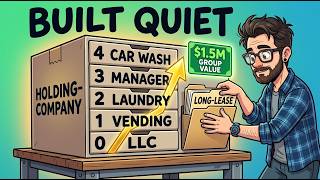
Stacked together — a vending route, several laundromats, and self-serve car washes, all owned under one holding company with separate entities underneath — a portfolio built this way can reach a combined value around $1.5 million at the multiples these businesses actually trade for, based on current BizBuySell benchmarks for laundromats and car washes. None of it requires outside investors, a public brand, or a name on a building. For readers exploring smaller starting points in this same category, boring cash-flow businesses that start around $20,000 follow the same underlying logic on a smaller scale.
The single most expensive mistake in this path is buying the first store on the seller's word — unverified cash numbers and a short lease that doesn't survive a change in ownership. The fix costs nothing: pull 24 months of water bills before signing anything, and make sure the lease outlasts the loan.
Watch the Full Walkthrough
The numbers above only tell part of the story. The video walkthrough shows each level of this climb in full narrative detail — including the week three different problems hit at once and how the structure held — making it worth watching for anyone considering laundromats, vending routes, or car washes as a real acquisition path.