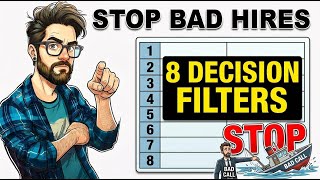
Tony Hsieh admitted that bad hires cost Zappos more than $100 million. Not a bad product, not a market shift — people. Zappos had the cash, the brand, and the momentum. One wrong leader hired three more under him, and the damage compounded quietly for years. Charlie Munger spent seventy years building a solution to exactly this problem, and he called it the LALAPALOOZA effect — eight decision filters, stacked in sequence, run every single time before the check goes out.
Key Takeaways
- Munger's LALAPALOOZA effect stacks 8 filters to catch bad decisions before they compound into irreversible losses
- The Bureau of Labor Statistics reports only about half of new businesses survive to year five; roughly one in three makes it to year ten
- A one-page Operator Constitution eliminates dozens of bad deals before formal due diligence begins
- The scorecard rule: proceed only if 6 of 8 filters show a clear Pass with zero hard Fails
- Bad senior hires typically cost 6 to 24 times the hire's annual salary once the full damage is counted
- All eight filters scale from Berkshire Hathaway down to a $500,000 plumbing shop — built for operators, not billionaires
Why Cash Doesn't Protect You From Filter Failures
CB Insights analyzed hundreds of startup post-mortems and found that 42 percent of failed companies cited no real market need, and 23 percent named the wrong team as a primary cause. The Bureau of Labor Statistics confirms the broader pattern: roughly half of new businesses are still operating at year five, and only about one in three reaches year ten. The common thread across most of those failures isn't a shortage of capital — it's a shortage of decision discipline.
The pattern appears just as clearly in small partnerships as in funded startups. A partner who looked perfect on paper quietly drains the line of credit. A senior hire brings three more wrong people in under him. A second location consumes eighteen months of profit. None of it was a money problem. It was a filter problem.
What the LALAPALOOZA Effect Actually Means
Munger coined the term because the word sounds absurd — deliberately so, to make it stick. The concept is straightforward: one filter is weak, two are useful, but six or eight filters all pointing in the same direction at the same moment is a different animal entirely. Nobody blows up on a single bad call. People blow up when three or four filters fail simultaneously and they never had three or four filters in place. Munger ran this system for seventy years and described the output simply: one plus one starts to feel like eleven when several boring checks all align at the same time.
Filters 1 Through 4 — Principles, Incentives, and People
Filter 1 — Write a One-Page Operator Constitution
In a 2007 talk at the University of Southern California, Munger returned repeatedly to the same premise: pick three or four simple ideas and refuse to break them. Not eighteen ideas, not a sixty-page strategy deck — three or four. The operator version is a single-page document built from three components. First, three principles you genuinely hold — for example: service quality before scale, cash before growth, people before process. Second, three never-rules with real teeth — never personally guarantee a deal above a fixed dollar amount, never hire for headcount instead of output, never sign a multi-year lease before you've earned it twice over. Third, three numeric guardrails — a minimum gross margin, a maximum customer concentration percentage, and a cash floor you will not cross.
Every project, partner, and significant hire runs through that page. If the deal violates one line, the default answer is no. Charles Barr applied exactly this filter when he acquired DiMartino Plumbing in 2021 for roughly $900,000 cash — approximately three times cash flow on around $1.5 to $2 million in revenue. His constitution was deliberately plain: simple service business, fragmented market, residential customers preferred over commercial. He walked from any seller who tried to count government relief checks as real revenue. That single page eliminated dozens of deals before he ever opened a data room.
Filter 2 — Build a Two-Column Incentive Map
Munger said for seventy years that he consistently underestimated the power of incentives — and admitted the same surprise every year. Before signing any partnership, senior hire, or vendor agreement of consequence, he mapped the incentives on paper: a two-column page. The left column lists every financial and non-financial reward for that person — base pay, variable pay, KPIs, title, territory, autonomy, recognition. The right column asks the harder question: what is the fastest way that person can win under this exact plan, even if the company quietly loses?
The sales representative who books unprofitable deals to hit quota. The general manager who underinvests in maintenance because the bonus is tied to this quarter's profit. The recruiter paid per placement who ships warm bodies instead of right fits. Harvard Business Review's research on corporate alliances found that roughly 60 to 70 percent fail — and the strategy was usually sound. The incentive structure was broken. If the easy win and the durable win don't align, you redesign or walk before the contract is signed.
Filter 3 — Run Every Major Commitment Through a Written Scorecard
For any commitment above a meaningful threshold — $25,000, a full-time hire, a new location — a written scorecard is required. Eight rows, one per filter. Three columns: Pass, Fail, or Unknown. Before signing, someone on the team must argue the opposite case out loud. The hard rule: proceed only if six of the eight rows show a clear Pass and zero show a hard Fail.
Atul Gawande documented the same logic in medicine when the World Health Organization introduced a nineteen-item surgical safety checklist across nearly four thousand patients in eight hospitals. Complications dropped from 11 percent to 7 percent. Deaths fell from 1.5 percent to 0.8 percent. A paper checklist, applied consistently, outperformed senior surgeons operating on instinct. Founders don't fail on small bets — they fail on the big bet where they applied less scrutiny, not more.
Filter 4 — Like, Admire, and Trust. All Three.
Munger's partner and hiring filter is unambiguous: two out of three is a no. Like means you would genuinely choose to spend five years in the trenches with this person — the real signal is how they treat people with less power than them, not how they treat you when they want something. Admire means you can name one specific quality about how they operate that you would be proud to replicate; if you can't name it, that's tolerance masquerading as admiration. Trust is the bank password test: if they held your company's banking credentials for an entire weekend with your phone off, would you sleep through the night without hesitation? A single beat of hesitation is an answer.
Roughly 24 percent of failed small businesses cite disagreements between owners, staff, and investors as a primary cause. Approximately 70 percent of small partnerships collapse inside five years. The base rate when you compromise on any one of the three is too poor to rationalize with a deal that looks good on paper.
Filters 5 Through 8 — Reputation, Cash, and Headcount
Filter 5 — Underpromise and Overdeliver on Every Transaction
Every quote, invoice, and promised completion date is either a deposit into a trust account or a withdrawal from it. The practical diagnostic: pull the last twenty jobs and compare quoted price to actual price, quoted completion date to actual finish, quoted scope to what was delivered. If the business typically runs fifteen percent over budget and ten percent over schedule, those numbers belong in the standard quote going forward. The realistic number goes to the customer; internally, the team chases a stretch target. The customer experiences a positive surprise instead of a negotiation. Do this consistently across a service business and reliability becomes the asset other operators can't copy by simply lowering their price. Warren Buffett has noted that it takes twenty years to build a reputation and five minutes to ruin it — this filter is the operational mechanism beneath that observation.
Filter 6 — Build a Dead Mentors Notebook
Munger called reading biographies of the eminent dead the cheapest available mentorship. A twenty-dollar biography of Andrew Carnegie may deliver more actionable insight per dollar than a $2,000-per-month executive coach. The reading list includes Benjamin Franklin, Andrew Carnegie, the eight chief executives profiled in The Outsiders by Will Thorndike, Buffett's annual letters from the 1970s forward, and Poor Charlie's Almanack. The cadence is one substantial biography per quarter — four per year, sixteen over four years.
The method matters more than the list. You don't read for inspiration; you hunt for filters. Each book yields two or three concrete rules: one hiring rule, one capital allocation rule, one never-again rule. Those go into a single notebook reviewed monthly. The Outsiders alone gives you Henry Singleton's decision to repurchase approximately 90 percent of Teledyne's outstanding shares between 1972 and 1984 when the stock traded cheap — a case study that permanently reframes how an operator thinks about their own balance sheet.
Filter 7 — Spend Less Than the Business Earns
Buffett still owns the Omaha house he bought in 1958 for $31,500. Munger drove modest cars his entire career. The point is not austerity — it's control. The operator who consistently spends less than the business earns never loses control of the cash, and the operator who never loses control of the cash stays in the game long enough for compounding to work.
Close the books monthly, not quarterly. Read the profit and loss statement and the cash flow statement line by line. If you cannot explain a line item to a smart twelve-year-old, you don't understand it well enough to manage it. Track three numbers relentlessly: gross margin, operating margin, and months of fixed costs covered by current cash on hand. Then hunt vanity spend — the impressive office that serves founders rather than customers, the industry software nobody can prove moves a line on the income statement, the organizational head added to look larger to outsiders. Approximately 70 percent of failed small businesses cite running out of cash. That is almost never bad luck. It is weak unit economics and overspending compounding quietly until the bank account reaches zero.
Filter 8 — Demand a No-Hire Plan Before Any New Role
Munger ran Wesco Financial — a multi-billion-dollar holding company — with a small team and refused to apologize for resisting bureaucratic growth. The filter: before any new role is posted, a one-page No Hire Plan is required. Could the problem be solved through better process, automation, pricing, or by eliminating the bottom twenty percent of customers who consume the most service time? If the role survives that test, you define the exact metric that must move and by how much — average response time, completed jobs per day, monthly revenue per employee — and pre-commit in writing before the role is posted. If that metric doesn't move by the agreed amount within ninety or one hundred and eighty days, the role is redesigned or cut.
CareerBuilder data shows roughly 41 percent of companies report a single bad hire cost more than $30,000, and a quarter put the figure above $60,000. A bad senior hire commonly costs six to twenty-four times the annual salary once the full damage is counted. Andy Grove used this filter at Intel to exit memory chips entirely and pivot into microprocessors — one of the most consequential capital reallocations in business history, triggered by a single uncomfortable question about whether a new CEO would keep funding a division that was already dying.
Running the Scorecard on Your Next Decision
"The goal was trying to be consistently not stupid instead of very intelligent." — Charlie Munger
Berkshire Hathaway compounded to more than $500 billion in market cap primarily by avoiding unforced errors — by walking from deals that didn't pass the filters, not by hitting improbable home runs. Some of the best decades were built on decisions that didn't happen: the hires not made, the buildings not bought, the deals walked away from.
For operators running a business between $500,000 and $5 million, every one of these filters costs nothing to implement. None require special credentials, expensive advisors, or industry connections. They require only the discipline to run them consistently — on the boring Tuesday and the exciting Friday, on the deal that feels different and the partner who looks perfect on paper. That is the LALAPALOOZA effect in one sentence: stacking eight cheap filters beats trusting one expensive instinct.
The action is straightforward. Open a notes app. Pick the next major commitment in front of you — the hire, the partner, the second location, the equipment purchase, the vendor contract. Write eight rows. Mark each one Pass, Fail, or Unknown. If six of the eight aren't a clear Pass, either walk or convert the unknowns into knowns before you sign.
If you're evaluating which types of businesses apply this filter stack best at the acquisition stage, the guide to 6 boring cash-flow machines you can buy with $30,000 walks through the acquisition logic and risk profile for each type. And if you're still choosing an industry, 6 boring businesses that make money for under $500 to start covers the low-capital entry points where this same decision stack applies from day one.
Watch the Full Breakdown
For a visual walkthrough of each filter — including the two-column incentive map, the eight-row scorecard template, and real acquisition case studies — watch the full video on the Harry's Stash YouTube channel. The video covers Charles Barr's DiMartino Plumbing acquisition and Devin Fitzgerald's home health agency purchase with the exact numbers from each transaction.