- Key Takeaways
- What Is the Compliance Cash Loop?
- The Starting Asset: What Truck Do You Actually Need?
- Licensing: The Regulatory Moat That Protects Established Operators
- Building the Route: Where Customers Actually Come From
- The Contract Structure: How the Loop Stays Closed
- The Numbers Behind a Full Grease Trap Route
- Week-by-Week Launch Plan
- Watch the Full Breakdown
The commercial grease trap cleaning business runs on a simple but powerful premise: restaurants are legally required to pay, and only licensed haulers are allowed to collect. That combination — mandatory demand and a constrained licensed supply — creates what operators in the industry call the Compliance Cash Loop, a recurring revenue structure that most people drive past every day without ever recognizing as a business model.
The National Restaurant Association requires restaurants to keep their grease interceptors below one-quarter capacity, and local ordinances enforce that requirement with permits, manifests, and quarterly inspections. One operator featured on the ServiceCore ToiletTalk podcast runs 30 to 40 stops per week at $400 per stop on quarterly auto-renewing contracts — revenue that never requires a sales call to generate again.
Key Takeaways
- Restaurants are legally required to maintain grease traps, creating mandatory recurring demand for licensed haulers
- Only licensed operators can service commercial grease traps, creating a regulatory moat around the business
- A single mid-sized restaurant account generates approximately $1,400 per year in recurring revenue on auto-renewing quarterly contracts
- Total startup costs: $60,000–$90,000 for a used vacuum truck plus $2,000–$7,000 in federal and state licensing
- Used cooking oil (UCO) creates a second revenue stream — bulk prices exceeded $1,400 per metric ton in early 2026
- The global grease trap cleaning truck market was valued at $1.42 billion in 2024 and is projected to grow at close to 6% annually
What Is the Compliance Cash Loop?
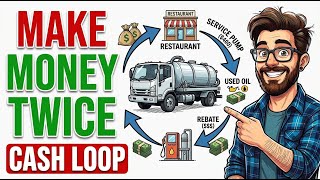
The Compliance Cash Loop is the four-part business structure built into the commercial grease trap cleaning industry. Once all four pieces are in place, revenue becomes largely automatic.
The first piece is the regulation itself. Fats, oils, and grease (FOG) buildup contributes to roughly half of all sanitary sewer overflows in the United States — which is why municipalities enforce FOG ordinances aggressively. Restaurants must hire a licensed hauler to service their grease interceptors at regular intervals, typically quarterly, and file compliance manifests as proof.
The second piece is the licensing barrier. Not just anyone can do this work. Licensed haulers must hold federal motor carrier authority, state environmental registration, and a commercial driver's license with a tanker endorsement. That entry barrier keeps the supply side constrained and protects pricing for operators already in the market.
The third piece is the contract structure. Once a restaurant signs with a hauler, switching is administratively expensive — updating compliance files with the city, retraining kitchen staff, and reissuing manifest paperwork. Churn is structurally low.
The fourth piece is the secondary revenue stream. Used cooking oil (UCO) collected during each service stop can be sold to renderers and biodiesel processors. According to industry analysts, bulk UCO prices in North America surpassed $1,400 per metric ton in early 2026, driven by sustainable aviation fuel demand pulling feedstock supply tight. One service stop effectively generates two separate checks.
The Starting Asset: What Truck Do You Actually Need?
Most people who research this business picture a six-figure tanker fresh off a dealer lot. The reality is more practical. A used vacuum truck — a medium-duty chassis with an 800 to 1,000 gallon steel tank and a mid-range pump — comes in between $60,000 and $90,000 out the door. Sites like usedvacuumtrucks.com maintain running inventory for comparison shopping.
The asset itself is straightforward: a tank, a pump, and a chassis. The key insight is that the truck does not generate income sitting in a yard — it generates income on a route. And the route only opens once the licensing and account structure are built around it.
Licensing: The Regulatory Moat That Protects Established Operators
The licensing stack is what new competitors complain about entering and what established operators quietly appreciate staying in. It consists of three layers.
Federal layer: A USDOT number, issued through the Federal Motor Carrier Safety Administration's Unified Registration Portal, costs nothing. Motor carrier authority filing runs approximately $300, plus a process agent fee of $25–$50.
State layer: Requirements vary significantly by location. Texas, Florida, Georgia, Tennessee, and North Carolina run streamlined transporter registration processes. Georgia requires registration with the state's Environmental Protection Division followed by a truck inspection at the local authority. Sarasota County, Florida charges approximately $200 per year for its hauler permit. New York and Delaware require a full transporter permit through the state environmental department. State selection meaningfully affects both startup cost and timeline.
Driver layer: In most states, a vacuum tanker over 26,000 pounds gross vehicle weight requires a Class B commercial driver's license with a tanker endorsement. Training and testing costs $1,500 to $4,000 depending on the school.
Total licensing cost across all three layers: $2,000 to $7,000, with a 6 to 16 week processing timeline depending on state speed. That is not a trivial barrier — which is precisely why it functions as a competitive moat once you are on the other side of it.
Building the Route: Where Customers Actually Come From
Restaurants are not searching for the cheapest hauler when their compliance deadline approaches. They are calling whoever appears on their local sewer authority's approved hauler list. That single fact redirects the entire customer acquisition strategy away from marketing spend and toward a more direct channel.
The most leveraged first move is visiting the local wastewater authority's FOG program coordinator. Confirming your registration is on file costs nothing but an hour of time. When a restaurant calls asking who is licensed in the area, your name is on the list the coordinator reads off. That one conversation can produce more leads than months of paid advertising.
The second channel is the in-person walk-in. Independent, owner-operated restaurants within a five-mile radius are the primary target. The approach is straightforward: ask what they are currently paying, ask when they were last serviced, then offer to beat their current rate by 10–15%, auto-file their compliance manifests, and put them on a recurring schedule. No funnel, no ad spend — a clipboard and a route map.
Route density is the single biggest lever in this business. Once accounts are clustered geographically, the truck stops running empty miles between stops and the driver stops being underutilized. The ServiceCore operator described hitting 30 to 40 trap services per week from a single truck once the route was tight. The industry inflection point sits around 20 committed accounts. Below that threshold, you are operating a vehicle. Above it, you are operating a route with compounding economics.
The Contract Structure: How the Loop Stays Closed
A standard grease trap service agreement runs 12 months with auto-renewal. Most local ordinances require pumping at least four times per year — sometimes more depending on trap size and kitchen cooking volume. Every signed account is therefore a quarterly invoice on a contract that renews without a new sales conversation.
Switching costs keep accounts in place. A restaurant that wants to change haulers must update its compliance file with the city, retrain kitchen staff on manifest procedures, and reissue paperwork with the local authority. That administrative friction creates the kind of customer retention most service businesses never achieve.
In Built to Sell, John Warrillow describes the profile of a business that commands premium valuation multiples: predictable cash flow and a defensible customer base. Restaurants are mandated to buy. Haulers are licensed to deliver. Switching costs create structural friction. The grease trap route checks every box on that list — and most people drive past it every day without seeing it.
The UCO revenue line is the second unlock most new operators miss during their first six months. When a grease trap is pumped, the collected material — used cooking oil and brown grease — is valuable feedstock for renderers and biodiesel processors. The restaurant pays to have it removed. The renderer pays to receive it. Both checks come from the same service call.
This dual-revenue structure is one of the features that distinguishes compliance-driven service businesses from traditional trades. For a comparison against another vehicle-based recurring service route, the breakdown of junk removal startup costs and margins covers a related model operating on similar economics.
The Numbers Behind a Full Grease Trap Route
A mid-sized restaurant with a 1,000-gallon trap serviced quarterly at $350 per pump generates $1,400 per year in recurring revenue — approximately $117 per month from a single account without any additional sales effort.
Scaling across accounts:
- $10,000 per month in pump-and-haul revenue requires approximately 86 accounts
- $30,000 per month requires approximately 256 accounts
- At 30–40 stops per week per truck, 86 accounts represents roughly 2.5 weeks of work — the remaining weeks of the month are pure margin pickup
The UCO rebate is additive on top of those pump-and-haul figures. The global grease trap cleaning truck market was valued at $1.42 billion in 2024 and is projected to grow at close to 6% annually, according to Growth Market Reports. A growing market, a permanent regulatory mandate, and a licensed-only supplier list represent three independent tailwinds all running in the same direction simultaneously.
For a broader comparison of cash-flow businesses across different capital levels, the analysis of six cash-flow machines available under $30,000 covers recurring-revenue models worth evaluating alongside this one.
Week-by-Week Launch Plan
Week 1: Finalize a disposal contract with the nearest rendering plant or permitted FOG processor. Get three bids — disposal pricing is negotiated, not published. Set up route dispatch software (ServiceCore and Routific are the two purpose-built platforms for liquid waste operators). Order printed leave-behind materials and open a dedicated business checking account.
Week 2: Map every independent restaurant within a 10-mile radius using Google Maps and Yelp. Walk into 15 to 20 locations per day. Skip cold calls and email funnels — the in-person conversation closes faster and builds the trust needed for a signed recurring contract. Visit the local wastewater authority's FOG program coordinator and confirm your name is on the approved hauler list.
Week 3: Execute the first service calls. Issue compliance manifests at every stop. Ask each new account for two referrals. Photograph the truck and completed work for your Google Business Profile and request the first five-star reviews from satisfied clients.
Week 4: Review account clustering and prioritize zip codes where you already have three or more accounts. Set every new account on the recurring auto-schedule. Calculate actual cost per stop. Target for the next 30 days: 20 contracted accounts — the route density inflection point that changes the entire unit economics of the operation.
Watch the Full Breakdown
For a visual walkthrough of the Compliance Cash Loop — including how route density changes the math, how the UCO revenue stream stacks onto pump-and-haul income, and what the path to $10,000 per month from a single truck actually looks like — watch the complete video breakdown on YouTube.
Watch: The Compliance Cash Loop — Commercial Grease Trap Business Explained