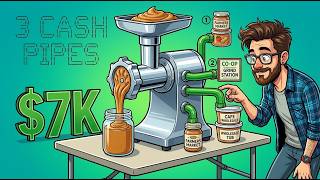
Most people walk past the nut butter grinder at the back of a Whole Foods and see a sample station. What they're actually looking at is a buyable business with 60 to 70 percent gross margins, a startup cost under $3,500, and three separate revenue streams running off a single machine. This is the Fresh-Grind Premium Engine — and it's one of the cleanest boring business ideas in American food retail.
Key Takeaways
- A used $870 eBay grinder launched Nerdy Nuts founder Craig Mount to $3,000 per Sunday by month three — and $1 million in peanut butter sales in a single month eighteen months later.
- Fresh-ground nut butter sells for $14 to $30 per pound at farmers markets versus roughly $4.80 per pound for Skippy Natural at Walmart. Same peanut, two to three times the price.
- Gross margins on a typical eight-ounce jar run 60 to 70 percent, according to the Homegrown Foods nut butter business guide.
- Total startup costs land between $2,500 and $3,500 — less than one month's rent in most American cities.
- Three stacked revenue streams (farmers market, grocery grind station, cafe wholesale) can push a single-operator business past $5,000 a month.
- The USDA tracks roughly 8,400 farmers markets across the United States. You need exactly one.
Why Fresh-Ground Nut Butter Commands a Premium
Skippy Natural retails at Walmart for approximately $4.55 per fifteen-ounce jar — about $4.80 per pound. According to the Homegrown Foods nut butter business guide, artisan eight-ounce jars at farmers markets sell for $10 to $14 each. That translates to $14 to $30 per pound for the same base ingredient.
Same peanut. Two to three times the price. The gap between a $4.80-per-pound grocery jar and a $14-to-$30-per-pound fresh-ground jar is the Fresh-Grind Premium Engine.
In Made to Stick, authors Chip and Dan Heath describe why some ideas are instantly believable: they share the trait of being concrete. The fresh-ground machine may be the most concrete food product in retail. Whole nuts go into the top of the machine. Pure butter pours out the front. There is nothing to fact-check. The proof is the show — and that visible transformation is exactly why a fresh-ground jar outsells a sealed jar at the same price point and out-prices it by three to one.
Choosing the Right Grinder: Three Categories
The hardware decision shapes startup cost, visual appeal, and throughput. There are three distinct categories.
The Olde Tyme Nut Butter Mill (Gold Standard)
The Olde Tyme mill, manufactured by Hampton Farms, is the machine Whole Foods uses in its stores. According to Pleasant Hill Grain's spec sheet, it grinds approximately 2.5 pounds of nut butter per minute through a 1.5-horsepower industrial motor. The hopper holds about 20 pounds of nuts, and the motor is rated for 100 percent duty cycle — meaning it cannot be burned out during a full Saturday market. A new unit runs roughly $4,300. Used units in good condition sell for $800 to $2,500 on Facebook Marketplace and auction sites. Reports on the Goodnature juice forum indicate that clean used PN-1 units have sold for $800 to $900. This is the serious operator's machine.
Budget Colloid Mills (Minimum Viable Path)
VEVOR sells a 110-volt commercial peanut grinder rated at 15 kilograms per hour for approximately $254, with a larger 30-kilogram-per-hour version at around $328. These machines lack the self-serve dispensing aesthetic of the Olde Tyme, but they grind reliably and allow an operator to enter the business for under $300 in machine cost. In most states, cottage food laws cover nut butter — which means a VEVOR grinder and a food handler certificate are enough to open a first market booth.
Stone Grinders (Theater and Texture)
Stone grinders rotate slowly at lower heat, producing a smoother final texture than standard colloid mills. The visual effect stops customers mid-stride: they film the machine and share the video. Commercial stone grinders range from a few hundred dollars on Alibaba to approximately $3,000 for a production-grade unit. If the local market skews raw-food, vegan, or clean-label, a stone grinder can justify an additional $2 per jar premium over a standard mill.
The Three Revenue Streams: Stacking the Engine
Most nut butter operators run only one of these paths. The operators clearing $5,000 to $7,000 per month run all three off the same machine.
Path One: The Farmers Market Table
Homegrown Foods' margin data shows a typical eight-ounce peanut butter jar costs approximately $2.50 in ingredients and packaging and sells for $10. Almond and cashew butter cost $3.50 to $5.50 in ingredients and sell for $12 to $14. Gross margin lands between 60 and 70 percent on every jar.
A solo vendor at a busy Saturday market can move 40 to 60 jars. At 50 jars averaging $10, that is $500 in gross revenue across four hours of selling. Two Saturdays per month produces $1,000. Four Saturdays produces $2,000. Add a Sunday market and monthly gross reaches $3,200 to $4,000 — with roughly $2,000 in gross profit from one folding table and approximately eight hours per week of active selling time. The USDA tracks roughly 8,400 farmers markets nationally, with most cities running two to four per weekend. Booth fees typically range from $25 to $75 per Saturday, and 50 jars at a single market covers that fee fifteen times over.
For a broader look at comparable low-capital businesses with strong margins, the 6 Boring Businesses That Make Money (Under $500 to Start) breakdown covers several setups with similarly minimal overhead and fast payback periods.
Path Two: The In-Store Grind Station
Hampton Farms' Grinder and Stock Program FAQ reports that most retailers using their mills pay off the machine in three to six months of nut butter sales — meaning the equipment pays for itself in 90 to 180 days. ACME Fresh Market in the northeast sells fresh-ground peanut butter from in-store grinders at approximately $5.99 per pound, and a busy store grinder can move 40 to 80 pounds per week — approximately $2,000 of nut butter through one machine in a single month.
The realistic path to an in-store grind station is through Path One first. Whole Foods' Local Producer Loan Program is structured around existing suppliers. A co-op or specialty grocer is the more accessible first placement: they want local producers, they want the foot-traffic theater, and many will revenue-share with a vendor who supplies their own equipment and requires no additional staffing.
Path Three: Wholesale to Cafes and Smoothie Shops
At the wholesale level, the unit of sale shifts from eight-ounce jars to five and ten-pound food service tubs. Local smoothie shops currently pay $10 to $14 for branded eight-ounce almond butter — the equivalent of $20 to $28 per pound. A fresh, locally produced product can be wholesaled at $7 per pound and still generate $3 per pound in margin after ingredients and packaging.
Fifteen wholesale accounts each buying 60 pounds per month at $7 per pound equals $6,300 in monthly revenue — approximately $3,000 in margin. The IBISWorld database counts roughly 72,000 coffee and snack shops nationally. A typical metro area contains 500 to 2,000 of them. Fifteen accounts represents one to three percent of that pool.
Stacking all three paths — two Saturday markets, one cafe wholesale account at $600 per month, and a 40-person subscription club at $30 per month — produces approximately $5,000 in monthly revenue from a single machine and a single operator. That is the ceiling most solo operators are building toward.
Startup Costs and Break-Even Timeline
The complete entry budget for a nut butter operation breaks down as follows:
- Used Olde Tyme grinder: $1,500 to $2,500
- 10-by-10 canopy and folding table: approximately $250
- First batch of mason jars, lids, and printed labels (100 jars): approximately $150
- 25 pounds of peanuts and 25 pounds of almonds: approximately $225
- Online food handler certification: $10 to $30
- Farmers market vendor permit: $25 to $200 per season
- Liability insurance through the Food Liability Insurance Program (FLIP): approximately $300 per year
Total fully loaded entry cost: $2,500 to $3,500. That is less than one month's rent in most American cities. At 50 jars per first Saturday generating $500 in gross revenue, startup costs are recovered in five to seven market days. The machine is the moat — and the moat is small. As a comparison, launching a mobile auto detailing operation requires similar startup capital, though nut butter has the advantage of repeat product purchases rather than one-time service calls.
Four Common Challenges and Their Fixes
Oil separation. Natural nut butters separate at room temperature. Customers unfamiliar with additive-free products sometimes mistake this for a defective jar. The fix is a label icon that reads "give me a stir" and copy that frames separation as a quality signal: no stabilizers, no additives, just nuts. Hampton Farms' own marketing leans on exactly this message.
Shelf life. Fresh-ground butter without stabilizers lasts approximately two to three months at room temperature, versus two years for a sealed commercial jar. The fix is printing a "made this week" date on every jar and leaning into scarcity. "Fresh this Saturday" is a sales line, not a defect disclaimer.
Allergen cross-contamination. Switching between peanut butter and almond butter on the same machine without a full clean creates cross-contamination risk. The fix is a documented cleaning schedule: run almond butter first on a spotless machine, run peanut butter last, log a 30-minute deep clean between product switches, and print a clear "contains peanuts and tree nuts" statement on every label per federal labeling requirements. Your state's cottage food page walks through the specifics in about 15 minutes.
Rainy Saturdays. Outdoor markets get rained out. The fix is a three-market portfolio — one outdoor Saturday market, one indoor or co-op Sunday market, and a basic online pre-order page for spillover demand. One washed-out weekend does not blow up the month's income.
Your 30-Day Launch Plan
- Day 1: Walk your strongest local farmers market as a customer. Buy something. Note whether any vendor is already selling nut butter. In most cities, the spot is open.
- Days 2–5: Read your state's cottage food law on the National Agricultural Law Center website. The relevant section takes about 15 minutes. Most states permit nut butter under cottage food rules.
- Days 6–10: Complete an online food handler course for $10 to $30 and save the certificate.
- Days 11–14: Search Facebook Marketplace, OfferUp, and the Goodnature forum for a used Olde Tyme PN-1 or PN-2 grinder. Set a firm price ceiling of $2,000.
- Days 15–20: Purchase jars, labels, canopy, and a first batch of 10 pounds each of peanuts and almonds. Run five test batches at home to dial in texture.
- Day 21: Submit a vendor application to your target farmers market. The application is one page.
- Days 22–30: Practice booth setup in your driveway and target under 20 minutes from arrival to operational.
Watch the Full Breakdown
The numbers above tell the story, but watching the machine run makes the Fresh-Grind Premium Engine tangible in a way a written breakdown cannot fully replicate. The full YouTube video — The Nut Butter Machine Quietly Paying $7K a Month at Farmers Markets — walks through the pond math live, shows the machine comparison side-by-side, and demonstrates exactly why a line forms in front of a grinder that never forms in front of a sealed jar on a shelf. Watch it here before you read the vendor application.
This article is for educational purposes only and is not financial or business advice. Cottage food laws and food handler requirements vary by state. Check your state's page on the National Agricultural Law Center website before starting any food business.