- Key Takeaways
- Why the Massage Chair Is a Vending Machine Worth Owning
- Which Chair to Buy: Three Real Options
- The Real Numbers: Three Venues, Three Revenue Splits
- Five Things That Break a Chair Route — and the Fix for Each
- Harry's 12-Month Route Map: One Chair to Three Locations
- Watch the Full Deep Dive on YouTube
- Is the Vending Massage Chair Business Worth Starting in 2026?
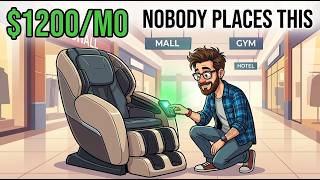
Somewhere in your city, a leather chair bolted to the floor of a mall food court is quietly depositing between $400 and $1,200 a month into someone's bank account. Not the mall's account. Not the chair brand's. The owner is a private operator who knocked on a door, signed a one-page agreement, and now collects card processor deposits on autopilot. This is the vending massage chair business — one of the cleanest boring business ideas hiding in plain sight at every mall, gym, and hotel lobby in North America.
Key Takeaways
- A single vending massage chair in a high-traffic venue can net $300–$670/month with zero employees and zero inventory to restock
- The all-in startup cost for a used commercial chair with card reader is approximately $4,000 — about the price of a decent used car
- Three venue types — mall food court, gym recovery zone, and hotel lobby — each carry different revenue-share structures and monthly net ranges
- The gym pitch, framing the chair as a free member recovery amenity rather than a vending machine, often lands zero rev-share and the highest net per chair on the route
- Five common operator failure points (breakdowns, venue pullouts, card reader outages, vandalism, and seasonal dips) each have a proven same-day fix
- A three-chair route can generate $1,200–$1,800/month net by the end of year one, based on published revenue bands from Vending Group and iSPA Express
Why the Massage Chair Is a Vending Machine Worth Owning
A standard vending machine sells a product — a gumball for a quarter, a bottle of water for two dollars. Narrow ticket, restocking runs every two weeks, thin margin. A coin-operated massage chair sells an experience. Three to five dollars in, five to ten minutes of relief out. That is roughly twenty times the per-transaction ticket of a gumball machine — and there is nothing to restock. Ever. The chair is the inventory.
The model works because the venue handles foot traffic for free. Place the chair and the mall, gym, or hotel fills the room with people who are already tired, bored, or sore. The transaction loop closes itself. That structural advantage — high ticket, zero inventory, venue-supplied traffic — is why the institutional version of this business is serious money. Smarte Carte, the largest operator in the space, runs more than 3,400 locations and over 150,000 deployed assets across airports, malls, gyms, and transportation hubs. Private equity has been circling this niche for years. The independent vending massage chair operator runs the same proven model at a one-chair scale.
The US massage equipment market generated approximately $3.6 billion in revenue last year, with chairs accounting for roughly 46% of that total. The dedicated commercial vending segment is not an experiment — it is a cash-flowing category that most people walk past every week without ever wondering who owns the chair.
Which Chair to Buy: Three Real Options
The chair decision comes down to budget, venue tier, and how much technical risk you are comfortable absorbing on a used unit.
Option 1 — The Workhorse: The Infinity IT-6900 commercial vending chair is built specifically for operators. It lists around $2,999 on sale (down from $4,999), comes vending-ready out of the box, and allows session pricing to be programmed from $1 to $5. Pair it with an EMV card reader for approximately $600 and the unit is operational.
Option 2 — The Bargain: A used Brookstone or Sanyo commercial chair from the secondary market. These originally retailed for $5,000–$6,000 new and appear regularly on resale platforms in the high hundreds to low thousands. Add a card reader and the all-in cost can stay under $2,000 — the right entry point for operators who want to validate the model before committing further capital.
Option 3 — The Premium: The Luraco i7 Plus, US-made and medical-grade, lists between $9,000 and $12,000. This is airport-tier equipment appropriate for high-dwell, high-volume venues that justify the capital outlay — but not the right first chair for most new operators.
For a first route, the used Brookstone-class chair is the practical starting point: approximately $3,200 delivered, $500 for a Nayax VPOS Touch card reader with real-time telemetry, and $300 for white-glove installation and floor anchoring. Total: roughly $4,000 all-in. Unlike product-based vending, that $4,000 buys a thirty-year asset. A bolted-down commercial chair does not depreciate the way inventory does — it cycles strangers through its seat ten times a day, for years.
The Real Numbers: Three Venues, Three Revenue Splits
Revenue math varies meaningfully by venue type. The figures below are drawn from published operator data: Vending Group's managed massage chair program guide, iSPA Express's per-chair revenue FAQ, Cozzia USA's national fitness chain partnership data, and Daiwa's publicly stated profit-share model.
Venue 1: Mall Food Court Edge
Vending Group, which runs managed massage chair business programs nationwide, publicly states that a single chair in a high-traffic mall area can generate up to $500 a month for the host location alone. iSPA Express reports their network averages around $600 a month per chair, with a realistic range of $300 to $1,000. The gross band for a B-tier mall chair — once pricing and placement are dialed in — runs roughly $400 to $1,500 a month.
Mall managers in the vending space typically take 10%–30% of gross revenue. At a 30% rev-share on $600 monthly gross, the mall receives $180. After approximately $36 in card processor fees and $60 for regular cleaning and maintenance, the operator nets around $320/month.
iSPA Express reports their vending massage chair network averages around $600/month per chair, with a realistic operator range of $300–$1,000 depending on traffic volume and session pricing.
Venue 2: Gym Recovery Zone
Cozzia USA partners with national fitness chains to place chairs in dedicated recovery zones, and Vending Group lists gyms as one of the strongest segments in the massage chair vending machine market because of the natural wind-down moment following a workout. The gross band for a solid independent gym runs $600 to $1,200 a month per chair.
The highest-leverage pitch in the entire route is the zero rev-share gym approach. Independent gyms often view a massage chair as a member retention perk rather than a vending revenue line. An operator who frames the chair as a no-cost recovery amenity — prominent signage included, zero rent, zero revenue share — can land a yes from a gym owner who would never agree to a traditional vending split. At $800 gross per month, with roughly 6% in processor fees and 10% held in a maintenance reserve, the gym chair nets close to $670/month. That is the highest net per chair in the route and the reason experienced operators prioritize gym placements when scaling.
Venue 3: Hotel Lobby
Independent and boutique hotels — where the general manager can approve a pilot without routing through corporate headquarters — offer long dwell times and tired travelers already predisposed to spending on comfort. Daiwa publicly runs a 50/50 profit-share model on its managed hotel setups. An operator who pitches a 60/40 split favoring the operator at an independent airport-area hotel can secure terms that most chain properties would never approve. At $700 monthly gross with a 60/40 split, fees, and maintenance reserve, the hotel chair nets approximately $360/month.
Three-Chair Route Total
Combined: $320 (mall) + $670 (gym) + $360 (hotel) = approximately $1,350/month net on the conservative end of published revenue bands. The upper edge of those same bands puts a three-chair route closer to $2,000/month net by the end of year one. For a broader look at low-overhead cash-flow assets that operate on a similar venue-operator structure, 6 Boring Cash-Flow Machines to Buy With $30,000 covers several models at the next scale up.
Five Things That Break a Chair Route — and the Fix for Each
1. The chair breaks. Motors and rollers eventually fail under heavy public use. Commercial chairs carry manufacturer warranties, and a relationship with a local repair technician handles what warranties do not. Once a route grows past two chairs, keep one spare unit in storage for same-day swaps. A broken chair is a one-day revenue outage, not a business-ending event.
2. The venue cancels the agreement. Build a portfolio of at least five placements so no single location is existential, and write a six-month notice clause into every venue agreement. Standard vending contract language — most venues will sign it because they want the passive income stream, too.
3. The card reader goes offline. Cellular hiccups happen. Run dual payment systems — a coin or bill acceptor alongside the card reader — so a connectivity issue does not zero out sessions entirely. The Nayax VPOS Touch sends real-time alerts through its app when a device goes offline. The fix happens from a phone, not by driving across town.
4. Vandalism or misuse. Anchor-bolt the chair to the floor, add clear posted signage, and carry a vending operator liability policy. Insureon prices vending operator general liability at approximately $37/month. A damage clause in the venue agreement covers the rest.
5. The January traffic dip. Mall foot traffic drops 20%–30% in deep winter. A route that includes a gym chair and a hotel lobby chair barely registers the calendar — both venues operate on need rather than seasonal shopping patterns. The diversified mix smooths revenue across the full portfolio.
Harry's 12-Month Route Map: One Chair to Three Locations
The following plan is based on conservative published revenue bands from iSPA Express, Vending Group, and Daiwa. It represents a realistic first-year path, not a best-case projection.
Months 0–1: Purchase a used Brookstone-class commercial chair for approximately $3,200. Add the Nayax VPOS Touch card reader ($500) and professional floor installation with anchor bolting ($300). Form a single-member LLC through the state portal and add a vending operator liability rider that prorates into the first month. Total startup outlay: approximately $4,000. One weekend of setup. No grand opening.
Month 1: Pitch a local barber shop in a strip mall with a one-page agreement and a 70/30 split favoring the operator. Month one produces roughly $350 gross while the regular clientele discovers the chair. Net after the split and processing fees: around $200. Boring. Forgettable. Real.
Months 2–3: Adjust session pricing from $3 to $5 for ten minutes — the same price point used by Infinity's own demo chairs. Barber clients begin treating the chair as a pre-appointment ritual. Usage stabilizes at approximately $500/month gross, with operator net climbing to around $300/month from chair one alone.
Month 5: With ninety days of clean Nayax revenue screenshots in hand, pitch a local independent gym. Frame it not as a vending placement but as a member recovery amenity: zero rent, zero rev-share, prominent co-branded signage for the gym. The gym owner says yes.
Month 7: The gym chair is running $600–$1,000/month gross. Net: close to $650/month. This is the inflection point where the passive income business starts behaving like a real operation rather than a side hustle.
Month 9: Two chairs and a year of transaction data support a single-page PDF pitch to the leasing manager at a local B-tier mall — three numbers: $600/month average gross, 30% split, $200/month free revenue for the mall with no capital outlay required from them. The pitch lands a placement at the edge of the food court near the parents' lounge, the type of dead corner most malls would otherwise write off.
Month 12: The mall chair produces approximately $800/month gross. Operator net: around $370/month. Three chairs total. Monthly net: $1,200–$1,800 depending on where the gym chair lands within its published range.
This is the same compounding mechanism Darren Hardy describes in The Compound Effect (Hardy Press, 2010): not one transformative move, but the same small action repeated — pitch one venue, install one chair, log one Nayax dashboard — until the slope becomes undeniable. For a look at how the same logic applies across other boring businesses that make money with minimal upfront capital, the pattern holds across nearly every low-overhead cash-flow model.
Watch the Full Deep Dive on YouTube
The video covers the exact chair specifications side by side, the leasing manager email that lands a mall spot, and a live walkthrough of the Nayax dashboard revenue numbers that make the math concrete. If you are evaluating whether this model fits your city and your budget, the visual context in the video makes the revenue bands significantly easier to internalize. Watch The Boring Mall Massage Chair Quietly Banking $1,200 a Month on the Harry's Stash YouTube channel for the complete step-by-step breakdown.
Is the Vending Massage Chair Business Worth Starting in 2026?
The case for this model is straightforward: under $4,000 all-in for a proven entry point, zero inventory, venue-supplied foot traffic, and a thirty-year asset that does not depreciate the way product-based vending stock does. The three-chair ceiling of $1,200 to $1,800 per month net represents meaningful supplemental income that does not require leaving a day job to manage — the Nayax dashboard handles monitoring, the dual payment system handles connectivity gaps, and the venue agreement handles the relationship.
The regulatory landscape is friendlier than most people assume. A basic state LLC, a vending operator general liability policy at approximately $37/month, and fifteen minutes of local permit research covers the compliance side in most jurisdictions. The same compliance moat that intimidates new entrants keeps underprepared competition out of the market entirely.
The practical first step costs nothing: open a map application, drop pins on every mall, gym, hotel, nail salon, and barber shop within twenty minutes of home, and count the venues. A pond of thirty to one hundred potential locations means only one first verbal yes is needed before any capital is committed. No chair purchase until that confirmation is in hand.