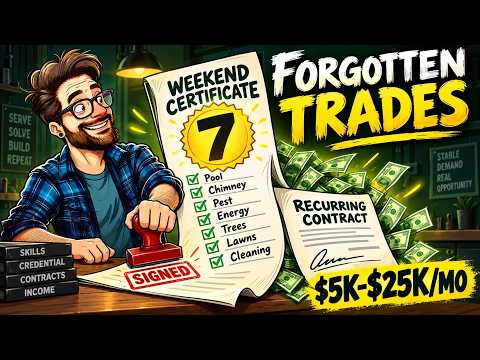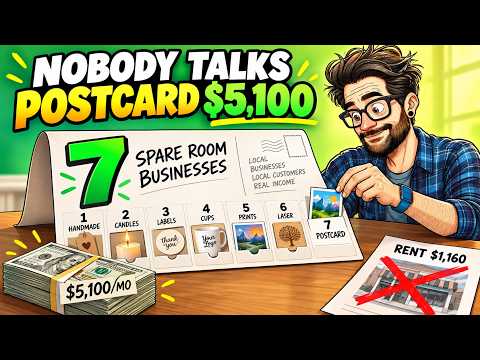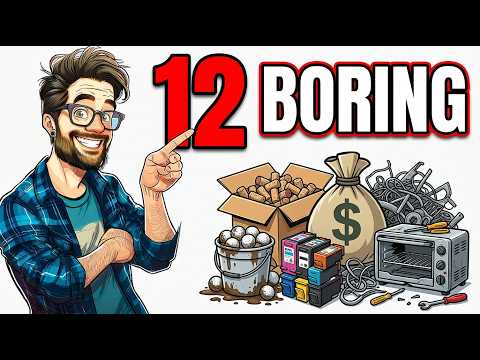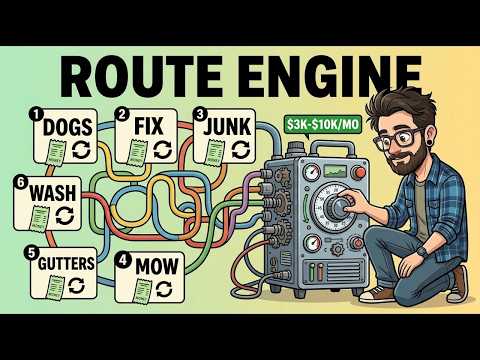
Every restaurant, retail shop, and job site on a given street already pays someone to haul away cardboard, fryer oil, cull wood, empty containers, and dirt. For the business paying that bill, it is a recurring cost with no way around it. For the operator who owns the truck, the route, or the license, that same cost is free inventory that pays on a schedule for years. This compilation pulls together two of the deepest breakdowns on the channel into a single list of fourteen boring businesses that share one quiet advantage: the customer has no legal or practical way to avoid paying.
The first seven are waste routes purchased once and monetized for years, seen through the eyes of Harry, a restaurant kitchen manager who started paying attention to what was leaving through the back door every night. The second seven are licensed system trades, ranked from the softest entry point to the highest-income apex, where a license lets the operator effectively name the price because the homeowner has exactly one legal option when a home or property system fails — and it is not a video tutorial.
Key Takeaways
- Every restaurant, shop, and job site already pays someone to haul away cardboard, fryer oil, cull wood, containers, and dirt — that spend already exists whether or not you capture it.
- Waste-route businesses turn another company's disposal cost into free inventory: the input is often paid for by the generator, not the operator.
- Licensed system trades work because failure removes the DIY option entirely — the homeowner's only legal path is a licensed pro.
- The seven licensed trades in this list are ordered from softest entry point to highest income, with much of the work recurring by law (inspections, permits, renewals).
- Both halves of this list rely on the same structural advantage: little to zero direct competition once a route or license is secured, not a superior product or marketing edge.
- Licensing, hauling permits, and pricing all vary by city and state — verify local rules before starting any of these businesses.
Why "Boring" Businesses Beat Trendy Ones
The appeal of boring business ideas is not that they are easy — it is that they are structurally protected. A trendy product can be copied within a month. A waste route or a licensed trade cannot be copied nearly as fast, because the barrier is not creativity or capital alone; it is a relationship, a permit, or a certification that takes real time to build or earn. That is the common thread running through every boring businesses that make money while you sleep story: the customer is not choosing you because you are the cheapest or the flashiest option. They are choosing you because there is effectively no one else to choose.
This is also why these businesses tend to be undervalued by people chasing side hustle ideas online. A pressure-washing app or a dropshipping store looks more exciting than a fryer-oil route, but the oil route has a built-in customer who legally cannot dispose of used cooking oil themselves in most municipalities. That single constraint does more for long-term revenue stability than almost any marketing tactic.
Part One: Seven Waste Routes You Buy Once and Get Paid On For Years
Harry, a restaurant kitchen manager, started this half of the story by simply watching what left through the back door every shift. Cardboard, fryer oil, cull wood from pallets, empty containers, and dirt or spoil from renovation and landscaping jobs all leave commercial properties constantly — and someone is already being paid, or already paying, to remove it. The operator who buys the route, not the restaurant that generates the waste, is the one capturing the long-term value.
Cardboard and Container Routes
Every shop that receives inventory generates a steady stream of cardboard and empty containers. Waste haulers who set up a recurring pickup schedule with a cluster of small businesses are not selling a novel service — they are formalizing a need that already exists, and once a route is locked in with a handful of accounts, it tends to stay locked in because switching haulers is friction the business owner has no incentive to absorb.
Fryer Oil
Used cooking oil cannot legally be poured down a drain in most jurisdictions, which means every restaurant with a fryer is a guaranteed, recurring customer for someone. Oil collection routes work because the restaurant is often relieved to have the liability handled, and the collected oil itself can carry resale value depending on the buyer.
Cull Wood, Dirt, and Job-Site Waste
Construction and landscaping sites constantly generate cull wood, dirt, and spoil that has to go somewhere. A single machine — a truck, a small dumpster trailer, or a skid steer — paired with a handful of steady job-site relationships can turn this waste stream into a recurring route business with minimal ongoing sales effort, since the same contractors tend to call the same hauler on every job.
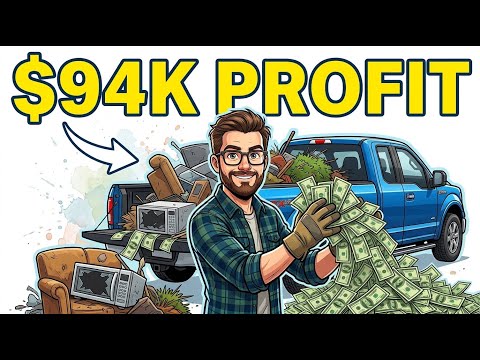
For a closer look at the economics, startup costs, and margins behind one of these exact routes, see How to Start a Junk Removal Business: Real Costs, Margins & Income.
Part Two: Seven Licensed Trades Where the License Sets the Price
The second half of the list shifts from waste to licensed system trades — the businesses that get called when a home or property system fails and the homeowner has exactly one legal option. These seven trades are ranked from the softest entry point to the highest-income apex, and much of the work recurs not because of marketing, but because of law: inspections, permit renewals, and code requirements guarantee repeat business regardless of how the operator markets themselves.
Why Licensing Removes the DIY Option
A homeowner can watch a video tutorial and attempt a cosmetic repair. They cannot legally self-certify a licensed system repair on gas lines, electrical panels, septic systems, or other regulated infrastructure in most jurisdictions. That single fact is what allows the licensed operator to name the price rather than compete on it — the alternative to paying is not a cheaper option, it is a code violation, a failed inspection, or a safety risk.
From Softest Entry to Highest-Income Apex
The trades in this list climb in a deliberate order: the softest entry points require the least capital and the shortest certification timeline, while the apex trade at the top of the list is the one where, according to the breakdown, the customer never even asks the price before saying yes. That progression matters for anyone evaluating licensed trades income as a long-term path — it shows there is a realistic on-ramp rather than a single high-barrier destination.
The last trade on the list is the one where the customer never asks the price before saying yes — and it is not the trade most people expect.
Readers weighing a licensed trade against other paths into high-income work may also want to compare it with 5 High-Paying Trades Most Grads Ignore (Under $2K to Certify), which covers certification costs and income ranges for several adjacent licensed paths.
The Common Thread: Zero Competition by Design
What ties all fourteen businesses together is not the industry — it is the structure. In every case, the customer's alternative to paying is worse than paying: illegal disposal, a failed inspection, or a safety hazard. That is a fundamentally different position than most small businesses occupy, where the customer always has a cheaper or faster substitute one search away. Boring businesses 2026 lists tend to get attention because they promise easy money, but the actual mechanism is narrower and more durable than that: capture a route or a license, and the competition problem mostly solves itself.
None of these businesses are free to start, and none are instant. Waste routes take time to build relationships with enough accounts to be worth running full time, and licensed trades require real certification hours before the license itself starts doing the selling. But both halves of this list point toward the same conclusion for anyone comparing passive income ideas: the highest-leverage version of "passive" is not doing nothing — it is doing the unavoidable work once (building the route, earning the license) and getting paid on it repeatedly afterward.
Watch the Full Breakdown
This article summarizes the structure behind all fourteen picks, but the original video walks through the specific numbers, entry costs, and ranking logic for each of the seven waste routes and seven licensed trades in order — including which one sits at the very top of the income list. Watch the full video breakdown on the HS channel for the visual walkthrough of Harry's route-by-route observations and the full climb through the licensed trades.
For more low-competition, cash-flow-focused business ideas, see 6 Boring Businesses That Make Money (Under $500 to Start).