- Key Takeaways
- Why the Certification Is the Real Moat
- Pool Cleaning: The CPO Certification Route
- Chimney Sweeping and Pest Control: Licensed, Recurring, Overlooked
- Certified Home Energy Auditor and Tree Trimming
- Commercial Cleaning Contracts: The Volume Play
- Why Recurring Contracts Beat One-Off Jobs
- Watch the Full Breakdown
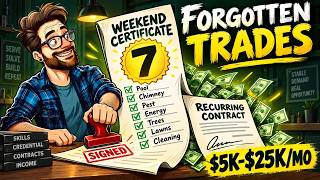
A weekend certification and a handful of recurring contracts are quietly funding full-time incomes for people who never went to college and never hired a crew. The pattern shows up across seven unglamorous trades: pool cleaning, chimney sweeping, pest control, home energy auditing, tree trimming, landscaping, and commercial cleaning. None of them require a degree. Most require a certification that costs a few hundred dollars and takes a weekend or two to earn. And the businesses that actually scale from that certification share one thing in common: they are built on recurring contracts, not one-off jobs.
The mental model here is worth naming, because it explains why these boring businesses that make money keep outperforming flashier ideas. Picture an office-park facilities coordinator named Harry, whose entire job is hiring vendors: the pool company, the pest company, the night cleaning crew. Harry writes checks to certified vendors every month. At some point, the realization lands: Harry could BE the certified vendor. That is The Certified Contract Moat — a cheap credential becomes the barrier to entry, and a signed recurring contract becomes the engine that compounds a boring trade into five figures a month.
Key Takeaways
- Seven low-capital trades can realistically pay $5,000 to $25,000 a month once built around recurring contracts.
- The certification, not a business degree, is the actual barrier to entry — most cost a few hundred dollars and take a weekend to earn.
- Pool cleaning uses the CPO (Certified Pool Operator) credential from the Pool and Hot Tub Alliance.
- Chimney sweeping and tree trimming both run on respected third-party certifications: CSIA and ISA Certified Arborist.
- Recurring contracts, not single jobs, are what compound a trade business into real monthly income.
- Real-world proof points exist: Bryte Pools' acquisition story and Cameron Bawden's Green Mango Pest Control and Coconut House Cleaning.
Why the Certification Is the Real Moat
Most people overestimate the difficulty of starting a trade business and underestimate the value of a credential. A four-year degree costs tens of thousands of dollars and years of time. A CPO certification, a CSIA chimney sweep credential, or an ISA Certified Arborist designation costs a few hundred dollars and a weekend. That gap is the opportunity. Once a person holds the certification, they are eligible for contracts that uncertified competitors simply cannot bid on — homeowners associations, property managers, and office parks all prefer, and often require, a certified vendor.
This is the same logic behind other high-paying trades most grads ignore: the credential filters out casual competition, and the person willing to get certified captures disproportionate demand relative to the tiny upfront cost.
Pool Cleaning: The CPO Certification Route
Pool cleaning is one of the clearest examples of the model. The Certified Pool Operator (CPO) certification, issued through the Pool and Hot Tub Alliance, qualifies an operator to service both residential pools and the commercial pools that make up HOA and apartment-complex contracts. The CPO certification cost is modest relative to the income it unlocks, and the course itself typically runs a single weekend.
The real-world proof point here is the Bryte Pools acquisition story, involving operators Brian and Mike, documented through Contrarian Thinking and Codie Sanchez. It illustrates the broader pattern: pool route businesses built on recurring weekly service contracts are valuable enough to be acquired, not just operated. A handful of commercial accounts, serviced on a recurring weekly schedule, is what turns a single-operator pool route into a business generating five figures a month rather than a side hustle collecting occasional one-off jobs.
Chimney Sweeping and Pest Control: Licensed, Recurring, Overlooked
Chimney sweeping runs on the CSIA certification, issued by the Chimney Safety Institute of America. It is a trade almost nobody considers, which is precisely why it remains underserved in most markets. Chimney inspections and cleanings are also naturally recurring: homeowners and insurers alike expect annual service, which means a single client relationship can generate revenue year after year with minimal additional sales effort.
Pest control operates differently in that it typically requires a state-issued pest control license rather than a single national certification, since requirements vary by location. But the business model is identical to pool cleaning and chimney sweeping: recurring monthly or quarterly service contracts, not one-time treatments. Cameron Bawden's Green Mango Pest Control is a documented example of this model working at scale, and Bawden's companion business, Coconut House Cleaning, applies the same recurring-contract logic to commercial cleaning contracts.
The recurring contract, not the one-off job, is where a boring trade actually compounds into real monthly income.
Certified Home Energy Auditor and Tree Trimming
The certified home energy auditor path, built on BPI or RESNET certification, is one of the newer entries in this category, driven by rising utility costs and government efficiency incentives. Homeowners increasingly want a professional audit before investing in insulation, HVAC upgrades, or solar. A certified auditor can charge for each audit while also referring the resulting work, creating a second revenue stream layered on top of the certification itself.
Tree trimming and arborist work follow the ISA Certified Arborist path through the International Society of Arboriculture. The arborist certification cost is higher than some of the other trades on this list, but it opens the door to municipal and commercial contracts that uncertified tree trimmers cannot access. Combined with landscaping and hardscaping work, which requires no formal certification but benefits enormously from recurring seasonal maintenance contracts, this pairing lets an operator run two complementary recurring-revenue lines out of one crew and one set of equipment.
Commercial Cleaning Contracts: The Volume Play
Commercial cleaning is the most scalable of the seven trades because it requires the least specialized certification and the most operational discipline. The entire business is built on winning and retaining recurring contracts with office buildings, retail spaces, and medical offices — the exact kind of vendor relationship the office-park facilities coordinator in the opening example manages every day. Coconut House Cleaning, again tied to Cameron Bawden, is a working example of turning a commercial cleaning contract base into a business that generates recurring revenue every month without a single new sales conversation once contracts are signed.
Why Recurring Contracts Beat One-Off Jobs
Every one of these seven trades could theoretically be run as a series of one-off jobs: a single pool cleaning, a single pest treatment, a single tree trim. But the businesses that reach $5,000 to $25,000 a month are the ones built around signed recurring contracts. A recurring contract converts unpredictable, lumpy income into a base that compounds month over month, and it is the single biggest differentiator between someone doing occasional side-hustle jobs and someone running a real service business.
This is a version of the same lesson found in other boring businesses that make money for under $500 to start: low capital requirements matter, but the real unlock is a business model that pays every month rather than once.
Watch the Full Breakdown
For a visual walkthrough of all seven trades, including the exact certification, cost, and time commitment for each one, watch the full video breakdown on YouTube. It covers real operator examples in detail and lays out The Certified Contract Moat pattern as it applies to each trade individually.
Educational purposes only. This is not financial advice. Certification requirements, licensing rules, and local regulations vary by city and state — check your city's rules before starting any of these businesses.