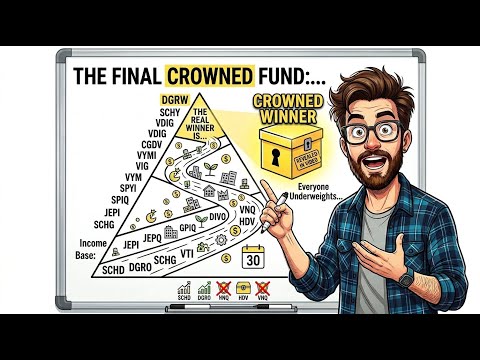
The loudest dividend ETFs rarely make the best retirement income tools. High yields that never grow, payouts cut at the first sign of trouble, funds built on short-term gimmicks — these are the traps that quietly drain a nest egg over a 20- or 30-year retirement. The funds worth building around are the unglamorous ones: broad, low-cost, rules-based dividend ETFs that raise their payouts year after year while barely generating a headline. This guide covers 14 of them, organized into three tiers — the Foundational Six, the Overlooked Four, and the Monthly Specialists — with the real numbers on yield, expense ratio, and dividend growth history for each.
Key Takeaways
- SCHD has raised its dividend for 13 consecutive years, with approximately 10.6% average annual dividend growth over the last decade.
- A fund with a lower starting yield but a 7–9% annual raise rate can out-pay a higher-yield fund over a full retirement — the compounding math favors the grower.
- The 14 funds split into three tiers: Foundational Six (core holdings), Overlooked Four (underexposed), and Monthly Specialists (paycheck-frequency income).
- Covered-call ETFs like JEPI (~8% yield) and SPYI (~6.5%) deliver large monthly checks but cap upside and carry variable payouts.
- DGRW is the only quality dividend growth fund on this list that pays monthly — combining a rising income engine with a 12-times-a-year schedule.
- International funds (SCHY, VYMI) add geographic diversification but come with lumpier, currency-influenced payouts less suited to tight monthly budgets.
Why a Growing Dividend Beats a Big Flat Yield
The instinct when building a retirement income portfolio is to sort by yield and buy the highest number on the page. That instinct is usually wrong, and understanding why changes how you evaluate every fund on this list.
Consider two investors with the same starting sum. One chooses a fund yielding 4% with dividend growth of roughly 1.5% per year. The other accepts a 2% starting yield from a fund growing its dividend at 8% annually. Within a decade, the second investor's annual payout has grown substantially larger — not because of superior luck, but because of compounding raises. Over a 20- or 30-year retirement, that gap widens further. This is the thread running through all 14 funds below: the best ones are not necessarily paying the most today. They are the ones whose checks keep getting bigger, year after year, regardless of what the market is doing.
The Foundational Six
These are the core holdings experienced dividend investors already expect to see. They are well-known for a reason — and even within familiar names, the trade-offs are worth understanding precisely.
1. SCHD — The Anchor
Schwab US Dividend Equity ETF | Yield: ~3.25% | Expense ratio: 0.06% | 5-year dividend growth: ~9%/yr | 10-year dividend growth: ~10.6%/yr
SCHD has raised its dividend for 13 consecutive years, with approximately 10.6% average annual dividend growth over the last decade — a raise that has historically outpaced inflation without requiring a single portfolio adjustment.
SCHD screens roughly 100 companies not just for paying a dividend, but for the financial strength to keep paying and raising it. With an expense ratio of just six cents per $100 invested, it is the natural foundation of a dividend income portfolio. Its most recent single-year growth rate slowed compared to the decade average — a reminder that no fund compounds in a perfectly smooth line — but the long-term record is exceptional. If there is one anchor for a retirement income stream, this is it.
2. DGRO — The Raiser
iShares Core Dividend Growth ETF | Yield: ~1.9% | Expense ratio: 0.08% | 5-year dividend growth: ~7%/yr
DGRO casts a wider net than SCHD, holding roughly 400 companies screened for consistent dividend growth. The starting yield is modest, but the mechanism is clear: a fund engineered to climb its distributions can eventually out-pay a higher-yielding fund over a long retirement if its raises are steadier and larger. For a detailed comparison of how DGRO and SCHD diverge in practice, see the full DGRO vs. SCHD breakdown.
3. VIG — The Disciplined Grower
Vanguard Dividend Appreciation ETF | Yield: ~1.5% | Expense ratio: 0.05% | 5-year dividend growth: ~9%/yr
VIG has one core admission rule: a company must have raised its dividend for at least 10 consecutive years to be included. That single filter removes an enormous number of shaky payers before they ever reach the portfolio. The result is a fund of businesses so consistent that rough markets have historically done little to interrupt the income stream — and at 0.05%, it is one of the cheapest dividend funds available.
4. VYM — The Breadth Play
Vanguard High Dividend Yield ETF | Yield: ~2.3% | Expense ratio: 0.04% | 5-year dividend growth: ~3.8%/yr
VYM holds nearly 600 companies, making it the broadest fund in the foundational tier. The trade-off is clear: more income today, slower raises over time at roughly 3.8% annual growth. One important overlap to note — VYM and SCHD hold many of the same large, steady dividend payers. Stacking both without checking underlying holdings may deliver less diversification than it appears to.
5. NOBL — The Aristocrat Fortress
ProShares S&P 500 Dividend Aristocrats ETF | Yield: ~2% | Expense ratio: 0.35% | 5-year dividend growth: ~5.4%/yr
NOBL holds only companies that have raised their dividend for at least 25 consecutive years — through the 2008 financial crisis, the pandemic, and every recession in between. The expense ratio of 0.35% is higher than the plain index funds, but what that premium buys is a portfolio of businesses that have treated the dividend as a non-negotiable promise to shareholders for a quarter-century. For investors who sleep better owning proven survivors, NOBL is a fortress.
6. HDV — The Trade-Off
iShares Core High Dividend ETF | Yield: ~3% | Expense ratio: 0.08% | 5-year dividend growth: ~1.9%/yr
HDV is concentrated — roughly 75 holdings — focused on higher-yielding companies with a financial health screen. The yield looks attractive next to VIG or DGRO, but HDV's dividend has grown at only about 1.9% per year over five years, barely keeping pace with inflation. HDV illustrates the essential trade-off in dividend investing clearly: a bigger check today very often means a smaller raise tomorrow.
The Overlooked Four
These funds sit one row below the famous names on most watchlists. Each adds something the foundational tier does not fully cover.
7. SCHY — International Dividends
Schwab International Dividend Equity ETF | Yield: ~3.5%
SCHY applies a similar quality and dividend screen to international companies rather than American ones, producing a yield noticeably higher than its domestic counterpart. The honest caveat: SCHY launched relatively recently and does not yet have a five-year dividend track record. The strategy is sound and the yield is real, but the history through a full market cycle simply does not exist yet. For investors heavily concentrated in domestic equities, SCHY is a sensible diversifier — held with clear eyes about its short history.
8. VYMI — International High Yield
Vanguard International High Dividend Yield ETF | Yield: ~3.6%
VYMI casts a wide net over hundreds of international companies, delivering an eye-catching yield. The important wrinkle: overseas companies often pay dividends once or twice a year rather than quarterly, and payout amounts fluctuate with currencies and local business cycles. VYMI functions as a diversification hedge rather than a predictable quarterly raise engine. It complements a domestic core; it does not replace it.
9. CGDV — Active Management
Capital Group Dividend Value ETF | Yield: ~1.2%
CGDV is the only actively managed fund in the overlooked tier. Real portfolio managers at Capital Group select holdings rather than following a fixed rulebook — allowing them to lean into quality and avoid the weakest names in ways a rigid index cannot. The honest caveat: CGDV is a younger fund that has not yet lived through a full market cycle. Capital Group has a serious multi-decade reputation as a firm, but this specific fund's short track record deserves real weight before it becomes a core holding.
10. PEY — High Yield with Growth
Invesco High Yield Equity Dividend Achievers ETF | Yield: ~4% | 5-year dividend growth: ~5.7%/yr
PEY attempts to deliver both a higher current yield and meaningful dividend growth — a combination that is genuinely uncommon. At roughly 4% yield alongside approximately 5.7% annual dividend growth over five years, the numbers back up the premise. The trade-off is real: PEY is more concentrated than broad index funds, and higher-yielding companies carry inherently higher dividend cut risk. It functions well as an income booster within a larger portfolio, not as a low-drama anchor.
The Monthly Specialists
Every fund above pays quarterly — four checks per year. These four pay monthly, matching the rhythm of a regular paycheck. Understanding what each one actually is, and is not, is critical before investing.
11. JEPI — Maximum Monthly Cash Flow
JPMorgan Equity Premium Income ETF | Yield: ~8% | Expense ratio: 0.35% | Payment: Monthly
JEPI generates income two ways: a portfolio of quality stocks, plus option premiums collected by selling covered calls. The combined yield of roughly 8%, paid monthly, is hard to ignore. The honest trade: the covered call strategy caps upside in strong bull markets, and the monthly payout is variable — higher in volatile months, lower in calm ones. JEPI is an income-now tool, not a dividend growth vehicle. It excels at delivering current cash flow; it is not designed to grow that cash flow over time. Pair it with growth-oriented funds rather than treating it as a standalone retirement engine.
12. SPYI — S&P 500 Monthly Income
Neos S&P 500 High Income ETF | Yield: ~6.5% | Payment: Monthly
SPYI applies a similar options-income strategy layered over the S&P 500 index, generating approximately 6.5% in monthly distributions. A notable feature is its tax-efficiency advantage in how distributions are structured — a meaningful plus in taxable accounts. Like JEPI, it trades away some market upside for the generous monthly payout, and it is a newer fund without a long track record through multiple full market cycles. Both facts deserve real weight before building a significant position.
13. DIVO — The Blend
Amplify CWP Enhanced Dividend Income ETF | Yield: ~4% | Expense ratio: 0.56% | Payment: Monthly
DIVO is the most unusual fund on this list. Rather than going all-in on covered calls the way JEPI does, or ignoring them the way SCHD does, DIVO holds a focused basket of high-quality dividend-paying companies and then selectively writes covered calls on some of them to add extra income on top. The result is a monthly payout of roughly 4% with genuine dividend-growing companies providing the foundation underneath.
The trade-offs are real: the expense ratio of 0.56% is the highest in the monthly tier, covered call writing caps upside when holdings run hard, and the tax treatment of option income can differ from qualified dividends — making account placement a meaningful decision worth discussing with a tax professional. For a retiree who wants a real monthly check and real growing businesses underneath it, DIVO is a compelling middle path between pure income and pure growth.
14. DGRW — The Monthly Growing Core
WisdomTree US Quality Dividend Growth ETF | Yield: ~1.3% | Expense ratio: 0.28% | Payment: Monthly
DGRW is the answer to the question in the title. It screens for companies with strong profitability and a real history of paying and growing dividends — then delivers that income monthly instead of quarterly. Almost every dividend growth fund covered above pays four times a year. DGRW pays twelve.
The starting yield of 1.3% is the lowest in the monthly tier, and that honesty matters. A retiree who needs substantial current income on day one will need to pair DGRW with higher-yielding funds like DIVO or JEPI for immediate cash flow, and let DGRW serve as the growing monthly core. For an investor building a rising monthly paycheck designed to compound over a decade or more, DGRW combines the quality dividend growth engine of DGRO or VIG with a monthly deposit schedule that matches the rhythm of a working paycheck. The growth is historical and not guaranteed, but a quality screen tilts the odds in your favor without removing the risk entirely.
How to Use These 14 ETFs Together
These 14 funds are a menu to build from, not a list to hold all at once. A straightforward structure puts SCHD, DGRO, or VIG at the core — proven history of raises, low cost, broad diversification. A monthly income sleeve using DGRW as the growth engine and DIVO or JEPI for current cash flow layers on top. NOBL or VYM can add breadth or stability depending on the trade-off that fits the plan. The 4-ETF dividend ladder using VIG, DGRO, SCHD, and DIVO is one practical starting framework for seeing how these funds combine into a real monthly income number.
The pattern across all 14 funds is the same: none of them won by being exciting. They won by being reliable — through good markets and bad — delivering a check that showed up regardless of the headlines. The best retirement income does not come from the loudest fund with the biggest yield. It comes quietly, from strong companies that keep paying, building into something larger than most investors expect.
Watch the Full Video Breakdown
For a visual walkthrough of all 14 funds — including side-by-side yield and growth comparisons, the full reasoning behind the fund order, and a clear picture of how DGRW earns the final spot — watch the complete video on YouTube. Every number cited in this article was pulled and cross-checked before filming.
Watch: 14 Quiet Dividend ETFs That Turn a Nest Egg Into a Monthly Paycheck
This article is for educational purposes only and does not constitute financial advice. Past performance does not guarantee future results. All figures cited are historical and may not reflect current data. Consult a qualified financial professional before making any investment decisions.