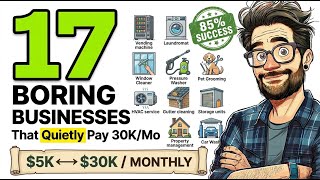
Most people pick one income lane — a trade, a degree, a side hustle — and stay in it forever. The operators quietly clearing $5,000 to $30,000 a month take a different approach: they stack income paths. Trades that pay while you sleep. Online skills backed by free certifications. Property plays that generate cash from assets you never own. This breakdown covers all 17 in one place — drawn from three deep-dive playbooks — organized by what it takes to start and what it realistically pays.
Key Takeaways
- Five licensed trades can each be entered for under $2,000 in certification costs — one HVAC operator scaled from $300,000 to $10 million in annual revenue in 24 months.
- Six in-demand online skills pay $5,000 or more per month using free training from HubSpot Academy, Ahrefs Academy, and Make Academy — no degree required.
- Six property business models generate consistent cash flow with as little as $30,000 in starting capital — without owning a single building.
- Brett Williams of Designjoy built a productized design subscription to $145,000 in monthly recurring revenue as a solo operator with zero employees.
- One self-storage sublease operator cleared $600,000 per month without ever owning a property.
- All 17 paths were selected for replacement-income potential — each can realistically replace a full-time salary within 12 to 36 months for an operator who treats it as a business.
Part 1: 5 Boring Trades That Pay Up to $200,000 a Year
Licensed trades are the most underrated income category for people looking to exit the 9-to-5. Entry costs are low, demand is structural, and most of the skilled competition is aging out. Certification costs across all five trades stay under $2,000 — in some cases, well under.
Mobile Pet Grooming
Penn Foster offers an accredited pet grooming certificate program that qualifies operators for professional client work. A mobile groomer running five to seven appointments per day can clear $80,000 to $120,000 annually with minimal overhead — no storefront, no lease, no waiting room. Customers pay a premium for door-to-door service, which makes the mobile format structurally less price-sensitive than brick-and-mortar grooming salons.
Licensed Solar Installer
The NABCEP (North American Board of Certified Energy Practitioners) PV Installation Professional credential is the industry-recognized standard for residential and commercial solar installs. A typical residential install runs $15,000 to $25,000 per job. A licensed crew of two to three technicians handling three installs per week reaches six figures in annual revenue quickly. California, Texas, and Florida represent the three highest-volume residential solar markets in the country.
HVAC Technician
The EPA Section 608 certification — required to legally handle refrigerants — costs under $200 to obtain. HVAC is where the most dramatic operator story in the trades category lives.
Trio Heating and Air scaled from $300,000 to $10,000,000 in annual revenue in 24 months — built on emergency service calls and recurring maintenance contracts.
HVAC combines high-ticket emergency demand (customers call regardless of budget when heat goes out in January) with recurring maintenance agreements that stabilize income through the off-season. The EPA 608 credential opens the door; the maintenance contract model builds the business.
Licensed Concrete Finisher
The American Concrete Institute (ACI) Flatwork Finisher certification is recognized across North America. Aristeo Construction is one of the prominent names in commercial flatwork — a firm built on concrete finishing contracts. Contractors operating in California also need a CSLB (Contractors State License Board) license. Concrete finishing rewards experienced operators with margins well above general labor, and the commercial contract path bypasses the price pressure common in residential work.
Licensed Septic Pumping
The Miller's Services playbook is the reference model for this trade: a regional septic pumping and inspection business running scheduled routes. Licensing requirements vary by state but typically involve a surety bond and modest fees. The business benefits from a completely captive customer base — every property with a septic system needs service on a fixed schedule, creating reliable recurring revenue that does not depend on ongoing marketing once a route is established.
The full certification path, bond requirements, and income ceiling for each trade are covered in detail here: 5 High-Paying Trades Most Grads Ignore (Under $2K to Certify).
Part 2: 6 Online Skills That Pay $5,000 a Month Using Free Courses
The second category requires no truck, no tools, and no startup capital beyond a laptop and an internet connection. Each skill below has a legitimate free learning path through an established platform. The certifications signal competence to clients before a portfolio exists — which matters most when starting from zero.
Email Marketing
HubSpot Academy offers a free email marketing certification covering campaign strategy, automation sequences, list segmentation, and deliverability. Freelance email marketers charge $1,500 to $5,000 per client per month. The results are trackable — open rates, click rates, revenue generated — which makes client retention high and referrals common. Three to four retained clients is a $5,000 to $15,000 per month business.
SEO Consulting
Ahrefs Academy provides free SEO training covering keyword research, on-page optimization, link building, and technical audits. An SEO consultant with three to five retainer clients at $1,500 to $2,000 per client per month generates $5,000 to $10,000 monthly. The work is largely asynchronous and geography-independent, making it stackable with other income paths on this list.
AI Automation
Make Academy (the training platform from Make, formerly Integromat) teaches no-code automation workflows at no cost. Liam Ottley and his Morningside AI agency are the primary case study in this space — a firm that packaged AI automation into monthly retainer deals for small and medium businesses. Demand is expanding rapidly as businesses that cannot justify a full-time developer budget look for affordable workflow automation solutions.
Productized Web Design
Brett Williams built Designjoy as a subscription-based productized design service: one flat monthly price, unlimited design requests, one active request fulfilled at a time.
Designjoy reached $145,000 in monthly recurring revenue with zero employees — one operator, one productized offer, one repeatable system.
Free coding bootcamps and no-code design tools have lowered the technical barrier significantly. The leverage is in the productized structure: fixed scope, fixed price, and no custom project negotiation on every deal.
Online Coaching
Alex Hormozi's $100M Offers framework is the operating manual for the coaching model. The core principle: a high-value offer solves a specific problem for a specific buyer and prices to the outcome rather than the hour. Hormozi's company Gym Launch sold for $46.2 million — built on packaging and licensing a coaching system to gym owners nationally. The coaching business itself requires no hard costs beyond time; the leverage is entirely in the offer design.
Lead Generation
Lead generation agencies find, qualify, and deliver warm leads to local service businesses — roofers, contractors, dentists, law firms — in exchange for a monthly retainer or a per-lead fee. The Morningside AI model overlaps here: using AI tools to automate outreach and qualification at scale. An operator running five to eight clients at $1,000 to $2,000 per month generates $5,000 to $16,000 in largely recurring monthly income.
The free course links, client acquisition path, and real operator income numbers for each skill are detailed in the companion article: 6 Freelance Skills That Pay $5,000 a Month in 2026 (Free Courses).
Part 3: 6 Boring Property Businesses That Generate Cash Without Owning Real Estate
The property category is where the mental model changes. These are not traditional real estate investments. Most require no mortgage, no ownership equity, and no renovation budget. They use leases, sublease arbitrage, and space-activation models to generate cash flow from property that someone else owns — and in some cases, from land that has never been productized at all.
Billboard Land Leases
A landowner with road frontage on a high-traffic corridor can lease billboard space to an operator — or self-operate a billboard — for $500 to $3,000 per month in passive income with minimal active management. The play is identifying underutilized parcels near highways or commercial corridors and approaching sign companies with a lease proposal. The land appreciates; the sign pays the monthly income.
Self-Storage Sublease via Neighbor.com
Neighbor.com is the marketplace that made this model scalable. Operators master-lease a large commercial space — a warehouse, a parking lot, an industrial unit — and sublease individual storage units to residential and business customers through the platform. The margin between the master lease cost and the per-unit revenue is the operator's profit.
One Canadian operator — who started his career as a garbage collector — built a $600,000-per-month self-storage sublease operation without ever owning a single building.
For more on low-capital property business models, see: 6 Boring Cash-Flow Machines to Buy With $30,000.
Airbnb Arbitrage
Airbnb arbitrage is the practice of signing a standard long-term lease on an apartment (with landlord permission) and reletting it on Airbnb at short-term rates. The spread between the monthly lease cost and the short-term revenue is the operator's income. Operators running five to ten units in high-demand markets — near airports, convention centers, or universities — generate $5,000 to $15,000 in net monthly income. Startup costs are primarily furniture and the first month's security deposit.
Niche Coworking Space
The generic coworking model is commoditized. The niche coworking model — a space purpose-built for real estate agents, e-commerce sellers, content creators, or legal professionals — commands premium memberships and low vacancy because the community itself is the product. Operators lease underutilized commercial space, fit it out at low cost, and sell monthly memberships at $300 to $800 per desk. A 30-desk operation at $500 per desk generates $15,000 per month in gross revenue before rent and operating expenses.
24-Hour Boutique Gym
The 24-hour gym model uses keypad-access entry and automated check-in to minimize staffing costs while keeping the facility revenue-generating around the clock. Boutique gyms built around niche disciplines — powerlifting, Brazilian jiu-jitsu, boxing — command higher membership prices and generate stronger retention than general fitness clubs. Alex Hormozi's Gym Launch, which sold for $46.2 million, was built on codifying the operations and marketing playbook for exactly this model.
SBA-Financed Self-Storage Acquisition
Nick Huber of Sweaty Startup is the primary reference operator for this path. The model: use an SBA loan to acquire an existing self-storage facility with 10% to 20% down, raise rents to market rate, reduce operating waste, and add ancillary revenue streams such as truck rental, packing supplies, and climate-control upgrades. The debt service is covered by the facility's operating cash flow from day one. Self-storage carries one of the lowest management overhead ratios in commercial real estate — no tenant maintenance calls, no unit renovations between leases. A 200-unit facility generating $60,000 in net operating income, purchased at a 6% cap rate with SBA financing, can cash flow $2,000 to $5,000 per month after debt service in the first year.
How Operators Stack These Income Paths
The operators at the top of the $5,000 to $30,000 monthly range rarely run just one path. A licensed HVAC technician might build a self-storage sublease operation using the trade business's cash flow as the master lease security deposit. An SEO consultant might productize a lead generation service and sell it to the same clients paying for organic traffic work. The stacking logic is straightforward: start with the path that fits your current resources — a truck and a $2,000 certification budget, or a laptop and six months of free course study — then layer a second path once the first is generating reliable income.
Every path in this list was filtered for one criterion: replacement-income potential. Each can plausibly replace a full-time W-2 income within 12 to 36 months for an operator who runs it as a business rather than a hobby.
Watch the Full Video Breakdown
The video version of this breakdown walks through all 17 income paths with real operator numbers, named founders, exact certification costs, and the filters used to determine which paths qualify as genuine replacement-income businesses. If you are deciding which lane fits your current situation — a truck, a laptop, or $30,000 in starting capital — watching the full breakdown makes it easier to see where you fit and what the realistic ceiling looks like. You can watch it here: 17 Boring Income Paths That Quietly Pay $5K–$30K/Month.