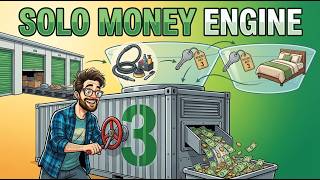
The most reliable path to building wealth outside a 9-to-5 rarely involves a flashy product, a venture-backed startup, or a large team. It usually involves a boring business — one that solves a repeatable problem, requires little overhead, and can be run by a single person. This breakdown covers three of them: mobile auto detailing, Airbnb hosting, and self storage investing. Together, they represent an entry point for almost any capital level, from a $500 driveway startup to a $30,000 SBA-financed acquisition — and an income ceiling that runs from $88,000 per year to a $350 million empire.
Key Takeaways
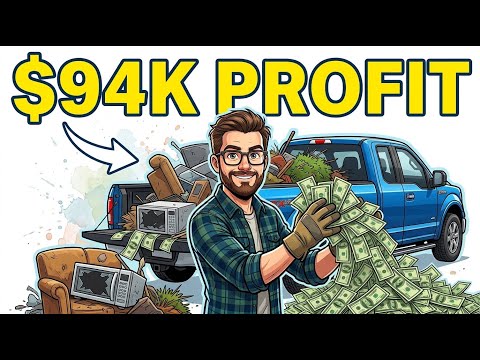
- A mobile auto detailing business can be launched for $500–$600 and generate over $88,000 per year solo, with upsell services like ceramic coatings reaching $2,500 per job.
- The average U.S. Airbnb host grosses $4,300 per month according to AirDNA's 2024 data — and spare-room hosts often net more than dedicated property owners due to the Hidden Room Dollar effect.
- Self storage generates an average 41% profit margin, and every $1 of net operating income (NOI) creates $14–$16 of equity at standard cap rates.
- AJ Osborne built his Cedar Creek self storage empire — now valued at over $350 million — while paralyzed in a hospital bed, with no employees managing day-to-day operations.
- All three businesses can be run solo, with no storefront, no mandatory team, and startup capital ranging from $500 to $30,000.
- Naval Ravikant's Transformation Premium explains why detailing customers pay $2,500 for a ceramic coating — they are buying a visible, lasting outcome, not just a service.
Business #1: Mobile Auto Detailing — $88K Solo From Your Driveway
Mobile auto detailing is one of the lowest-barrier service businesses available in 2026. The entire startup kit — pressure washer, foam cannon, vacuum, microfiber towels, and chemicals — runs $500 to $600. There is no storefront lease, no commercial build-out, and no employee payroll. You bring the service directly to the customer's driveway.
The income ceiling is higher than most people expect. Real operators on Reddit report clearing $10,000 to $12,000 per month. A 22-year-old documented in the research behind this video reached $75,000 per month — an outlier, but one that illustrates the scalability of the upsell ladder available in detailing. A conservative solo operation targeting $88,000 per year sits well within reach once a recurring customer base is established.
The Upsell Ladder: From $75 to $2,500
The entry price for a basic exterior wash sits around $75. The real margin lives in premium services. Paint correction commands $300 to $800 per vehicle. Ceramic coatings — a semi-permanent protective layer that repels water, UV radiation, and contaminants — run $1,500 to $2,500 per application. A single ceramic coating job replaces a full week of basic washes in gross revenue.
This upsell structure connects directly to what Naval Ravikant calls the Transformation Premium. Customers pay not just for a clean car, but for the visible, lasting transformation of a vehicle they care about. A car that looks brand new after a $2,000 ceramic coating is a fundamentally different product than a $75 wash. The perceived value — and willingness to pay — scales with the quality of the outcome delivered.
The 30-Day Launch Plan
The fastest path to a first paying customer in mobile detailing runs through social proof on free platforms. Document every job from day one with high-quality before-and-after photos. Post them on Instagram and local Facebook groups. Offer two or three discounted (not free) detail jobs to neighbors or family members in the first week — this builds reviews, referrals, and a photo portfolio simultaneously. A well-executed social-first launch should produce a recurring customer pipeline within 30 days.
For a complete breakdown of the startup costs, pricing strategy, and first-year income projection, the full mobile auto detailing deep dive covers every variable in detail.
Business #2: The Airbnb Business — $4,300/Month With No Property Required
The Airbnb opportunity is frequently misrepresented as requiring property ownership. It does not. There are three distinct operating models, and two of them require zero real estate equity to get started.
Three Airbnb Business Models
The first model is the spare room. A host rents out an unused bedroom in their primary residence. Startup costs are minimal — professional photography and a guest-ready room setup — and the income is nearly pure margin because the host already covers the underlying housing cost as a personal living expense.
The second model is the dedicated property — purchasing or long-term leasing a property exclusively for short-term rental. This requires more capital and carries higher fixed costs: mortgage or lease payments, utilities, furnishing, and cleaning. Gross revenue is higher in absolute terms, but net margins are often compressed compared to the spare-room model.
The third model is rental arbitrage — signing a long-term lease on a property with landlord permission, then subletting it on Airbnb at a short-term premium. The operator never owns the asset, takes on the lease risk, and captures the spread between monthly rent paid and the short-term rental revenue earned.
The AirDNA Numbers and the Hidden Room Dollar
According to AirDNA's 2024 data, the average U.S. Airbnb host grosses $4,300 per month. This figure spans urban apartments, rural cabins, spare rooms, and dedicated units — it establishes a realistic benchmark for what a well-managed listing can generate across most U.S. markets.
The most counterintuitive finding in Airbnb hosting is the net income advantage that spare-room hosts hold over dedicated property owners. Because a spare-room host's fixed housing cost is already absorbed as a living expense, every dollar earned from the spare room drops almost entirely to net income. A spare-room host generating $1,500 per month with $100 in incremental costs nets $1,400. A dedicated property host generating $4,000 per month with $3,200 in costs — mortgage, insurance, utilities, cleaning — nets $800. The spare-room host wins on net margin despite lower gross revenue. This is the Hidden Room Dollar mechanism that most Airbnb comparisons overlook.
One critical friction point for new Airbnb hosts is city-level regulation. Many major U.S. cities — including New York, Los Angeles, and San Francisco — have introduced registration requirements, nightly caps, or outright bans on short-term rentals. Any prospective host must verify local ordinances before listing. AirDNA's market data tool can identify cities where the regulatory environment remains permissive and occupancy rates are strong.
Business #3: Self Storage — $50M Empires With 41% Profit Margins
Self storage is the most capital-intensive of the three businesses, but it carries the most compelling long-term wealth-building mechanics. It operates with no tenants living on-site, no employees required for day-to-day management, no inventory, and profit margins that most retail or service businesses cannot approach.
The Operators Who Built Real Empires
AJ Osborne is the most cited operator in modern self storage. He built the Cedar Creek Capital portfolio — now valued at over $350 million — while managing it from a hospital bed during a period of near-total paralysis. The business ran without him because self storage, when structured correctly, operates on systems rather than active daily labor. Metal boxes collect rent. A management software platform handles billing. Automated gate access replaces staff.
Nick Huber, known through the Sweaty Startup brand, operates a 61-facility portfolio with a reported cost basis of $34 million. His acquisition framework targets secondary and tertiary markets where purchase prices are lower and competition from institutional operators is limited, then implements digital systems — online rentals, automated access, remote management — to minimize operating overhead across the entire portfolio.
The Math That Makes Self Storage Exceptional
The average self storage facility generates a 41% net operating income margin. The math compounds at the asset level through cap rate mechanics: every $1 of NOI created — through raising rents, improving occupancy, or reducing operating expenses — creates $14 to $16 of asset value at a 6–7% cap rate.
Every $1 of NOI added in self storage translates to $14–$16 of property equity at prevailing cap rates. Raising monthly rents by $5 across 200 units adds $1,000/month in NOI — and $14,000–$16,000 of property value.
The SBA 504 and 7(a) loan programs make self storage acquisition accessible without full purchase-price capital. SBA financing typically covers 80–90% of the acquisition cost, meaning a $300,000 facility can be acquired with $30,000 to $60,000 in cash. The facility's own NOI services the debt, and the operator captures the equity creation above it.
Investors who already think about cash flow through dividend portfolios will recognize the structural similarity to other $30,000 cash-flow machines covered on this site — but self storage adds an equity multiplier through NOI leverage that passive income vehicles rarely replicate.
Which Solo Business Fits Your Situation?
Mobile auto detailing is the clearest choice for anyone starting with under $1,000 and a willingness to do hands-on physical work. The income ramp is fast — a first paying customer within 30 days is achievable — and the upsell ladder to ceramic coatings and paint correction drives meaningful income growth without hiring anyone. It is an active income business, not a passive one, but the solo economics at this capital level are hard to match.
Airbnb hosting via the spare-room model is the lowest-friction entry for anyone with an existing home and an unused bedroom. The Hidden Room Dollar dynamic makes this the highest-net-margin model relative to capital deployed. The dedicated property and arbitrage models require more capital, more active management, and a careful review of local regulations before committing.
Self storage is for the long game. It requires more upfront capital even with SBA financing, more patience during acquisition and stabilization, and deeper market research to identify the right entry point. But the 41% margin profile, the NOI-to-equity multiplier, and the low-labor operating model make it the strongest generational wealth vehicle of the three.
Watch the Full Breakdown on YouTube
The video version of this breakdown covers the full numbers behind each business — including live Reddit operator income reports, the AirDNA market dashboard walkthrough, and the complete SBA acquisition model for self storage — in a visual, chapter-by-chapter format you can jump through directly. Watch 3 Boring Businesses You Can Run Solo From Anywhere on YouTube for the complete deep dive, and subscribe to Harry's Stealth Wealth so you don't miss the weekly one-business breakdowns that go even deeper on each of these models.