- Key Takeaways
- The Ownership Audit: Two Questions That Separate Businesses from Jobs
- Side Hustle #1 to Avoid: Rideshare Driving
- Side Hustle #2 to Avoid: Last-Mile Delivery
- Side Hustle #3 to Avoid: Basic Dropshipping
- Side Hustle #4 to Avoid: Data Entry and Basic Transcription
- Harry's Winter: The Math Nobody Screenshots
- The Boring Play That Passes: Peer-to-Peer Storage
- How to Start With Peer-to-Peer Storage: Three Steps
- Watch the Full Breakdown
The gig economy advertises flexibility. What it delivers, for most people, is a job with extra steps — one where the platform owns the customer, the algorithm sets the price, and you walk away owning nothing you can sell. Before pouring another weekend into a hustle that quietly fails you, run it through a simple two-question filter called the Ownership Audit. Four of the most aggressively promoted side hustles on the internet fail both questions. One overlooked, unglamorous alternative passes — and it keeps paying long after you've set it up.
Key Takeaways
- Rideshare drivers net as little as $9.21 per hour after real costs, according to the Economic Policy Institute — far from the $25 the apps advertise.
- The Ownership Audit asks two questions: Do you own the customer? and Do you own the asset? If the answer to either is no, you own a job, not a business.
- Beginner dropshippers routinely lose money — a realistic first run produces roughly $3,800 in revenue against costs that push the net result to a loss of around $2,200.
- Peer-to-peer storage through platforms like Neighbor.com generates $150–$350 per month for approximately 45 minutes of monthly management.
- The U.S. self-storage market is operating at 93% full nationwide and is projected to grow from roughly $66 billion today toward $112 billion by 2031.
- A landscaper named Harry cleared $255 per month from two listed spaces — roughly matching his entire Uber winter — with zero extra miles on his truck.
The Ownership Audit: Two Questions That Separate Businesses from Jobs
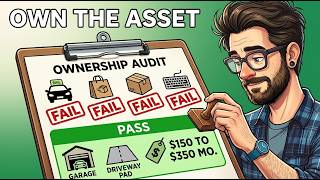
The Ownership Audit is a two-question filter that cuts through any side hustle pitch in under a minute.
Question one: Do you own the customer? If the platform disappeared overnight, could you still reach and bill the person who pays you?
Question two: Do you own the asset? Is there a space, a list, a machine, or a route that holds its value while it earns?
If the answer to either question is no, you don't own a business. You own a job with extra friction. Run every hustle below through that filter and the results become consistent and hard to ignore.
Side Hustle #1 to Avoid: Rideshare Driving
Rideshare companies advertise $25 per hour. In high-demand markets like San Francisco and New York, drivers genuinely gross $30–$32 per hour. In mid-size cities like Charlotte or Nashville, the survey median sits around $20–$22 gross. That's the number on the billboard.
The real number is different. Gridwise built an earnings calculator using more than 500,000 real driver data points and applies a roughly 40% haircut to gross earnings — accounting for gas, maintenance, rideshare-specific insurance, and the 15.3% self-employment tax. A driver doing 30 hours a week for 50 weeks grosses around $31,200 annually but pockets closer to $18,700. That works out to about $12.47 per hour.
The Economic Policy Institute, once waiting time between rides is factored in, puts the effective rate closer to $9.21 per hour. Two independent sources, the same brutal direction.
The hourly rate isn't even the core problem. Every mile driven depreciates the one asset that made the income possible — the driver's own car. Uber owns the rider relationship, controls pricing, takes a 25–30% cut from every fare, and can quietly throttle trip volume without notice. There is no customer list, no asset to sell, and no route that compounds over time. As an emergency cash faucet or for disciplined operators running airport surges in a company vehicle, rideshare has a narrow use case. As a business, it fails the first question of the Ownership Audit on day one.
Side Hustle #2 to Avoid: Last-Mile Delivery
DoorDash, Instacart, and Amazon Flex follow the same shape as rideshare, slightly worse. With tips, DoorDash drivers report $15–$25 gross per hour. Amazon Flex blocks run $18–$25 gross. Apply the same 40% all-in cost haircut and most operators land between $10 and $14 per hour.
The hidden erosion comes from block timing. A four-hour Flex block looks like $72–$100 on paper. In practice, it includes staging time before pickup, warehouse wait time inside the block, and the return drive after — quietly consuming five or six real hours of a day. The effective hourly collapses before most people notice.
The ceiling is the deeper issue. One hour in equals one hour's pay out — permanently. There is no version of tomorrow where the route mastered today pays without showing up. A DoorDash account cannot be sold. Smarter app routing keeps packing more stops into the same pay window at the same flat rate. A disciplined operator on an e-bike running two apps through the lunch and dinner rush in a dense city can net $17–$22 cleanly. But it remains a shift, not an asset.
Side Hustle #3 to Avoid: Basic Dropshipping
Basic dropshipping is the entry on this list that stings most, because the pitch is built entirely around ownership it never actually delivers. Find a product, mark it up, run ads, collect the spread. The math collapses at every link in the chain.
Generic dropshipping margins run 15–25%. On a $50 product at a 20% margin, the gross profit is $10 — before a single dollar in customer acquisition. As of 2026, acquiring one customer through Meta or Google ads costs $68–$84. A realistic beginner run produces roughly $3,800 in revenue against $3,000 in ad spend and fees, for a net loss of around $2,200. The seller effectively paid out of pocket for a part-time job that returned less than nothing.
The structural reason it breaks: nothing in the chain is owned. The supplier sets the floor price. Meta sets the traffic price. Shopify takes its cut. Any competitor can copy the product page and undercut by three dollars the same afternoon. Temu and Shein have demonstrated they can flood entire categories with subsidized pricing and eliminate the margin entirely.
A version of dropshipping that survives does exist — branded products with 60–80% margins and an owned email list. That's a real business requiring genuine skill and roughly a year of patience before meaningful profit. It is not the start-tomorrow play being advertised in most social media ads.
Side Hustle #4 to Avoid: Data Entry and Basic Transcription
Data entry and transcription are the quietest failures on the list. Platforms like Rev pay $0.45–$1.10 per audio minute, translating to $5–$15 per hour after fighting through poor audio quality. Raw data entry on freelance marketplaces pays $3–$8 per hour once global competition drives prices to the floor. Net of platform fees at 20% and self-employment tax, most operators earn $4–$9 per hour in practice.
The hourly rate isn't the real danger here. The floor isn't set by car depreciation — it's set by AI. OpenAI's Whisper, Otter, and Descript already transcribe at 95% accuracy for a fraction of a cent per minute. Document-parsing tools are doing the same thing to data entry through automated invoice and form processing. Entering this market today means competing with a machine that gets faster and cheaper every month.
The legitimate exception is certified medical or legal transcription, which pays $18–$25 per hour because accuracy carries genuine legal and clinical consequences and human judgment is preferred. But that requires months of specialized training. It is not the no-skill, start-today product that generic transcription platforms market.
Harry's Winter: The Math Nobody Screenshots
Harry runs a 14-lawn landscaping route in the suburbs, clearing around $63,000 April through October. Last November, he did what most people in his position do — he started driving for Uber to bridge the winter income gap.
The first two weeks he grossed $980 and calculated it at $24 per hour. December's holiday surge brought $1,400. Then his mechanic flagged early wear on his front rotors — $340 out of pocket, which he told himself wasn't Uber's fault. By February, the self-employment tax bill on his Uber income came to $490, and wear-related costs tied to those extra miles — rotors, oil changes, tires — added another $620.
Four months of driving had netted Harry roughly $1,900. That works out to $8.77 per hour. He had been renting himself out and calling it a business. That realization led him to the Ownership Audit — and to a different kind of play entirely.
The Boring Play That Passes: Peer-to-Peer Storage
The side hustle that clears both questions of the Ownership Audit is one that most financial content skips — because it isn't exciting enough to make a compelling thumbnail.
Peer-to-peer storage means renting out space already under your control: a garage bay, a driveway pad, a basement corner, an empty side yard. Listed on a platform like Neighbor.com, that space connects with nearby people who need somewhere to park an RV, store furniture between moves, or stash seasonal equipment — and they pay every month without significant ongoing interaction.
The income numbers are more compelling than the concept suggests. Indoor space rents for $50–$200 per month. Vehicle, RV, or boat parking commands $100–$400 per month. A typical suburban host renting one garage bay and one driveway pad can realistically generate $150–$350 combined monthly. Neighbor's own data showed hosts spending about 45 minutes per month managing everything, which penciled out to roughly $294 per hour of actual work in late 2023.
Real examples exist at every scale. A host named Noah listed a driveway and an unpaved lot as RV and boat parking in 2021. By 2026 he was earning $24,398 annually from under five hours of work per month — Neighbor auto-charges renters, who come and go on their own schedule, and Noah answers the occasional message. A host named Rose in Hawaii reportedly built a six-figure income renting parking. Mike Lowe rents spots on ten acres of Florida lakefront to campers and RVers. Different sizes, identical machine.
The professional self-storage industry is operating at roughly 93% full nationwide, per Marcus & Millichap, and the overall market is projected to grow from approximately $66 billion today toward $112 billion by 2031. The target isn't filling a thousand units — it's finding one renter for one space in a country where most garages are already packed to the door.
If peer-to-peer storage resonates, the broader guide to rental business ideas that make money without doing the work covers six comparable models that follow the same ownership logic. For a wider look at low-startup businesses built on the same principle, see 6 boring businesses that make money under $500 to start.
How to Start With Peer-to-Peer Storage: Three Steps
Getting a first renter requires no renovation, upfront investment, or specialized knowledge.
Step one: Photograph the space in good light, swept and clean, with accurate dimensions in the listing description. Neighbor surfaces well-photographed listings higher in its search results — this is the only meaningful work at launch.
Step two: Price the listing 10–15% below comparable spaces nearby. Landing the first renter quickly matters more than optimizing the rate on day one.
Step three: Once a review or two is in place, raise the price to market rate. Most hosts land their first renter within two to four weeks.
On liability: Neighbor provides $1 million in host coverage at no extra cost — the inverse of rideshare driving, where personal auto policies typically exclude commercial use. A host protection plan covers damage, and photographing the space before move-in handles the remaining exposure.
For those who rent and have no space to offer: a cheap commercial bay can be leased and sub-listed in individual units for the spread. For those where storage isn't an option, a neighborhood yard-cleanup route — knocking on 15 doors and offering weekly service for $20 per visit — passes both Ownership Audit questions. Ten yes answers equals $200 per week, about $800 per month, for one morning of work. The customer relationship is direct, no app sits between you and payment, and the route itself is an asset that can be sold.
Harry ran the two-question test in March and stopped driving. He listed his off-season trailer pad as covered RV storage at $145 per month — first renter in 11 days. He cleared out a detached garage bay over one Saturday and listed it at $110 — renter in three weeks. Combined: $255 per month, roughly $3,060 per year. About equal to his entire Uber winter — except this version pays him through his busy landscaping season too, with zero extra miles on his truck and zero hours taken from his week.
Watch the Full Breakdown
The video version of this analysis walks through the Ownership Audit calculations in real time, with Harry's full month-by-month income timeline and the exact listing steps. Watch 4 Side Hustles to Avoid (And the Boring One to Do Instead) for the complete walkthrough.
For education only. Not financial advice. Check your city's local ordinances before listing any space — most questions can be settled in about 15 minutes of searching.