- Key Takeaways
- Why the 9% Yield Shortcut Is the Most Fragile Paycheck You Can Build
- Introducing the Three-Job Dividend Paycheck
- The SCHD Foundation Underneath It All
- How Much Capital Does This Actually Require?
- What the Same Portfolio Could Pay in Ten Years
- Building Toward the Target With Consistent Contributions
- Watch the Full Breakdown
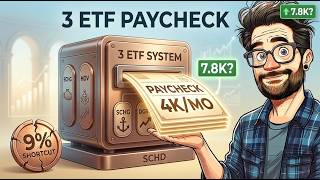
$48,000 a year in dividends — paid to you whether the market rises or falls — is a specific, buildable target. The path to it, however, matters as much as the destination itself. Most investors instinctively reach for the highest yield available, seduced by the arithmetic of a 9% payout that appears to require only a fraction of the capital. What that approach obscures is the fragility underneath. A quieter alternative, built on three ordinary ETFs each assigned a single job, arrives at the same $4,000-a-month paycheck — and then systematically grows it, year after year, without any additional investment.
Key Takeaways
- To generate $48,000 per year in dividends, the required capital depends entirely on your portfolio's blended yield.
- A 9% single-fund approach requires roughly $533,000 but leaves income vulnerable to a single distribution cut.
- The Three-Job Paycheck assigns SCHG (growth engine), HDV (yield anchor), and DGRW (raise machine) each a distinct role.
- At a blended yield of approximately 1.57%, the three-fund combination requires roughly $3 million to produce $48,000 annually.
- Assuming 7% annual dividend growth, that same portfolio could pay approximately $94,000 per year — nearly $7,800 per month — within a decade.
- SCHD serves as the foundational layer beneath the entire structure, with a yield historically near 3.7% and roughly 13% annual dividend growth over the past five years.
Why the 9% Yield Shortcut Is the Most Fragile Paycheck You Can Build
The arithmetic on a high-yield strategy looks compelling at first glance. At a 9% distribution rate, generating $48,000 per year requires just over $533,000 invested — a number well within reach for many serious savers, and the simplicity of a single-fund solution has obvious appeal. The problem is structural, not superficial.
A fund paying 9% is typically doing one or more of three things: carrying elevated credit or sector risk, gradually returning investors' own capital through return-of-capital distributions, or sustaining outsized payouts that become difficult to maintain across a full market cycle. The yield looks generous right up until it doesn't.
The consequences of a distribution cut are immediate and difficult to recover from quickly. If that 9% yield is trimmed to 6% — a moderate reduction by most standards — the same $533,000 portfolio generates approximately $32,000 per year instead of $48,000. A retiree drawing on that income loses more than $1,300 per month without selling a single share. That shortfall arrives without meaningful warning, often during market downturns when asset values are also under pressure. As explored in Pausing Dividend ETFs for 6 Months: The $13,900 Mistake, the long-term cost of disrupting a dividend income plan compounds in ways that are not immediately apparent.
The durable alternative accepts a larger required capital base in exchange for a paycheck spread across hundreds of companies, three distinct strategies, and three separate fund providers — no single announcement can collapse the income stream.
Introducing the Three-Job Dividend Paycheck
The framework rests on a straightforward principle: rather than demanding that one fund simultaneously handle growth, income, and dividend raises, the three-job structure assigns each function to a dedicated ETF. When a fund is responsible for only one task, it can execute that task effectively. The result is a portfolio where each fund's strength offsets another's limitation.
The recommended allocation is 30% SCHG, 35% HDV, and 35% DGRW. Weighted together, that combination yields approximately 1.57% — materially lower than 9%, and deliberately so. That lower blended yield is the source of the income's durability.
Job 1 — The Growth Engine: SCHG
SCHG, the Schwab US Large Cap Growth ETF, carries an expense ratio of 0.04% and holds approximately 197 companies — predominantly the largest growth-oriented businesses in the United States, with Nvidia and Microsoft among its top positions. Its current dividend yield is approximately 0.33%, which is negligible as a current income source.
That near-zero yield is not a design flaw. It is the job description. SCHG's role is capital appreciation. Over the past five years, the fund has historically returned approximately 17% annually; over ten years, approximately 18% annually. Past performance does not guarantee future results, but the pattern illustrates the function clearly: SCHG is the engine that keeps the broader portfolio expanding. While HDV and DGRW generate cash income, SCHG ensures the underlying capital base does not stagnate. It serves as SCHD's growth partner, providing the appreciation component so the portfolio keeps building rather than merely paying out a fixed amount.
Job 2 — The Yield Anchor: HDV
HDV, the iShares Core High Dividend ETF, carries an expense ratio of 0.08% and holds approximately 81 companies screened for high-quality businesses with sustainable payout profiles. Its yield sits at approximately 3% — a meaningful, current income figure that performs real work inside the portfolio.
HDV is a concentrated fund by design, with significant sector tilts that introduce more concentration risk than a broad-market index would carry. That is not a disqualifying characteristic; it reflects the fund's specific purpose. As the yield anchor, HDV delivers dependable current income today — the cash that handles the immediate demands of a monthly paycheck. As one component within a three-fund framework, it performs this role without the income instability that accompanies a high-yield single-fund strategy.
Job 3 — The Raise Machine: DGRW
DGRW, the WisdomTree US Quality Dividend Growth Fund, distributes dividends on a monthly schedule — a feature income investors often prioritize for cash-flow planning. Its yield is modest at approximately 1% to 1.1%, which may appear underwhelming alongside HDV's 3% on a current-yield basis.
That comparison misframes DGRW's purpose. It is not competing with HDV for current income. DGRW is built around dividend growth and business quality, targeting companies with consistent histories of increasing their distributions. Its job is to make the paycheck larger over time, not to maximize what it delivers today. While HDV anchors the income in the present, DGRW engineers the income's upward trajectory into the future. The pairing of a yield anchor and a raise machine is what separates this framework from a static high-yield position.
The SCHD Foundation Underneath It All
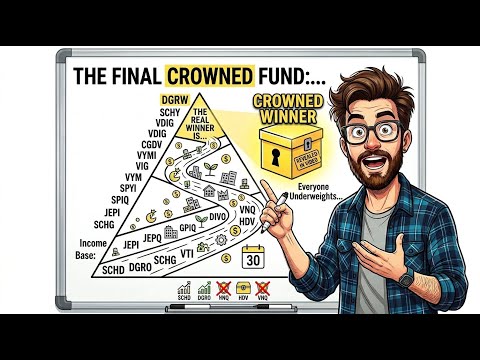
Beneath all three funds sits SCHD — the Schwab US Dividend Equity ETF — which functions as the foundational layer of the entire framework. With a yield historically near 3.7% and a track record of raising its dividend by approximately 13% per year over the past five years, SCHD provides the stable, growing income floor on which the Three-Job Paycheck is constructed. For a detailed look at how SCHG and SCHD complement each other as a core portfolio combination, SCHD and SCHG: The 70/30 Core Satellite Strategy Explained covers the pairing in depth.
How Much Capital Does This Actually Require?
At a blended yield of 1.57%, producing $48,000 per year requires approximately $3,000,000 invested. A 9% single-fund approach requires roughly $533,000 for the same annual income. The gap in required capital is real — and it is the price of building a paycheck that no single distribution announcement can eliminate.
The instinctive reaction is to treat $3 million as an insurmountable target versus $533,000 as an achievable one. The calculation shifts when the question changes from "how much capital do I need on day one?" to "how reliably will this income hold across twenty or thirty years of retirement?" A paycheck spread across hundreds of companies and three separate fund structures is not exposed to the same single points of failure as a concentrated high-yield position. The larger capital requirement is not a penalty. It is the cost of durability.
What the Same Portfolio Could Pay in Ten Years
The most important distinction between a high-yield approach and a dividend-growth approach does not appear on day one. It accumulates over time.
A high-yield fund paying 9% is generally designed to sustain that payout rate, not to raise it meaningfully year over year. The income holds relatively flat or erodes in real terms. A dividend-growth portfolio, by contrast, is built specifically to increase its payout annually. That compounding effect, applied to a $3 million base, produces a materially different outcome over a decade.
Assuming 7% annual dividend growth — a reasonable pace for a portfolio tilted toward dividend-growth funds, though past performance is not a guarantee — a portfolio generating $48,000 in year one could pay approximately $94,000 per year by year ten. That is roughly $7,800 per month from the same original capital, with no new contributions. The paycheck nearly doubled without any additional investment.
That trajectory is what distinguishes building for dividend growth from purchasing yield. The nine-percent fund cannot replicate it. Its structure maximizes the day-one figure, not the decade-ten figure. Investors who prioritize current yield trade future income for present income — a trade that works against compounding over a long retirement horizon.
Building Toward the Target With Consistent Contributions
Few investors begin with $3 million in liquid capital. The more common path is a steady monthly contribution into the same three-fund mix over many years. The variable a working investor actually controls is not market returns and not the portfolio's yield — it is the consistency and size of the monthly contribution.
With SCHG providing capital appreciation alongside the income from HDV and DGRW, a regular contribution schedule benefits from both growth and reinvested dividends simultaneously. Those dividends, reinvested automatically into additional shares, generate additional dividends in turn — the compounding flywheel that transforms a modest beginning into meaningful income over a patient timeline. HDV and DGRW begin paying income immediately, even during the accumulation phase. Those early distributions, reinvested rather than spent, accelerate the compounding and steadily close the gap toward the $4,000-a-month target.
Watch the Full Breakdown
For a visual walkthrough of how the Three-Job Paycheck comes together — including the exact capital calculations, fund allocations, and ten-year income projections — watch How to Make $4,000 a Month in Dividends With Just 3 ETFs on the Harry's Financial YouTube channel. The video covers each fund's role in detail and walks through the math behind the $3 million target and the decade-long income growth scenario.
This article is for informational and educational purposes only and does not constitute financial advice. Always conduct your own research and consult a qualified financial professional before making any investment decisions. Past performance of any fund or strategy does not guarantee future results.