- Key Takeaways
- The Compliance Revenue Loop: Why These Businesses Don't Chase Clients
- Business 1: Hood and Kitchen Exhaust Cleaning
- Business 2: Commercial Used Cooking Oil (UCO) Disposal
- Business 3: Curbside Bin Cleaning
- Business 4: Sewer and Drain Line Cleaning
- Business 5: Portable Toilet Route
- Three Filters for Choosing the Right Business
- Watch the Full Breakdown on YouTube
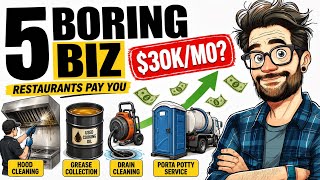
Five service businesses quietly running on regulated, recurring problems that restaurants cannot legally ignore generate anywhere from $50,000 to $4.3 million per year — and none of them require a degree, a patent, or a social media following to launch. The unifying principle is something called the Compliance Revenue Loop: when a customer has a legal obligation to keep paying, the contract renews itself. Health codes, fire codes, and EPA regulations become the sales team. This article breaks down the startup math, customer acquisition strategies, and profit margins for all five businesses, along with the three filters that separate equity-building routes from glorified jobs.
Key Takeaways
- A packed solo hood cleaning route grosses approximately $30,000 per month from one van running 48 jobs across four nights per week.
- Used cooking oil pays operators twice per drum — a service fee from the restaurant plus a per-gallon commodity payment from the biodiesel buyer.
- The used cooking oil market hit $8.47 billion in 2026 and is projected to reach nearly $14 billion by 2033, according to Coherent Market Insights.
- A 31-year-old in Montana generated $4.3 million in 2025 revenue at a 22% net margin running a portable toilet route (CNBC Make It).
- The Compliance Revenue Loop means NFPA 96, EPA regulations, and local health codes effectively auto-renew contracts without a single follow-up sales call.
- All five businesses pass at least two of three equity filters: legal obligation, route density, and acquirability.
The Compliance Revenue Loop: Why These Businesses Don't Chase Clients
Most service businesses live and die by repeat sales efforts. These five operate differently. Each one is anchored to a legally mandated recurring problem the customer cannot ignore. Restaurants cannot skip hood cleaning — NFPA 96 (2025 revision) and insurance carriers require signed certificates. They cannot let drains clog, because health codes mandate functional drainage. They cannot let used cooking oil overflow, because EPA regulations govern disposal. Multifamily properties cannot let bins go uncleaned, because health departments enforce it.
Once an operator is the trusted vendor on file for a compliance-sensitive business, switching vendors means restarting an entire compliance paper trail. That friction is the moat. These are not just service routes — they are regulated recurring revenue businesses dressed in work boots. For lower capital-entry alternatives in this space, see 6 Boring Businesses That Make Money (Under $500 to Start) for models with lighter upfront requirements.
Business 1: Hood and Kitchen Exhaust Cleaning
The hood cleaning truck pulls into the alley at 10 PM, after the line cooks go home. The crew runs a high-pressure hose to the roof, blasts a season's worth of cooked grease off the exhaust fan and ductwork, and leaves behind a signed certificate of compliance. NFPA 96 requires this cleaning at mandated intervals, insurance carriers demand documented proof, and fire marshals enforce it. High-volume kitchens running more than 16 hours per day require monthly service; standard restaurants operate on a quarterly cleaning schedule. Nobody in the building wants this job — the owner simply needs the certificate signed and filed away.
Revenue Model and Startup Costs
The operating math is straightforward: 3 jobs per night, 4 nights per week, 4 weeks per month equals approximately 48 jobs monthly. The average ticket runs $450 to $800 depending on hood size, producing $21,000 to $38,000 in monthly gross revenue from one van. After fuel, chemicals, insurance, and software, MFS Trade School documents solo operators clearing $8,000 to $15,000 per month in take-home pay. Startup requirements include a used van or box truck ($15,000–$35,000), a hot-water pressure washer rated at minimum 3,000 PSI (~$5,000), and IKECA (International Kitchen Exhaust Cleaning Association) certification (~$2,000). The IKECA cert is non-negotiable — without it, most insurance carriers will not back the operation, and a single grease fire on an uncertified job site can end the business permanently.
Getting the First Contract
Walk in during lunch prep with a one-page NFPA 96 compliance summary and offer a free inspection. Most restaurant managers do not know their required cleaning frequency — that conversation positions the operator as the compliance expert and the default vendor. New restaurant openings are the softest pitch: they need a cleaning contract before the first fire marshal walkthrough and have no existing vendor relationship to protect. The long-term retention move is timestamped before-and-after photos and a manager-initialed certificate of service on every visit. That paperwork is the insurance shield, the sales proof, and the reason no competitor can poach the account without forcing the manager to rebuild a compliance file from scratch. These contracts routinely run five to ten years on a single restaurant once the compliance binder is established.
Business 2: Commercial Used Cooking Oil (UCO) Disposal
This model collects payment from two directions simultaneously. The operator services a route of 15 to 30 restaurant accounts, swapping full drums of used cooking oil for empty ones and hauling the load to a rendering plant or biodiesel buyer. The restaurant pays a service fee. The buyer pays per gallon. Same drum. Two revenue streams. Restaurants have no legal alternative — cooking oil cannot go down a drain or into a standard dumpster, making the pickup service a compliance requirement rather than a discretionary spend. The EPA also notes that recycling waste grease into biofuel cuts greenhouse gas emissions by 86% compared to fossil fuels, adding a marketable sustainability angle to every client pitch.
The used cooking oil market hit $8.47 billion in 2026 and is projected to reach nearly $14 billion by 2033. — Coherent Market Insights
Route Economics and the Competitive Moat
A solo route of 150 accounts producing roughly 70 gallons per month equals 10,500 gallons monthly. At a blended margin of $0.75 to $2.00 per gallon after fuel and disposal costs, gross profit runs $7,800 to $21,000 per month. Reiter USA profiles an operator who scaled from 150 accounts to 500 accounts, with annual revenue ranging from $378,000 on the low end to $1.26 million at the top — from restaurant grease. Entry costs range from $24,000 to $85,000 all-in, covering a used collection truck, pumping equipment, drums, an environmental hauler permit, and liability insurance. The physical moat is a branded, locked, tamper-proof drum bolted to each account's dock. Once that drum is secured to the building, a competitor cannot swap it out without ripping hardware off the property — a friction that holds accounts for years without a single retention sales call.
Business 3: Curbside Bin Cleaning
This is the most accessible entry point in the group. A hot-water pressure washer mounted on a trailer or small truck handles a residential or commercial route of 150 to 250 bins per day. Dirty wash water is captured in an onboard tank and discharged at an approved car wash drain — skipping this step triggers stormwater violations that can end the business in week one. The eco-friendly closed-loop system is both the legal shield and the sales pitch. The model runs on pure subscription revenue, with customers paying monthly or quarterly and canceling at very low rates.
Jason Feller of Crystal Clean Canz spent 20 years managing private clubs before purchasing a $48,000 bin cleaning trailer. He built a book of 300 recurring customers at an average of $35 per month — $105,000 per year before touching a single commercial account. Apartment complexes pay $100 to $400 per month per property. Startup costs run $15,000 at the low end for a basic trailer and up to $95,000 for a custom truck. Bin cleaning passes two of three equity filters (legal obligation and route density); acquirability depends on local market density and the size of the contracted book.
Business 4: Sewer and Drain Line Cleaning
The emergency call is the marketing, not the business model. The actual revenue engine is the Annual Maintenance Agreement: restaurants pay $150 to $300 per month for scheduled monthly drain treatment with one included emergency call, locked in for 12 to 24 months. The close is a single question — would you rather pay $300 per month every month, or $2,000 at 6 PM on a Friday when the dining room is full and the kitchen drain just backed up? The answer is always the contract. This business is also deeply recession-resistant: people still flush, restaurants still cook, and grease still solidifies regardless of economic conditions.
Margins, Gear, and the Upsell Ladder
National service firms report gross margins of 45% to 55% on routine drain work and up to 65% on hydro jetting. Flat-rate pricing on a snake job runs $150 to $350; a hydro jet on a main line runs $400 to $800. Commercial route operators report $400 to $500 per hour billable on focused accounts. A solo operator with a paid-off van clears $6,000 to $12,000 per month net on a focused commercial book (Contractor Magazine). Entry gear totals $15,000 to $60,000: a used cargo van ($10,000–$25,000), an electric drain snake ($1,500–$4,000), a hydro jet skid unit ($3,000–$20,000), and a sewer inspection camera ($4,000–$12,000). Check state plumber registration requirements before purchasing equipment — requirements vary significantly by jurisdiction. The premium upsell is sewer camera inspections at $150 each, which generate pipe relining leads worth $10,000 to $30,000 per job. Drain cleaning is the lead magnet; relining is the profit center.
Business 5: Portable Toilet Route
A solo operator services 20 to 35 units per day — vacuum, rinse, restock, move on. Construction sites anchor the route with multi-month contracts that establish reliable monthly recurring revenue. Event venues layer in premium weekend pricing at two to three times the standard construction site rate, and they book six to twelve months in advance.
A 31-year-old in Montana generated $4.3 million in revenue in 2025 at a 22% net margin — $946,000 net in a single year from portable toilets. — CNBC Make It
That same operator produced $3.1 million in 2024. The scaling strategy was systematic tuck-in acquisition: every small competitor who wanted to retire became an inbound deal, adding a ready-made route with existing contracts attached. The North American portable toilet rental market is worth $7.86 billion and is growing at 6.2% annually through 2031, according to the ServiceCore 2024 Portable Sanitation Industry Benchmark Report. Solo operators typically clear $50,000 to $150,000 per year — $4,000 to $12,000 per month net — before adding a second truck.
A basic 10-unit launch costs $50,000 to $75,000 all-in: 15 used units at approximately $700 each, a used vacuum truck ($25,000–$60,000), an EPA waste hauler permit, commercial auto insurance, and a small storage yard. ADA and luxury units charge double the standard rental rate, making them a strong margin lever even with just two units in the fleet. The ServiceCore benchmark identifies route density as the single most important profitability driver — the best-margin operators refuse jobs beyond a fixed radius from the hub and charge a 25% to 40% premium on long-distance singles. Density compounds; geographic sprawl destroys margins.
Three Filters for Choosing the Right Business
Before committing capital to any of these models, apply three questions. First: does the customer have a regulatory requirement to keep paying? If yes, the contract renews by obligation, not by ongoing sales effort. Second: can a tight, profitable route be built within a five-mile radius of an existing base of operations? If yes, fuel costs and drive time stay manageable from day one. Third: would another operator pay to acquire the book of accounts in five years? If yes, the route is a sellable asset, not just a job. Hood cleaning, grease disposal, drain cleaning, and portable toilets pass all three filters. Bin cleaning passes the first two; acquirability depends on local market density.
The structural advantage these businesses share is that the truck, the route, the contracts, and the compliance file form a system that keeps earning whether the owner is on the truck or not. That is the line between a cash-flow job and a transferable asset. For additional cash-flow business models in the same capital range, see 6 Boring Cash-Flow Machines to Buy With $30,000 for route and asset models worth comparing side by side.
Watch the Full Breakdown on YouTube
For the complete walkthrough — including exact first-contract scripts, startup cost comparisons across all five models, and real operator case studies — watch the full video on the Harry's Stash YouTube channel. The video covers how a solo hood cleaning route reaches $30,000 per month, how grease haulers collect payment from two directions on every drum, and how the Montana porta potty operator scaled from $3.1 million to $4.3 million in a single year through disciplined tuck-in acquisitions.