- Key Takeaways
- What Is the Access Toll Method?
- Space 1: The Cell Tower Land Lease
- Space 2: The Parking Space Rental
- Space 3: The Wall or Fence Advertising Lease
- Space 4: The Seasonal Lot Lease
- Space 5: The Community Garden Plot Rental
- Space 6: The Film Location and Photoshoot Venue
- Three Filters to Choose Your First Space
- Watch the Full Breakdown
- The Quiet Logic of Boring Money
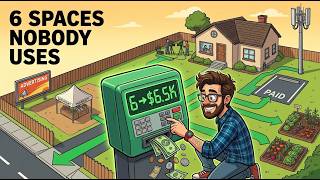
Most people assume a business requires building something — a product, a service, a skill. The reality is far simpler. If you already control a space someone else wants to use, you can charge for access to it. That single idea underpins six overlooked rental income streams that require no construction, no specialized knowledge, and in most cases, very little upfront capital. Whether it is a blank wall, a spare parking slot, a bare corner of a lot, or a patch of ground you currently mow and ignore, each of these spaces represents what can be called access rent.
Key Takeaways
- A cell tower ground lease can pay $500–$3,000 per month from land you already own — the carrier covers all construction costs
- Spare driveways and parking slots can start generating income within days of listing on peer-to-peer apps like Neighbor or CurbFlip
- A blank wall along a busy road can command $1,000–$10,000 per month in advertising lease income
- Film location and photoshoot venues are the highest-earning option on this list, with rates from $89 per hour to $24,000 per day
- Community garden plot rentals offer low-drama, recurring seasonal income that renews itself every spring
- Never sign a flat-rate lease longer than five to ten years — always negotiate annual increases and a revenue share where possible
What Is the Access Toll Method?
The Access Toll Method comes down to one principle: you hold a space, someone else needs it, and you charge for access. No crew. No inventory. No trade license. The space itself — a patch of ground, a blank wall, a spare driveway — is the entire business. What varies across the six options below is the tenant type, the income range, the startup timeline, and the degree of ongoing involvement. The one constant is that you are not selling labor. You are selling a window of access to something you already control.
For a broader look at low-capital business models built on assets rather than skills, the 6 Boring Businesses That Make Money (Under $500 to Start) guide covers complementary ideas worth pairing with the spaces below.
Space 1: The Cell Tower Land Lease
Of all six options, the cell tower land lease produces the highest monthly income for the least ongoing effort — and it requires nothing from you except access to the right patch of ground. Phone carriers constantly need land for towers to close coverage gaps. If your property sits near a dead zone with good elevation and line of sight to a busy road, a carrier will pay you a monthly check simply to host the structure.
A single rural ground lease often runs $500 to $1,250 per month. Strong sites climb past $4,000. A busy urban rooftop hosting more than one carrier can clear $6,500 per month or more.
The economics work because you are not renting dirt — you are renting a fix for the carrier's coverage problem. That distinction is why rates are high relative to raw land value. The carrier pays for the tower build, the permits, and all equipment. Your only meaningful task is negotiating the lease terms. Carriers use site acquisition scouts who actively hunt for land near dead zones, and landowners can also list their ground on lease marketplaces. Firms like Vertical Consultants specialize in helping landowners negotiate favorable terms without adding any labor.
According to Steel in the Air, a respected cell tower lease negotiation resource, most rural landowners should expect $500 to $1,250 per month before an expert pushes it higher. The timeline is the main drawback: from first contact to a signed lease and a built tower typically takes six to eighteen months. The most common mistake is accepting the first flat offer without negotiating annual rent increases or a lease term limit. Cap any agreement at five to ten years with no automatic renewal clause.
Space 2: The Parking Space Rental
Where the cell tower lease is a slow, patient play, parking is fast. A spare driveway or single slot can be listed and earning within days. Peer-to-peer parking apps have turned idle asphalt into a legitimate recurring income stream for property owners who would otherwise leave that space empty.
A spare driveway or slot typically rents for $50 to $250 per month. A larger lot used for boat and RV storage can pull up to $2,200 per month. Real-world operator Stacy Spahr, an insurance agent in Oregon, earns roughly $175 per month per vehicle and approximately $2,500 per month in total after expenses by renting a spare lot for RV and boat storage.
Apps like Neighbor, Pavemint, CurbFlip, and Spacer handle payment collection, deposit holding, and guest communication. Good photos, a fair rate, and clear access hours are the full setup. Startup cost is essentially zero. The concern most new hosts raise — the safety of letting strangers onto their property — is addressed by the platforms: they collect deposits and hold payments, while the host sets the access rules, including gate codes, operating hours, and overnight restrictions. You hand over a window of access, nothing more.
Space 3: The Wall or Fence Advertising Lease
A blank wall or long fence running along a busy road looks like nothing. To an outdoor advertiser, it is a billboard waiting to happen. Wall and fence advertising leases operate on a simple formula: the rent tracks the traffic count and the visibility of the surface.
An urban wall in view of heavy traffic can command $1,000 to $10,000 per month. Even a quiet rural sign earns $500 to $2,000 per year just sitting there.
One documented owner negotiated a flat $1,500 per month for a single wall lease, plus an additional $500 for every extra advertiser added to the structure. He does not design, print, or sell the ads. He grants access to a surface and collects the check. Beyond the flat-fee model, owners can negotiate a revenue share — typically 15 to 25 percent of the advertising company's gross — with an annual increase built in. The share arrangement is where the real upside lives, particularly on high-traffic corridors where ad revenue grows over time.
To start, contact an outdoor advertising company or a local ad broker. They scout visible walls and fences along traffic corridors routinely and will approach the owner if the surface qualifies. Startup cost runs from zero to roughly $500 for minor surface cleanup. The ad company handles installation and maintenance. Timeline is typically a few months.
The single most expensive mistake on this list is signing a long-term flat-rate lease. Locking into a fifteen-year agreement with automatic renewal sounds stable — but if traffic on the road doubles within two years, ad revenue on the fence climbs while the owner remains frozen at the original flat rate. The fix: cap any lease at five to ten years with no automatic renewal, and negotiate a revenue share with annual increases instead of a flat fee.
Space 4: The Seasonal Lot Lease
A lot does not need a year-round tenant to generate meaningful income. It needs a season. Pop-up markets, weekend events, and seasonal storage runs all need temporary ground — and they pay for it by the day or the weekend.
Small neighborhood lots pull a few hundred dollars per day. Premium city lots in desirable neighborhoods have commanded $3,600 to $24,000 per day for retail or event activations. The math on a modest arrangement is straightforward: a lot rented to a weekend farmers market at $300 per Saturday generates $1,200 per month from ground that previously sat empty. The market organizer brings the vendors, the booths, and the foot traffic. The lot owner brings the footprint and the access window.
Event organizers and farmers market operators find available lots through Craigslist, Neighbor, and direct outreach. Often the first deal comes from approaching a local market organizer directly with the lot dimensions and access terms. Startup cost ranges from near zero to about $1,000 for basic signage or minimal fencing. Timeline to a first booking is typically two to four weeks. Protect the arrangement with a clear season window, a refundable deposit, and a requirement that the lot be returned in clean condition before the deposit is released.
Space 5: The Community Garden Plot Rental
Community garden plot rental is the calmest income stream on this list. It renews itself every spring, attracts reliable tenants who treat the space with care, and requires no planting, harvesting, or agricultural knowledge from the lot owner.
The model works by subdividing a lot into individual plots, adding water access, and renting each plot to a gardener for the growing season. Small beds rent for $15 to $55 per season. Mid-size plots run $28 to $70. Larger micro-farm blocks can pull $350 to $600 each per season. Real operator Elliott Farm Services rents 1,000-square-foot garden plots for $84 per season including tax, with a $50 refundable deposit on each — generating repeat demand every spring.
Gardeners find available plots through local extension offices, city parks departments, and platforms like SharedEarth and YardYum. Startup cost runs from $500 to $5,000 depending on scale, covering fencing and water line installation. That infrastructure becomes the durable asset that justifies charging every season thereafter. Plots can typically be filled within a single spring sign-up window. The most common concern — a renter abandoning a plot mid-season — is handled by the deposit, which covers any cleanup, and by the seasonal agreement, which returns the plot to available inventory the following spring.
Space 6: The Film Location and Photoshoot Venue
Film location rental carries the highest income ceiling on the entire list, and it applies to spaces most owners would never consider marketable: a home with good light, a warehouse corner, a rooftop, a field. Production teams and photographers pay to rent the space for a single day — or a few hours — at rates that make short-term accommodation income look modest by comparison.
Standard spaces rent from $89 per hour. Premium homes and studios command $100 to $300 per hour. Large production spaces have earned $960 to $24,000 per day.
To put that in perspective: a home that earns $100 per night as a short-term rental can earn $100 per hour as a film location. Same property, a dramatically different check. Giggster lists a Los Angeles film location starting from $89 per hour, priced below comparable local spots and still booking regularly. Photographers, location scouts, and small production teams book through platforms like Giggster, Peerspace, and Avvay. The owner provides access and nothing else — no crew, no gear, no styling.
The math on a conservative booking schedule: two weekend shoots per month at four hours each, priced at $89 per hour, generates $712 per month from a space already owned. Stack that alongside a parking slot rental and a couple of garden plots, and a realistic first-year range lands between $8,000 and $14,000 on a part-time basis after platform fees.
Startup cost is near zero — strong listing photos and a clear profile are typically sufficient, since renters are expected to return the space in the condition they found it. Smart hosts require a refundable deposit, event insurance for larger productions, and take before-and-after photos of the space. The most common pricing mistake is charging by the day out of caution. Pricing by the hour with a four-hour minimum consistently outperforms a flat day rate. The hourly model, booked a few times per month, generates more income with greater scheduling flexibility.
For a broader comparison of rental-based income streams that operate without day-to-day labor, see 6 Rental Business Ideas That Make Money Without Doing the Work.
Three Filters to Choose Your First Space
Every space on this list runs through the same three filters. Use them to identify which one to price first.
Filter 1 — Control before construction. Start with what you already hold. Your cost stays near zero when you are not acquiring anything new to run the income stream.
Filter 2 — Near-zero effort. Choose a space you can manage in roughly one hour per week, with a deposit and a simple access agreement handling the operational details.
Filter 3 — A tenant pool already in your area. Pick the space that someone nearby already wants — whether that is a carrier looking for coverage, a driver hunting for cheap parking, an advertiser seeking visibility, an event organizer needing ground, a gardener searching for a plot, or a production crew looking for a location.
The first step is to identify one space you already control, search what a comparable space rents for in your area, and write that number down. That is your access rent proof — before signing anything. The winner is not whoever owns the most land. The winner is whoever notices the underused space first and prices its access.
Watch the Full Breakdown
For a visual walkthrough of all six spaces — including real income examples, platform recommendations, and the lease term trap that can cost landlords thousands — watch the full video: 6 Boring Spaces You Already Control That Quietly Pay Rent on the Harry's Stash YouTube channel. The video covers each space in sequence, breaks down the three-filter framework in detail, and shows how stacking multiple small tolls creates a meaningful annual income stream from property you already own.
The Quiet Logic of Boring Money
As David Chilton noted in The Wealthy Barber, wealth is built slowly, through small, boring, steady decisions — not one lucky swing. Six boring spaces. Six access tolls. None of them require building anything. They require only that you look at what you already control and ask who might pay to use it.