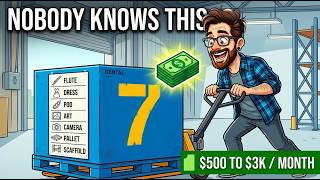
Most side hustle advice tells you to work harder. This idea tells you to buy smarter. There is a category of physical asset you purchase once and then rent to a rotating pool of customers for a decade — the same object earning on repeat while you do almost nothing after the initial setup. These are not glamorous. A student flute. A steel storage container. A stack of scaffolding poles. But the math behind them is some of the cleanest in small business: profit is not determined by the sticker price of the asset — it is determined by how many times that same asset goes back out the door.
Key Takeaways
- Seven rental assets — from musical instruments to scaffolding — follow the same buy-once, earn-forever model across a wide range of startup budgets.
- The Rerun Revenue Loop is the core framework: track each asset like a hotel room, by occupancy rate, not by what it cost.
- Most of these assets pay for themselves within one to two years; everything after that is near-pure margin.
- B2B rental assets (scaffolding, pallets) out-earn B2C assets because demand is tied to every job, not every season.
- Any asset that sits idle for 90 days without earning 20% of its cost needs to be repriced or moved to a new channel immediately.
- A starter scaffolding rental business can be launched for $10,000–$50,000 and can generate $500–$3,000 per set per month.
The Rerun Revenue Loop: Why Rental Beats Selling
John Warrillow's book The Automatic Customer makes a simple but powerful argument: a business built on things that rebuy themselves is worth far more than one chasing a new sale every single day. A rental asset is the purest expression of that idea. You buy the object once. It sells itself again and again to each new renter. The asset becomes its own recurring customer.
The operators who win in rental are not the ones with the most expensive gear. They are the ones who track utilization — the percentage of time an asset is out earning — the same way a hotel manager tracks room occupancy. If an asset has not earned back 20% of its cost within 90 days, it needs to be repriced or listed on a new channel. That single written rule separates a profitable rental portfolio from an expensive collection of idle equipment.
The 7 Boring Rental Assets, Easiest to Boldest
1. Musical Instrument Rental
A single student flute or clarinet rents for $20–$50 per month, and the school-year calendar does most of the selling. Each instrument rents for nine or ten months a year, to a new student every fall, for up to a decade. A modest fleet of 40–50 student instruments can generate several hundred to over $1,000 per month on a reliable, recurring basis.
The demand is structural: parents do not want to spend $900 on a trumpet for a 12-year-old who might quit by March. They want a low-commitment monthly rental. Music and Arts, a national chain, has built an entire business on this model, which confirms the market is real in virtually every town with a school band program. A starter fleet costs $5,000–$15,000 in student-grade instruments and typically pays for itself within one or two school years. Everything after that is near-pure margin, minus occasional cleaning and minor pad replacements. To land the first renters, attend instrument fitting nights at local schools and offer a price that undercuts the national chain. One beginning band program can yield 20 renters in a single weekend.
2. Formalwear and Dress Rental
A $200 dress rented at $80–$150 per occasion can go out four, five, or six times in a single prom-and-wedding season — and then repeat the cycle the following year. A working inventory of 30–60 pieces puts startup costs at roughly $8,000–$25,000 once tailoring and a small showroom are factored in. Partnering with a prom vendor fair or a bridal boutique that does not offer rentals is the fastest route to first customers — potentially within weeks of launch, if inventory is ready before prom season opens.
3. Mobile Storage Pods
A single steel storage container rents for $150–$250 per month, and the asset lasts 10–15 years without going out of style or depreciating meaningfully. PODS built a national franchise business on this exact model — a franchise that now costs well over a million dollars to buy into. The small-operator play is to acquire a handful of used containers directly for $10,000–$50,000 plus a trailer and capture the same demand at a fraction of the overhead.
Two distinct customer pools exist. Homeowners moving or renovating need temporary storage. Contractors need a locked on-site box for tools and materials for months at a time — and that contractor customer is the more reliably recurring of the two. A $10,000 container renting at $200 per month pays itself back in roughly four years of steady bookings. After payback, that box is near-pure profit for another decade. Local moving companies and real estate agents are the best referral channels — they route renovation clients weekly and welcome a storage option to pass along.
4. Art Leasing
Art leasing is the quietest model on this list. A single framed piece leased to a corporate office generates $50–$300 per month. A rotating portfolio of 20–30 pieces can bring in $1,500–$5,000 per month — from art hanging on someone else's walls, with no delivery trucks, no heavy lifting, and no seasonal demand spikes.
Businesses rent art because property managers and hotel operators do not want the overhead of buying, maintaining, and refreshing a permanent collection. They want updated walls every quarter with zero administrative burden. The pitch is four words: rotate quarterly, no maintenance. Startup costs run $5,000–$25,000 for an opening set of prints, canvases, and framing. Once a piece has paid for itself on one wall, it moves to the next and starts earning all over again.
5. Camera and Film Equipment Rental
This is where the daily income numbers become significant. According to ShareGrid — the peer-to-peer camera rental platform with over 12,000 members and $100 million worth of gear listed — a top Sony camera body averages $112 per rental day. A modest kit of one body and a couple of lenses can realistically generate $700–$1,000 or more per month for active listers. ShareGrid also provides equipment coverage up to $750,000, eliminating the need to purchase separate insurance policies.
The demand comes from wedding videographers, YouTubers, and small production houses that need a specific lens for one shoot and will not justify buying it outright. A starter kit costs $3,000–$8,000. A $6,000 camera body earning $112 per day only needs 10–15 rental days per year to cover its depreciation. Every rental day beyond that is profit. In a busy metro area, new listers on ShareGrid can often secure a first booking within their first week.
6. Pallet, Crate, and Tote Rental
This is where the rental model stops being a hobby and starts operating like a machine. A single reusable pallet or plastic tote earns only a few dollars per trip — but multiply that across thousands of units in constant rotation through warehouses and distribution centers, and the result is a genuine recurring revenue engine. CHEP, the company behind those iconic blue pallets visible on loading docks across the country, built a multinational business on exactly this model: renting reusable pallets to companies that prefer renting over owning, storing, and replacing their own supply.
For a small operator, the entry point is $5,000–$25,000 in inventory and one warehouse account. The customer is typically a logistics or warehouse manager who already rents similar assets and understands the value proposition immediately. If you are exploring adjacent cash-flow businesses, the 6 boring cash-flow machines to buy with $30,000 covers several complementary models worth pairing with a pallet rental operation.
7. Scaffolding Rental (The Boldest and Best)
Scaffolding is the most powerful asset on this list by a clear margin. One set rents for $500–$3,000 per month. More importantly, it gets rented on every construction job, every paint job, and every restoration project in a given market — not seasonally, not occasionally, but on every job. No contractor buys their own scaffolding and lets it sit idle between projects. They rent it, permanently.
The proof is in the industry itself: United Rentals and Sunbelt, the two largest equipment rental companies in the United States, are multi-billion-dollar businesses built on this exact reality. According to Entrepreneur magazine, a starter scaffolding rental business can be launched for $10,000–$50,000. With three or four recurring contractor accounts, a starter inventory can pay itself back within roughly a year. After that, every rental cycle is a rerun — the same steel, earning on every job, for a decade.
To land the first clients, print a simple price list and deliver it directly to local contractors and home service companies. Because scaffolding is needed on active job sites, first revenue can realistically arrive within 30 days. Once a contractor trusts your delivery and pickup process, they call on the next job, and the one after that.
A $22,000 piece of equipment — a small excavator — rented at $200–$400 per day generates over $2,000 per month and pays itself back in approximately 11 months. Every month after that is a rerun.
Three Filters That Separate Winners from Collectors
Most people who explore rental businesses buy an asset and watch it collect dust. Three filters consistently separate operators who build real income from those who do not.
Filter 1: Buy what a business rents on every job, not what a consumer rents once. Recurring beats seasonal. Scaffolding and pallets sit at the top of this list precisely because demand is tied to business operations — every project, every shipment — rather than a single event or time of year.
Filter 2: Price for utilization and protect the asset. Take a deposit on every rental. Photograph the asset's condition at every handoff with no exceptions. Set a written rule: if the asset has not earned back 20% of its cost within 90 days, reprice it or list it on a new platform. Without this rule written down and followed consistently, underperforming assets silently drain a portfolio.
Filter 3: Give every asset its own profit-and-loss line. You cannot manage what you do not measure. Track each item individually — its cost, its rental income, its days booked versus days idle. The operator who knows their utilization rate by asset wins. The one running on instinct does not.
A Realistic 12-Month Path
Applied consistently, these assets and filters compound. In month one, a small batch of pallets and totes gets purchased. By month three, a first recurring warehouse account is signed and that income gets rolled into expanding inventory. Around month six, a starter scaffolding run gets funded using pallet profits, with pitches going to contractors met through the warehouse network. By month ten, both fleets are in steady rotation and a part-timer handles pickups. By month twelve, with two or three recurring B2B accounts across both asset classes, it is realistic to clear over $3,700 per month on top of a regular salary — not by working more hours, but from objects bought once that keep going back out the door.
For lower-budget starting points that complement a rental operation, the 6 boring businesses that make money under $500 to start is worth reading alongside this one — several of those models can serve as early distribution channels for rental assets.
Watch the Full Video Breakdown
The numbers and framework read clearly on the page, but seeing all seven rental business ideas compared side by side makes the utilization logic click faster. The YouTube video walks through each asset with a visual comparison of startup costs, monthly income ranges, and the Rerun Revenue Loop applied in real terms. Watch the full breakdown on Harry's Stash — and drop a number from 1 to 7 in the comments to vote for the next deep-dive. Whichever number gets the most replies becomes the subject of the next full breakdown: exact costs, how it works, and how to start from zero.