- Key Takeaways
- The Rented-Surface Spread: A Framework, Not a Trick
- Business 1: Wall and Fence Ad-Space Leasing
- Business 2: Community Fridge and Little Free Pantry Sponsorship
- Business 3: Car-Top Advertising and Mobile Billboard Operation
- Business 4: Film Location and Photoshoot Venue Brokering
- Business 5: Community Garden Plot Rental
- Business 6: Seasonal Lot Leasing — The Highest Ceiling on the List
- What a First Year of Building This Actually Looks Like
- Watch the Full Video Breakdown
The assumption that collecting rent requires owning real estate is one of the most expensive beliefs a person can carry. Property deeds, mortgages, and down payments are one path to passive income — but they are not the only path. A growing category of operators earns steady monthly income from surfaces they control but never own: walls, rooftops, rooms, and vacant lots. This framework is called the Rented-Surface Spread, and six proven business models demonstrate exactly how it works.
Key Takeaways
- A single well-placed wall ad panel can generate $200–$800 per month for the operator who brokers it — without owning the building.
- A standard 60/40 revenue split, with the building owner taking 40%, is the typical opening arrangement for wall ad deals.
- Car-top ad operators who sell locally rather than through national networks can earn $150–$500 per vehicle per month.
- Film location brokers can earn hundreds to thousands of dollars per shoot day from spaces they do not own.
- Seasonal lot operators have cleared thousands over a 6–10 week season by sublicensing idle parking lots to pumpkin patches and Christmas tree sellers.
- All six models share one mechanic: control the right to monetize a surface, identify the payer, and keep the spread.
The Rented-Surface Spread: A Framework, Not a Trick
Three questions determine whether any surface is worth pursuing. First: who controls the right to monetize it — not who owns the property, but who can grant that right? Second: who would actually pay to use it — a local business, a production crew, a seasonal seller? Third: is the spread real — what does it cost to secure access versus what a payer will offer for it?
If that gap is genuine, there is a business. A deed is one way to control a surface. It is rarely the only way, and often not the most efficient one.
In The Almanack of Naval Ravikant, the core idea is to own a piece of something that earns without your time. Controlled surfaces do exactly that — the wall does not clock out, and the lot does not call in sick.
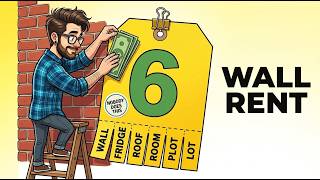
Business 1: Wall and Fence Ad-Space Leasing
A single well-placed ad panel on a busy commuter road can generate between $200 and $800 per month for the person who controls that wall — not necessarily the building owner. The operator approaches the owner with a revenue-share arrangement (60/40, with the owner taking 40%, is a standard opening), draws up a one-page written agreement, and sells that advertising position to a local business that wants exposure on the corridor.
The building owner gets income from a wall that was previously earning nothing. The advertiser gets consistent impressions from passing traffic. The operator collects the spread between the two sides of the deal.
Real-world proof exists at scale. Mihir Mody built a company called Addwallz by organizing wall painters into an ad-space network, splitting revenue 60/40 with the wall side, and growing the company hundreds of percent year-over-year — without purchasing a single building.
A practical starting point is a one-page rate sheet covering traffic estimates, ad dimensions, and monthly pricing. Walking that sheet into 10–15 local businesses near the target wall — gyms, auto shops, restaurants — with a discounted first month for a longer commitment turns a single yes into a proof of concept. Recurring six- to twelve-month contracts are far more valuable than one-off placements. The contract, not the single sale, is where income steadies out.
Most municipalities require a permit for off-premise signage: a zoning review, written landowner consent, and a modest filing. That paperwork is also a competitive moat — it filters out casual copycats who see the model working but never bother to navigate the process.
Business 2: Community Fridge and Little Free Pantry Sponsorship
Community fridges and little free pantries serve genuine neighborhood needs. Local businesses — dentists, real estate agents, grocers — want hyperlocal goodwill and name recognition. A broker connects the two: a sponsorship logo placement on the fixture's signage in exchange for a monthly fee, with the broker taking a referral cut from the fridge or pantry operator.
A single sponsored fixture can generate $50 to a few hundred dollars per month. Stacking sponsorships across multiple fixtures in a neighborhood lifts that figure meaningfully. The entry friction is lower than any other model on this list: approach the group already running the fixture, offer to source a sponsor for a cut, and walk into local businesses with a cause-based pitch. Sales resistance is minimal because the sponsor is backing something the community already values — it is not a cold advertising transaction.
First money can arrive within a couple of months. The monthly ceiling is the lowest of the six models, but so is the cold-start friction.
Business 3: Car-Top Advertising and Mobile Billboard Operation
Networks like Firefly install digital rooftop screens on vehicles and pay drivers a flat monthly fee for carrying the display. Firefly's documented driver payout sits around $300 per month for a full-time rideshare driver. The driver earns the flat check; the network keeps the ad-sales margin.
That margin is what a local operator can capture instead of the network. Listing your own vehicle is the near-passive entry point — zero cost, income within a couple of weeks of acceptance. The operator move is to recruit a handful of local drivers and sell ad slots directly to nearby businesses, bypassing the national network. A local gym, diner, or car dealership paying for branded miles on a defined commuter route can generate $150–$500 per vehicle per month, with the local operator keeping the spread the network would otherwise pocket.
Recurring commitment structures matter: four- to twelve-week minimum ad-buy agreements smooth the income line significantly compared to week-to-week arrangements. Selling close to home and signing longer contracts is the edge most operators never bother to build.
Business 4: Film Location and Photoshoot Venue Brokering
Production companies, ad agencies, and independent photographers need real spaces — photogenic living rooms, quirky garages, bright kitchens — and have limited ways to source them independently. Location marketplaces fill that gap, and a single shoot day can pay anywhere from a few hundred to a few thousand dollars.
The broker variation of this model requires written consent from a space owner for a revenue split, a dozen well-lit photos, and a free listing on a location marketplace. Naming the aesthetic clearly in the listing — mid-century, industrial, cozy cottage — is the entire entry ticket. The highest-value client is not the flashy commercial production. It is the local content creator or independent photographer who rebooks monthly. A single monthly rebooker provides more reliable income than sporadic high-budget shoots. Build the regulars first and let the large productions come as a bonus.
Paperwork is non-negotiable in this model. A signed location agreement, proof of insurance naming the host, and a photographic walkthrough before and after every shoot protect both operator and space owner from post-shoot disputes. A handshake with no documentation is where operators actually get burned.
Business 5: Community Garden Plot Rental
Urban residents who want to grow food but lack yard access represent consistent, underserved demand. The operator secures lease or use permission on an underused lot — a church corner, a vacant residential patch, a utility strip — subdivides it into individual plots with basic fencing, water access, and signage, and rents those plots to residents by the season.
A single plot rents for a modest yearly fee. A lot subdivided into several dozen plots, with optional workshop programming added, converts a dead patch of land into real seasonal income. Neighborhood grants frequently cover modest build-out costs. The land-use permission itself is the competitive moat: the liability coverage and defined plan that landowners and municipalities require filters out casual operators who never formalize the arrangement.
Business 6: Seasonal Lot Leasing — The Highest Ceiling on the List
This is the fullest expression of the Rented-Surface Spread. The operator negotiates a short-term license on idle, unused space — a mall corner, a church lot, a school edge — for a six- to ten-week season. That controlled access is then subleased to the highest-value seasonal user: a pumpkin patch, a Christmas tree seller, a fireworks stand, or an overflow parking operator. The operator keeps the spread between the license cost and the sublease payment.
A skilled operator can clear a spread worth thousands of dollars over a single 6–10 week run. Andrew, who co-runs North Pole Christmas Tree in San Diego, has worked the same seasonal lot for years. In early seasons he paid as little as $1,000 for lot access; later, around $3,500 for a city-owned location. He runs the operation alongside a full-time day job in construction. He never owned the ground — he controlled it for the season that mattered.
The repeating income mechanism is to lock the same lot for next season before the current one ends. A returning tenant and a landowner who already trusts you means less negotiation and better margin. The first season is the hard one. Every season after that is largely a phone call.
Three failure patterns to avoid: agreeing to a sublease without written terms, skipping the local temporary-use permit check, and trying to line up the seasonal tenant during the season rather than before it. The required paperwork — a modest filing in most jurisdictions — is the entire barrier, and also precisely what filters out the operators who never come back for a second attempt.
What a First Year of Building This Actually Looks Like
Blending multiple models is where income stabilizes. Two wall advertisers on recurring contracts, a car-top listing, occasional room bookings, and one seasonal lot locked with a returning tenant — assembled with honest expectations — can settle somewhere around $3,900 per month by the end of a first year. Not a jackpot. Not a guarantee. A real, modest, growing check from surfaces that were never owned.
The limiting factors are local: the quality and quantity of available surfaces, and how consistently local advertisers and tenants are approached. Those are solvable variables, not fixed constraints. For a broader look at low-capital business concepts that generate reliable cash flow, the analysis of 6 rental business ideas that make money without doing the work covers complementary models worth stacking alongside these. The breakdown of 6 boring businesses that make money under $500 to start is also worth reviewing for additional low-barrier starting points.
Watch the Full Video Breakdown
The numbers and mechanics above cover the full framework, but the video version walks through each of the six models with narrative examples that make the mechanics easier to internalize. Watch the complete breakdown on YouTube: 6 Ways to Collect Rental Income Without Owning Property.