- Key Takeaways
- The Keepsake Fix Fee: Why Boring Repairs Pay
- 1. Pearl and Bead Necklace Restringing
- 2. Watch Batteries, Straps and Bracelet Sizing
- 3. Jewelry Repair and Ring Sizing
- 4. Sewing Machine Servicing and Repair
- A Setback: The Small Pearl Quoting Mistake
- 5. Vintage Turntable and Stereo Repair
- 6. Clock Repair
- 7. Guitar Setup and Repair
- What Harry's Year Looked Like
- Three Filters for Picking Your Bench
- Watch the Video
- Frequently Asked Questions
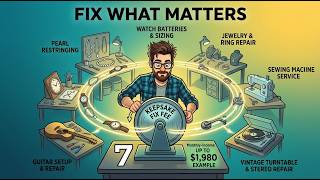
A broken pearl necklace pays five dollars an inch to restring, and in a lot of towns the person who used to fix watches and pearls has retired. Nobody took over the bench. Most people assume a repair business needs a storefront and a big loan, but these boring business ideas need one spare room and one short course. This guide walks through seven bench repairs, each with its course, its cost, and what a repair pays, using real shops' published prices.
This article is for educational purposes only and is not financial advice. Every price below comes from a real shop's price list, but prices and course offerings change, and home businesses, small torches and repair work can have local rules, so check your city's rules before you start. All income figures are examples, not promises.
Key Takeaways
- Seven bench repairs (pearl restringing, watch batteries, jewelry repair, sewing machines, turntables and stereos, clocks, guitar setups) can run from one spare room.
- Each starts with a short course, from an eight hour pearl and bead stringing class at $200 up to a seven day guitar course at about $2,100.
- The shared idea is the Keepsake Fix Fee: people pay to fix things they can't replace, and the price is set by the memory, not the object.
- Example month-twelve income ranges from about $1,080 (jewelry repair) to about $1,980 (turntables and stereos) per repair type.
- One setback to learn from: tiny pearls under five millimeters take nearly twice as long to knot, so measure before you quote.
The Keepsake Fix Fee: Why Boring Repairs Pay
Meet Harry, who runs dispatch at a busy heating and cooling company. All day he hears the same thing: people will pay almost anything to fix something they can't replace. Then his mom's pearl necklace snapped, and the jeweler said they'd have to send it out. Harry wondered who was on the other end of that envelope.
That is the Keepsake Fix Fee. A grandmother's pearls, a dad's watch, a turntable that played every record in the house: customers are paying for the memory, not the object. People will often pay more to fix a thing they can't replace than it would cost new, because for them there is no new. Matthew B. Crawford makes a related point in Shop Class as Soulcraft: fixing a real broken thing takes real thinking, and real thinking is worth paying for.
If you like this style of low-cost, skill-based income, see our guide to 6 boring businesses that make money under $500 to start.
1. Pearl and Bead Necklace Restringing
This is the easiest of the seven. All Strung Out, a restringing shop that takes strands by mail, charges $5 an inch for knotted work and $3.50 an inch for unknotted, with a $15 minimum. An 18 inch strand at $5 an inch is $90, and a 16 inch Akoya strand takes about 60 to 90 minutes. Repair Jewelry Solutions puts the going rate at $3 to $10 an inch, so $5 sits in the middle.
The work: take the strand apart, thread it on new silk, and tie a tiny knot between every pearl, so that if it breaks again only one pearl falls. You need a desk, a good lamp and a bead board.
Course and tools
Studio Jewelers in New York runs a Pearl and Bead Stringing class: eight hours over four sessions, in person, no experience needed, $200 with materials included. Esslinger sells a professional pearl and bead stringing kit for about $100 (silk, needles, knotting tool, bead board, tweezers, pliers, cutters and cement). The whole start is around $300, and you can practice on thrift store strands first.
Sue Runyon Designs in Layton, Utah works from a home studio and lists $56 to restring a 16 to 18 inch strand of 6 to 8 millimeter pearls, and $42 for a bracelet.
Finding customers and income
Restring five strands for friends and family, photograph each, set up a free Google Business Profile, then walk into nearby jewelry stores. There are more than 16,000 jewelry retailers across the country, and All Strung Out even offers wholesale accounts to jewelers who would rather send the work out.
Example year: month one, about five strands; month six, eight to ten paid strands; month twelve, fifteen strands at about $90 is around $1,350 a month. Add a silk fee, as HerMJ does at $5 to $20, and it is closer to $1,440. Price by the inch, not the necklace: a 16 inch strand at $5 an inch is $80 for roughly an hour, and the price explains itself. No license was found for restringing itself, but check your city's rules on home businesses.
2. Watch Batteries, Straps and Bracelet Sizing
Watch Technicians, a four location shop in Saint Louis, lists watch batteries from $19.99, and the swap takes about 15 minutes. Band adjustments run $20 to $25, and a strap or bracelet replacement runs $25 to $150 and up. Dupe Watch puts a strap replacement at $20 to $50 and up.
AWCI, the American Watchmakers Clockmakers Institute, ran a one day class called Making Money with Watch Bands and Batteries: eight hours, hands on, $595, with a tool kit and batteries. Class lists change, so check what is offered today. Esslinger's deluxe watch repair tool set is about $90, a case closer kit about $60, and name brand batteries can cost under a dollar each when bought in lots of 100 or more.
Example income: forty batteries a month at about $20 is around $800, plus twenty band sizings at about $22.50 adds $450. Month twelve is roughly $1,250 a month, from one corner of the same desk you set up for pearls.
3. Jewelry Repair and Ring Sizing
Expert Jewelry Repair and Design in Appleton, Wisconsin lists $60 to size a ladies' ring down, $70 to size it up one size, and $20 to solder a broken chain. Kambourians in Richmond, Virginia lists $75 to size a 14 karat gold ring down and $100 to size it up. Silver is $45 down and $70 up, and chain solders start at $75.
The course is one week. Midwest Jewelry Academy runs a Jewelry Repair course, Monday to Friday, nine to five, in person, for $1,650 with materials and tools included, and is enrolling for 2027 classes. Esslinger sells a small torch kit for about $180, a steel ring mandrel for about $30 and a ring stretcher for about $205. Call your insurance company about a small torch. Robin Sowers lists herself as a home based, part time bench jeweler in Petersburg, Virginia.
Example income at month twelve: twelve ring sizings at around $65 plus fifteen chain solders at $20 is about $1,080 a month.
4. Sewing Machine Servicing and Repair
QuiltMap puts a mechanical machine tune up at $75 to $150 and a computerized machine at $120 to $200. Retiming runs $100 to $200, and a motor or belt replacement $80 to $250. SewingTrip adds a $25 to $60 diagnostic and shop labor at $60 to $120 an hour.
The work is cleaning lint, oiling, adjusting tension and retiming the hook so needle and bobbin meet again. Many machines aren't dead, just dirty and out of time. Houston Sewing Repair in Houston, Texas has one technician, Edward: cleaning starts at $99, a full service with timing is $199, and the $50 diagnostic is credited toward the repair.
Learning it and what it costs
The Sewing Doc Academy runs a two day virtual bootcamp on modern machine service for around $700, shipping you a practice machine with a $250 refundable deposit. The Sewing Machines Institute sells a self paced digital correspondence course for about $700 and a starter antique machine course with a textbook for about $100. Its five day in person training in Temple, Texas runs about $4,000 with a tool kit. Parts are bought per repair and billed to the customer: a hook might be $20 to $80, a motor $40 to $150, a circuit board $150 to $400.
Your first customers are quilters: visit a guild meeting, leave cards at fabric stores, offer pickup and delivery. Example month twelve: fifteen tune ups at about $110 plus five diagnostics at $25 is about $1,775 a month. Charge the diagnostic and then credit it, as Edward does.
A Setback: The Small Pearl Quoting Mistake
Harry's first month went well until one strand of tiny pearls, smaller than five millimeters. He quoted his normal per inch rate, but the knotting took close to twice as long, and he lost money on his best looking order. The fix: measure the pearl before you quote. Pearl and Clasp charges $4 an inch and adds $10 per 18 inch strand for pearls under five millimeters. Harry copied that rule onto his price card and the loss never came back.
5. Vintage Turntable and Stereo Repair
StereoWorth puts a turntable belt replacement at $40 to $80 (about a 15 minute task), a full turntable service at $100 to $200, recapping a 1970s receiver at $300 to $600, and a diagnostic at $50 to $100. Austin Stereo puts a full vintage amp or receiver restoration at about $500 to $1,000 and up. Belts cost about $10 to $25 and a service kit $20 to $60.
This is the one slot without a famous short course. The closest structured path is Penn Foster's online Electronics Technician diploma, about $840 over seven to ten months. Many learn the way Ralph Larsen did: a Milwaukee news site profiled his shop, Cranky Uncle Trotsky's Vintage Stereo Repair, in 2010, noting he fixed stereos at his apartment kitchen table. A hot air rework station with soldering iron is about $90, and an oscilloscope with multimeter about $200.
Example month twelve: ten services at $150 plus eight belt swaps at $60 is about $1,980 a month.
6. Clock Repair
John Bockelmann of Bocks Clocks in Roscoe, New York lists a time only wall or shelf clock overhaul at $75 to $100, time and strike at $150 to $200, and a full chiming clock at $175 to $250. A small anniversary clock cleaning is $75. Clockworks in Huntington, Massachusetts lists $200 to clean, oil and test.
The NAWCC (National Association of Watch and Clock Collectors) runs a four day workshop, Basic Time and Strike, The American Kitchen Clock, plus a two day schoolhouse clock course and online School of Horology videos. No posted price was found, so check their site. A bushing tool runs around $230 and needs a drill press; a spring winder is around $278; a gallon of cleaner around $65. Time After Time Antique Clock Repair in Makawao, Hawaii says its workshop is home based, and Clockman Clock Repair lists its NAWCC certificates on the page. The NAWCC has nearly ten thousand members worldwide.
Example month twelve: eight time and strike overhauls at around $175 is $1,400 a month, and clocks can sit on the bench for days so you can run several at once.
7. Guitar Setup and Repair
GuitarListings puts a standard setup at $60 to $100, $70 to $115 with new strings, $85 to $130 for a floating tremolo, and $90 to $140 for a twelve string, with big cities 20 to 40 percent higher. New York Guitar Repair lists a basic setup at $90. A setup means adjusting the neck, setting string height, filing the nut and setting intonation.
Carl Chalmers runs Chalmers Guitar Repair in Citrus Heights, California, home based and by appointment only: $85 for a hardtail electric, $90 with a tremolo, $80 for an acoustic or bass. The American School of Lutherie in Portland, Oregon runs a seven day hands on course in setup, fret work and basic repair for about $2,100, tools provided. Southeast Guitar Repair Academy has an online program for about $3,000 that includes business training. A full lutherie school costs $15,000 to $20,000 plus about $1,000 in tools. A StewMac basic setup kit is about $127 on sale.
This is the biggest pond: about 2.4 million fretted instruments shipped in the United States in one recent year (NAMM, via Danville Music). Start on your own guitars, then friends, then music stores and teachers. Example month twelve: twenty setups at about $90 is around $1,800 a month. Post a price list like Carl does and quote anything bigger after inspection.
What Harry's Year Looked Like
Harry took the eight hour stringing class, paid for it from savings, and added a watch tool kit later. By month twelve, as an example: fourteen strands at about $90, forty five batteries at about $20, and twenty five band sizings at about $23, roughly $2,735 a month from one spare room and one short course.
For comparison with other low-cost paths, see 5 high-paying trades most grads ignore.
Three Filters for Picking Your Bench
- What's broken in your own drawer? That is free practice stock.
- Which course can you reach? A drive, a weekend, or an online class you can pay for from savings.
- Who in town already sends this work out? Jewelers, quilt shops and music stores already have work waiting.
Your free task for the next 24 hours: count the broken things in your jewelry drawer or hall closet, then call one local jeweler and ask who restrings their pearls and what they charge per inch.
Watch the Video
Want the visual walkthrough, including each course card? Watch the full breakdown on YouTube: 7 Boring Businesses That Fit in One Spare Room. Then drop a number, one through seven, in the comments to say which one you would start.
Frequently Asked Questions
See the FAQ section below for quick answers to common questions about starting a repair business from home.