- Key Takeaways
- The Three-Engine Framework for Monthly Dividend Income
- Engine One — SCHG: Why the Growth Fund Belongs in an Income Plan
- Engine Two — DGRW: The Monthly Raiser
- Engine Three — DIVO: The Income Engine and the Tax Catch
- The Honest Capital Math: How Much Do You Actually Need?
- The High-Yield Shortcut and the Trap Door Underneath It
- What DGRW's 6% Annual Raise Does Over Ten Years
- Watch the Full Breakdown on YouTube
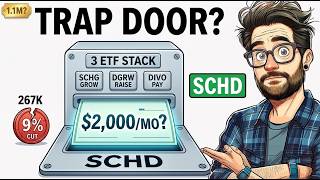
Two thousand dollars a month in passive dividend income is a number that appears in financial planning spreadsheets, retirement scenarios, and late-night calculations across the internet. But the question that rarely gets an honest answer is this: how much capital does it actually take, and which funds are worth trusting to do the work? This breakdown examines a specific three-ETF portfolio built around SCHG, DGRW, and DIVO — with SCHD anchoring the foundation — runs the real math on the capital required, and explains exactly why the high-yield shortcut most investors reach for first contains a trap door worth understanding before it closes.
Key Takeaways
- SCHG pays almost nothing today (~0.33% yield) but has historically grown at ~16% per year — it builds the investment base, not today's check.
- DGRW distributes income every single month and has raised its payout at roughly 6% per year, compounding income over time on the same shares.
- DIVO yields approximately 4.6% monthly via covered-call income, but a significant portion of that income is taxed as ordinary income — holding it in an IRA eliminates the tax drag.
- At a blended yield of ~2.2%, generating $2,000 per month requires approximately $1.1 million in invested capital.
- A 9% high-yield product needs only ~$267,000 for the same check, but a single cut to 6% costs $667/month overnight and requires $133,000 more capital to recover.
- A $100,000 DGRW position grows from ~$117/month to ~$209/month over ten years at 6% annual raises — without adding another dollar.
The Three-Engine Framework for Monthly Dividend Income
The instinct for most investors entering dividend income planning is to sort funds by yield and buy the highest number available. That approach works until it does not, and the reason it eventually breaks is that yield is only half of the income equation. The other half is the size of the invested base that yield is paid on.
The three-engine framework treats each fund in the portfolio as having a distinct job. One grows the pile. One raises the check at a reliable annual rate. One pays the highest current income. And SCHD — with over fourteen consecutive years of dividend growth and no cuts in its entire history — holds the floor beneath all three engines, providing stability when market conditions make everything else uncertain. Think of it as the spine that does not flinch.
Engine One — SCHG: Why the Growth Fund Belongs in an Income Plan
SCHG carries a dividend yield of roughly 0.33%. On a $100,000 position, that produces barely $30 per month. On the surface, it looks entirely out of place in a portfolio designed to generate $2,000 a month in dividends.
The logic becomes clear when the income equation is written out in full: monthly income = yield × total invested capital. Most investors optimize the yield side and treat the invested amount as a fixed constraint. SCHG works on the other side. With an average annual return near 16% over the past five years and an expense ratio of just 0.04%, SCHG compounds the investment base at a rate that meaningfully expands the pile the rest of the portfolio's yield is applied to.
A higher-yield fund applied to a larger base will eventually produce more income than the same yield applied to a stagnant one. SCHG is not a paycheck today — it is a paycheck multiplier over time. That distinction separates investors who find their income growing five years from now from those who find it flat. For a closer look at how SCHG pairs with SCHD in a core portfolio structure, the SCHD and SCHG 70/30 core satellite strategy breakdown covers the mechanics in detail.
Engine Two — DGRW: The Monthly Raiser
DGRW's current yield sits around 1.4%. Nothing dramatic. But two features make it a meaningful piece of a long-horizon income plan.
First, it distributes dividends every single month — not quarterly, which is standard for most equity ETFs. For investors building toward a specific monthly income target, monthly distributions reduce the timing friction of managing cash flow across the year.
Second, DGRW has raised its payout at approximately 6% per year. That figure looks modest in isolation. Compounded over a decade on the same invested capital, the effect on income is substantial — the specific numbers are worked through below. DGRW holds companies selected for dividend growth potential: businesses with the balance sheet strength and earnings consistency to sustain and increase dividends even during market pressure. It is not trying to win the yield comparison today. It is built to pay meaningfully more relative to its original cost a decade from now.
Engine Three — DIVO: The Income Engine and the Tax Catch
DIVO holds a concentrated basket of blue-chip equities — companies such as Visa, UnitedHealth Group, and Home Depot — and sells covered call options on roughly 25% of the portfolio at any given time. The premium collected from those options pushes DIVO's yield to approximately 4.6%, paid monthly. That is the highest current income of the three engines and the fund most investors would instinctively lead with.
The honest catch: a significant portion of covered-call income is classified as ordinary income by the IRS rather than as qualified dividends. In a taxable brokerage account, that means the effective after-tax yield is meaningfully lower than the 4.6% headline figure. The practical fix is holding DIVO inside a tax-advantaged account — a traditional IRA or a Roth IRA — where the distinction between ordinary income and qualified dividends becomes irrelevant.
There is also a structural trade-off embedded in DIVO's covered-call strategy. Selling call options on a portion of the portfolio means surrendering some upside in exchange for income today. In a strong bull market, DIVO will lag pure equity funds because it has sold the right to a portion of those gains. For an investor whose primary objective is monthly cash flow, this is often a reasonable exchange. For an investor whose objective is maximum long-term growth, DIVO would be the wrong tool. The 4-ETF dividend ladder breakdown covering DIVO alongside VIG, DGRO, and SCHD examines how it fits into a broader laddered income structure.
The Honest Capital Math: How Much Do You Actually Need?
A portfolio blending SCHG, DGRW, and DIVO — weighted toward the income side while retaining meaningful growth exposure — produces a blended yield of approximately 2.2%. That figure is deliberately conservative because two of the three engines prioritize growth and dividend growth over current yield.
The capital calculation at a 2.2% blended yield is straightforward:
$24,000 per year (the annual equivalent of $2,000/month) ÷ 0.022 = approximately $1,090,909 — or roughly $1.1 million.
That is an uncomfortable number. It is also an honest one, and honest numbers are more useful than optimistic projections when designing a plan that needs to hold up through real market cycles. It is worth sitting with that figure before examining what appears to be a much easier path.
The High-Yield Shortcut and the Trap Door Underneath It
A generic high-yield product paying 9% makes the capital math look dramatically different. At 9%, generating $2,000 per month requires approximately $267,000 — less than one-quarter of the capital the three-engine build needs. The gap between the two approaches is over $800,000. If today's check size is the only variable that matters, the shortcut wins decisively.
The trap door opens when the payout gets cut.
High-yield products paying 9% are historically among the most vulnerable to distribution reductions when markets become volatile or the options premiums and income strategies that fund them compress. A cut from 9% to 6% on a $267,000 position reduces the monthly check from $2,000 to approximately $1,333 — a recurring loss of $667 per month for as long as the reduced yield persists.
Recovering to $2,000 per month at the new 6% yield requires approximately $400,000 in capital. The investor now needs to find an additional $133,000 just to return to the income level they started at.
The compounding problem is that payout cuts rarely arrive alone. The same market conditions that pressure high-yield fund distributions frequently depress share prices simultaneously. The investor loses monthly income and watches the principal that income is paid from shrink in the same period — a two-front erosion that is difficult to recover from without significant additional capital.
The shortcut never tells you the trap door is there until you are already falling through it.
What DGRW's 6% Annual Raise Does Over Ten Years
The DGRW compounding example is worth working through with specific numbers because the result runs counter to how most investors intuitively think about yield.
A $100,000 investment in DGRW at a 1.4% yield generates approximately $117 per month on day one. Not compelling on its own. At a 6% annual raise compounding for ten years on the same shares — with no additional capital invested — that same position pays approximately $209 per month by year ten. The monthly check has grown by nearly 80% without a single additional dollar entering the account.
Scaled to a $500,000 position: the starting monthly income of roughly $583 grows to approximately $1,045 per month over the same decade on the same capital.
This is the fundamental behavioral difference between the two approaches. The high-yield shortcut starts at maximum income and erodes. The three-engine build starts at a modest income level and grows. One trajectory works for an investor with a decade or more of runway. The other requires finding replacement income as yields are cut or principal declines — precisely the wrong time to be looking for it.
Matching the Right Tilt to Your Situation
The appropriate weighting among the three engines depends on time horizon and income urgency. Investors who need maximum monthly income immediately should tilt more heavily toward DIVO and accept a lower long-term growth ceiling. Investors building toward a future income target with a decade or more of runway should tilt toward SCHG and DGRW, accepting a smaller check today in exchange for a substantially larger one later.
Neither weighting is universally correct. The error is adopting one approach without understanding what the other is trading away — and then being surprised when the math does not develop as expected. The fund that pays you almost nothing today may be the one that pays you the most ten years from now. That is the whole game.
Watch the Full Breakdown on YouTube
For a complete visual walkthrough of the three-engine portfolio — including how the blended yield calculation works, a side-by-side comparison of the high-yield shortcut, and what the capital requirements look like at various monthly income targets — watch the full video on YouTube. The video covers each fund's role in the portfolio and walks through the DGRW compounding math step by step.
This article is for educational purposes only and does not constitute financial advice. Always conduct your own research and consult a qualified financial professional before making investment decisions. Past performance does not guarantee future results.