- Key Takeaways
- The Lie That Keeps Small Operators Stuck
- Move 1: Walk Into Your Worst Competitor and Extract One Thing
- Move 2: Never Stop Measuring, Especially After You Start Winning
- Move 3: Copy the Proven Product and Ship It Better
- The Number That Proves Fast Followers Win
- Running the Steal-and-Ship Loop on Your Own Street
- Watch the Full Breakdown on YouTube
A funded competitor just opened across the street with ten times your budget. The instinct is to dream up something brilliant — a loyalty app nobody has seen, a gimmick so clever it can't be copied. That instinct is the real problem. The two most dominant companies of the last hundred years, Walmart and Microsoft, built their empires almost entirely on copying. Sam Walton and Bill Gates didn't out-invent anyone. They out-copied them, and shipped faster. That discipline has a name: the Steal-and-Ship Loop. Here is exactly how it works — and how any small operator can run it on the competitor keeping them up at night.
Key Takeaways
- Sam Walton openly credited copying competitors as the foundation of Walmart's growth: "most everything I've done I've copied from somebody else" — his words, from his own autobiography.
- Microsoft built its empire on bought and borrowed ideas: MS-DOS was purchased for around $75,000 and licensed to IBM; Word and Excel both entered markets that other companies already owned.
- Research cited in Forbes found that only about 11% of first movers — original inventors — stay on top long term. Roughly eight out of nine are eventually passed by a faster copier.
- The Steal-and-Ship Loop runs four steps: watch, extract one proven thing, ship a better version, then watch again.
- In 2025, Walmart became the first retailer to reach a $1 trillion market cap — built on "boring but reliable" copying and cost discipline, not original invention, according to Warwick Business School.
- You don't need to beat the whole competitor. You need to out-execute them on a short list of proven moves you copied and improved.
The Lie That Keeps Small Operators Stuck
The most dangerous idea in small business is this: to beat someone bigger, you need to be a genius. You need to sit alone until lightning strikes and you pull a brand-new idea out of thin air. That belief has frozen more good operators than any competitor ever did. It keeps business owners waiting for inspiration while the person across the street just keeps shipping.
The evidence points firmly in the opposite direction. Sam Walton, founder of the biggest retail chain in history, opened his autobiography Made in America by writing that most everything he had done he had copied from somebody else. He even credited Harry Cunningham of Kmart — the very competitor everyone assumed he wanted to destroy — for showing him what a discount store could be. The man who built Walmart wasn't shy about being a copier. He was proud of it. That is the starting point for understanding why the original-idea myth is the real reason most small operators stay stuck.
Move 1: Walk Into Your Worst Competitor and Extract One Thing
The Walton approach starts in the most counterintuitive place imaginable: the worst competitor you have. Not the best. The worst. Even a failing business is doing one thing brilliantly — and that one thing is sitting there for free.
One of the most repeated stories in Walmart's history illustrates this perfectly. Walton walked out of a competitor's store with his own managers. The place was a disaster — disorganized, badly run, a mess by every operational measure. His managers started laughing about how terrible it was. Walton stopped them. Yes, the store was a mess. But did anyone see the candle display? The candle display was perfect. While everyone else was busy feeling superior, Walton had already studied the one excellent idea and was halfway home to copy it.
That is the whole discipline in one picture. He didn't visit competitors to feel better about himself. He visited to extract. One excellent thing from each store, even the worst store on its worst day. Walton claimed no human being had ever walked through more competitors' stores than he had — and no human ever would.
The reframe that makes this feel immediately right: you are not photocopying their business. You are extracting the one principle they proved works and shipping your own version, better. The candle display wasn't a copyright. It was a lesson. Walton took the lesson, not the candles. For any small operator, this changes the entire relationship with a bigger rival. Every dollar that larger company spends testing a new layout, a new loyalty program, a new process is research the small operator gets for free. They run the experiments. You read the results and copy what works. The bigger they are, the more they are teaching you.
Move 2: Never Stop Measuring, Especially After You Start Winning
The natural assumption is that the watching stops once you are ahead. Walton proved the opposite. The richer he got, the harder he looked — and the proof is one of the best business stories ever told.
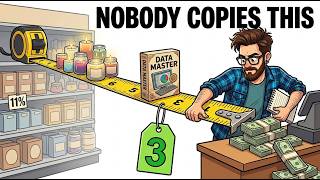
By the early 1980s, Sam Walton was one of the richest men in the world and ran the largest retailer in the United States. He had won by every measure that mattered. Most executives at that point hire consultants and stare at spreadsheets. Walton flew to Brazil to study local stores in person. When he reached one competitor's shop, he didn't wait for a formal meeting. He got down on his hands and knees on the floor with a tape measure and started measuring the width of the aisles.
The staff had no idea who he was. They called the police. Sam Walton — billionaire, founder of Walmart — was arrested and hauled away while his Brazilian hosts rushed to bail him out. When asked what on earth he was doing, his answer was completely sincere: he was measuring the aisles to find out whether these Brazilians knew something about running a store that he didn't already know. No ego. No sense of having already won. Just a relentless certainty that somewhere, someone had solved a problem he hadn't — and his only job was to find it and ship it faster than they could.
The results are on the record. Walton grew Walmart from 153 stores in 1975 to nearly 2,000 by the time he died in 1992. Revenue went from roughly $1 billion to nearly $44 billion — a 44-times jump in 17 years. All of it built on found ideas, shipped faster than the people who first invented them. The habit that drove that growth was permanent competitor-watching, not a single moment of inspiration.
Move 3: Copy the Proven Product and Ship It Better
If copying still sounds like the lazy operator's game, Microsoft's history dismantles that idea permanently. In the early 1980s, IBM came to Microsoft needing software to run the first IBM personal computer. Microsoft didn't have an operating system. Bill Gates didn't lock himself in a room to invent one. He went and bought one.
Microsoft paid Seattle Computer Products a license fee and then purchased the full rights for a total of around $75,000. They renamed the product, licensed it to IBM, and kept the right to sell it to every other computer maker on earth. CBS News once called it the best tech deal ever made. That one bought-and-shipped product helped make Microsoft a billion-dollar company by the early 1990s.
The operating system was just the start. Microsoft Word came after WordPerfect already owned word processing. Excel came after Lotus 1-2-3 owned spreadsheets. Windows itself was famously inspired by the graphical interface of the Macintosh. Almost nothing that made Microsoft a giant was invented inside the building. What made the difference was execution quality — copying did not mean copying badly. It meant shipping the better version.
Excel didn't just imitate Lotus. Microsoft took it to the Macintosh first, won around 90% of that market, then came back to the PC and, by one count, won or tied 28 of 38 head-to-head reviews against Lotus 1-2-3. WordPerfect went from owning roughly 80% of word processing to nearly zero. Microsoft didn't out-imagine anyone. It out-executed everyone.
One practical note on the legal boundary: you copy the principle, not the property. You don't take a competitor's logo, brand name, or exact proprietary wording — those are protected, and a few minutes of checking keeps you completely clear. But the idea of a faster checkout process, a loyalty program structure, or a service sequence that demonstrably works — nobody owns those principles. They are yours to take and improve.
The Number That Proves Fast Followers Win
Here is the single data point that reframes the entire debate. Research cited in Forbes found that only about 11% of first movers — the original inventors — stay on top long term. Out of every nine companies that get somewhere first, roughly eight are eventually passed by someone who copied them and executed better. The inventor takes the risk and usually does not keep the prize. The fast follower wins far more often than the original genius with the brand-new idea.
In 2025, Walmart became the first retailer ever to reach a $1 trillion market valuation. Professor Christian Stadler at Warwick Business School studied how they did it and concluded their strategy was "boring but reliable." One trillion dollars — built on copying, cost discipline, and out-executing. Not one original invention required.
The pattern repeats across industries and decades. Canva launched in 2013 as a stripped-down version of what Adobe already did — simpler, browser-based, and built for people who weren't professional designers. Adobe had spent decades building tools for professionals. Canva copied the core result, removed the learning curve, and shipped it to everyone Adobe had ignored. By 2023, Canva had over 135 million users and a valuation of around $26 billion. They didn't invent design software. They copied it, stripped the friction, and out-executed.
Google ran the same play. A company called Overture proved that selling small ads next to search results could work. Google watched, copied the model, and shipped a cleaner version roughly two years later. Today almost nobody remembers Overture. The smart copier wins because they let the first mover spend the money proving the idea, skip the dead ends, and arrive with a tighter version aimed at the customer the inventor forgot. Lower cost. Proven demand. Better execution. That is the quiet edge — and it is available to any operator on any street.
Running the Steal-and-Ship Loop on Your Own Street
The loop runs in four steps, and it never fully ends.
Watch — the way Walton watched, even after you're winning. Walk competitors' stores, study their websites, stand in their lines. The watching is a permanent operating discipline, not a one-time audit.
Extract one thing — the candle display, not the whole store. Find the single thing they do better than you and write it down in one sentence. Not ten things. One.
Ship a better version — the way Microsoft shipped a cleaner Excel. Take the underlying principle and execute it better than the originator can defend.
Go back and watch again — around and around, with no lightning bolt required at any step.
There are roughly 30 million small businesses in the United States. You are not trying to beat all of them. You don't even need to beat the entire chain across the street — only out-execute one competitor on a short list of proven moves you copied and improved. Whether you run a local service business like junk removal or any of the other boring businesses that generate real money, the Steal-and-Ship Loop applies the same way: one competitor, a short list of proven moves, shipped better. That is the Walton way, the Gates way, the Canva way — scaled to your corner.
Watch the Full Breakdown on YouTube
For a visual walkthrough of the complete Steal-and-Ship Loop — including the Sam Walton Brazil arrest story and the full Microsoft operating system deal broken down step by step — watch the video on YouTube. Every move is illustrated with real business examples to make the framework easy to apply to your own situation this week.