Four hundred thousand dollars sounds like a retirement milestone. But the moment you run the actual math on what that portfolio pays in monthly dividend income, the picture becomes more complicated. At a sensible blended yield, $400,000 generates roughly $1,333 per month in dividend income — not a fortune, but not nothing either. Whether that number carries you through a 30-year retirement starting at age 60 depends on three decisions most people never think through before they stop working.
Key Takeaways
- A $400,000 dividend portfolio at a 4% blended yield pays approximately $1,333 per month without touching principal.
- Retiring at 60 creates a two-year window with no Social Security — a gap that derails more retirement plans than market crashes.
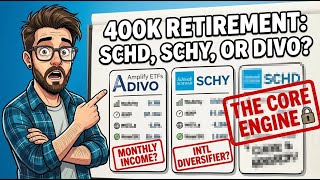
- A three-fund structure of DIVO (monthly income), SCHY (international balance), and SCHD (dividend growth) blends to roughly 4%, with built-in income growth.
- Adding an early Social Security claim at 62 (~$1,500/month) brings total income to approximately $2,800 per month, or about $34,000 per year.
- Dividend growth — not starting yield — is the variable that decides whether a portfolio lasts 30 years or runs dry at 75.
- Keeping one to two years of expenses in cash protects against forced share sales during downturns, the central risk of early retirement.
What $400,000 Actually Pays in Monthly Dividend Income
The most common mistake early retirees make is assuming a large lump sum automatically produces large income. A portfolio with a blended dividend yield of 4% — achievable through a disciplined mix of income-focused and growth-oriented ETFs — generates $16,000 per year on a $400,000 base. Divided across twelve months, that is $1,333 per month in pure dividend income, without selling a single share of the underlying funds.
For context: $300,000 at the same yield produces roughly $1,000 per month, and $500,000 produces about $1,667. Four hundred thousand sits squarely in the middle — meaningful income, but not enough on its own to cover the average American retiree's monthly expenses without a deliberate plan for the shortfalls.
$400,000 at a 4% blended dividend yield = $1,333/month in passive income before any principal withdrawal.
The Floor and Growth Test: A Three-Layer Retirement Framework
Rather than chasing the highest possible starting yield, a more durable approach applies a three-layer test to any dividend retirement plan. Layer 1 establishes the income floor — what the portfolio actually pays on the day retirement begins. Layer 2 addresses the bridge — the gap between retirement and other income sources like Social Security. Layer 3 measures growth — whether income rises faster than inflation over the decades ahead. All three layers must hold for a dividend-funded retirement to sustain itself over 30 years.
Layer 1: Building the Income Floor with DIVO, SCHY, and SCHD
A three-fund structure covers three distinct jobs that no single dividend ETF can handle alone.
DIVO is an enhanced dividend income fund that holds large, established dividend-paying companies and writes covered calls on top of those positions to generate additional cash flow. The strategy has historically produced a yield in the mid-4% range, paid out monthly — an unusual feature at this quality tier. The covered call premium is taxed primarily as ordinary income rather than at the lower qualified dividend rate, which makes DIVO most efficient inside a tax-advantaged account such as an IRA. It functions best as a monthly income booster rather than the sole holding in a retirement portfolio.
SCHY provides international dividend exposure that most American retirement portfolios lack entirely. The fund holds dividend-paying companies domiciled outside the United States, charges an expense ratio of approximately 0.08%, and has historically yielded in the mid-3% range. The case for SCHY is not purely yield — it is diversification of timing. International dividends and domestic dividends do not move in lockstep, meaning a difficult decade in one market can be partially offset by strength elsewhere. For a retiree who cannot afford a lost decade precisely when withdrawals begin, that geographic balance carries significant long-term value.
SCHD serves as the core holding that anchors the entire structure. Launched in 2011, the fund charges a minimal expense ratio and currently yields approximately 3.5%. The most important characteristic of SCHD is not its starting yield — it is its dividend growth rate. SCHD has historically grown its dividend at a near double-digit annual pace since inception, positioning it as the engine that lifts portfolio income over time rather than the fund that pays the most on day one. For a closer look at how SCHD compares on long-term dividend growth metrics, DGRO vs SCHD: The Dividend Growth Stall Investors Need to See covers the data in full.
A portfolio that leans on DIVO for monthly cash flow, SCHY for geographic diversification, and SCHD as the growing foundation blends to a yield of approximately 4% — the basis for the $1,333 monthly income floor on a $400,000 base.
Layer 2: The Two-Year Social Security Gap
Retiring at 60 creates a problem that most retirement projections quietly skip. Social Security cannot be claimed until age 62, which means a retiree who leaves work at 60 faces two full years of living on dividend income alone. On $1,333 per month — roughly $16,000 per year — that stretch demands disciplined spending and a concrete plan for unexpected expenses. It is also the window where even a modest market decline can tempt an investor into selling shares at depressed prices, permanently reducing the portfolio's income-generating capacity.
When age 62 arrives, the income picture improves substantially. The average Social Security benefit in 2026 runs a little over $2,000 per month at full retirement age. Claiming early at 62 reduces that figure — a typical worker might receive approximately $1,500 per month at the early claim date. Adding that to the $1,333 in monthly dividends brings the total to roughly $2,800 per month, or about $34,000 per year.
That combined income is meaningful — but the average American retiree household spends closer to $4,800 per month. At $2,800 per month, this plan funds a careful retirement, not an extravagant one, and works best alongside a paid-off home and disciplined spending habits. Modeling that gap before stopping work is precisely why running the numbers in advance matters. For strategies that extend the income bridge even further before Social Security begins, The Dividend Bridge: Retire 10 Years Before Social Security outlines how to sustain dividend income across a longer pre-Social Security runway.
Layer 3: Dividend Growth Is the Variable That Decides Everything
Year-one income rarely determines a retirement's long-term success. A high-yield fund that never raises its payout is, in real terms, a declining income stream — it pays the same nominal dollar amount every year while inflation steadily erodes purchasing power. A portfolio built around dividend growth behaves fundamentally differently.
If the underlying portfolio dividends compound at 6–7% annually — comfortably below the historical pace of SCHD's dividend growth — the $1,333 monthly floor in year one can potentially climb toward $2,000 per month within a decade, without contributing a single additional dollar. Over a 30-year retirement, that compounding lift progressively closes the spending gap that appears so daunting in year one. The income a portfolio pays in year ten is almost never what it paid in year one — and that trajectory, not the starting number, is what ultimately decides whether the money lasts.
The Four Percent Rule: Why You Cannot Double-Dip
A common misconception is that a 4% dividend yield and the classic 4% safe withdrawal rate can be stacked — withdrawing 8% of the portfolio's value per year in total. They cannot. The dividend yield and the withdrawal rate draw from the same pool of capital. Treating them as additive depletes the account rapidly and contradicts the logic underlying both frameworks.
The more accurate framing: dividend income already accounts for most of the safe withdrawal allowance. In a weak market year, living on dividends alone avoids selling any shares at depressed prices. In a strong year, a modest additional redemption may be reasonable. This flexibility is what makes a dividend-income structure distinct from a pure total-return approach — it directly reduces the probability of forced sales during market downturns, which is the core mechanism of sequence of returns risk.
Sequence of returns risk describes the disproportionate damage caused by poor market performance in the early years of retirement. A bad stretch of returns in years one through five — when withdrawals are already drawing down the portfolio — inflicts far more permanent harm than the same poor run twenty years into retirement. A portfolio that continues paying dividends through that stretch allows the retiree to live on income rather than liquidating positions, preserving the portfolio's capacity to recover. Keeping one to two years of living expenses in cash reinforces this buffer further, ensuring that no market drawdown ever forces a sale at the wrong price.
Watch the Full Breakdown on YouTube
The framework above covers the core math, but the full video walkthrough on Harry's Financial Fitness goes further — including a live look at the blended yield calculation, the Social Security bridge timeline, and the compounding income projection across a 30-year retirement horizon. Watch Is $400,000 Enough to Retire on Dividends at 60? on YouTube for the complete visual, step-by-step guide to every number in this analysis.
The Bottom Line
Whether $400,000 is enough to retire on dividends at 60 comes down to three variables: whether the two-year Social Security gap can be navigated without panic-selling shares, whether the portfolio holds enough dividend growth to stay ahead of inflation over time, and whether retirement spending can fit within a disciplined budget while the compounding raises accumulate.
Execute all three correctly and a $400,000 dividend retirement income portfolio can sustain a retiree for thirty years or more. Miss any one of them — chasing yield without growth, ignoring the Social Security bridge window, or underestimating monthly expenses — and the same $400,000 can run dry well before 75.
Four hundred thousand dollars is not a retirement finish line. It is a floor. A growing floor, bridged correctly and managed with patience, turns out to be enough far more often than the people insisting on a million-dollar minimum will ever admit.