- Key Takeaways
- How Required Minimum Distributions Are Calculated
- The Dividend Coverage Gap: Why Yield Alone Falls Short
- How the Forced-Sale Gap Grows With Age
- Four Strategies to Protect a Dividend Portfolio From Forced Sales
- RMDs Move Money Between Accounts, Not Out of the Market
- Watch the Full Video
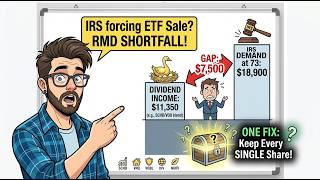
At age 73, a $500,000 traditional IRA generates an IRS bill of roughly $18,900 in a single year — the required minimum distribution. A portfolio blending SCHD and VOO at typical current yields throws off only about $11,350 in actual cash dividends on that same balance. The $7,550 gap gets closed the only way a custodian can close it: by selling shares of the exact funds built on the principle that the shares are the goose and the dividends are the eggs. The good news is every piece of this problem is fully predictable, and predictable problems have solutions you can build years in advance — including one that lets you keep every single share.
Key Takeaways
- RMDs are calculated on your entire IRA or 401(k) balance using the IRS Uniform Lifetime Table — not on dividends, gains, or available cash.
- At age 73, the divisor is 26.5, forcing a withdrawal of approximately 3.77% — well above what most dividend ETF blends yield in cash.
- An in-kind transfer lets you satisfy an RMD by moving shares to a taxable account rather than selling them — a critical tool in a declining market.
- Qualified charitable distributions (QCDs) let eligible donors send up to roughly $100,000 annually from an IRA to charity without the amount appearing in adjusted gross income.
- Roth conversions before age 73 are the single largest planning lever: Roth accounts carry no RMD requirement for the original owner.
- Delaying your first RMD to April 1 the following year can stack two full distributions into one tax year, potentially spiking income and raising Medicare premiums.
How Required Minimum Distributions Are Calculated
A required minimum distribution is not based on what a portfolio earns — it is based on what a portfolio is worth. Each year, the IRS takes the December 31 account balance of every traditional IRA and 401(k) you hold, divides it by an age-based factor from the Uniform Lifetime Table, and the result is the minimum that must be withdrawn — regardless of market conditions, dividend income, or available cash.
At age 73, the divisor is 26.5. On a $500,000 balance, the calculation is straightforward: $500,000 divided by 26.5 equals approximately $18,868, or 3.77% of the account. That withdrawal is taxed as ordinary income in the year it is taken. One important planning note: for investors born in 1960 or later, the SECURE 2.0 Act moves the RMD starting age to 75 beginning in 2033. The math is identical — the window simply opens later, which creates more time to apply the strategies below.
The Dividend Coverage Gap: Why Yield Alone Falls Short
The problem becomes concrete when real portfolio numbers meet the IRS requirement. A common dividend-focused allocation is 60% SCHD and 40% VOO. Based on current data, SCHD yields approximately 3.1% and VOO yields approximately 1.05%. Blended, the combined portfolio pays roughly 2.27% in cash — about $11,350 annually on a $500,000 balance.
The IRS requires 3.77%. Dividends cover only about 60% of the bill. The remaining $7,550 must come from somewhere, and if no cash reserve is standing by, the custodian sells shares to close the gap. For a portfolio of purely VOO, the situation is even starker: roughly $5,250 in dividends against an $18,868 demand means income covers barely a third of the obligation.
On a $500,000 IRA at age 73, a 60% SCHD / 40% VOO blend generates approximately $11,350 in dividends — leaving a $7,550 shortfall that must be funded from share sales unless a plan is in place.
If you hold dividend ETFs inside a traditional IRA, this shortfall is not a corner case — it is the default outcome. Building a diversified dividend ETF ladder can improve total yield, but even a well-constructed income portfolio rarely closes the entire gap against an age-73 RMD rate of 3.77%.
How the Forced-Sale Gap Grows With Age
The Uniform Lifetime Table divisor shrinks every year, which means the forced withdrawal percentage rises every year. On a static $500,000 illustration balance, the trajectory makes the direction unmistakable:
- Age 73 — divisor 26.5, withdrawal rate 3.77%, approximately $18,868
- Age 75 — divisor 24.6, withdrawal rate approximately 4.07%, approximately $20,325
- Age 80 — divisor 20.2, withdrawal rate approximately 4.95%, approximately $24,752
- Age 85 — divisor 16.0, withdrawal rate 6.25%, approximately $31,250
The forced-sale gap — the difference between what dividends cover and what the IRS requires — grows from roughly $7,550 at 73 to nearly $20,000 per year by age 85, even on a static balance. Real account balances move with markets, so treat these as directional illustrations rather than forecasts. What they show clearly is that waiting does not shrink this problem.
To make that gap tangible: at 73, covering the $7,550 shortfall on the blended SCHD-VOO portfolio translates to selling approximately 130 shares of SCHD and 4 shares of VOO in a single year — at whatever price the market happens to offer that week. Repeat that process for a decade and the compounding base shrinks noticeably while the dividend income stream is still being counted on.
Four Strategies to Protect a Dividend Portfolio From Forced Sales
Each strategy below targets a different part of the RMD problem. They are not mutually exclusive — the strongest defense combines several of them, ideally starting years before age 73.
1. The In-Kind Transfer: Move Shares, Not Cash
An RMD does not have to be settled in cash. A custodian can transfer actual shares — SCHD, VOO, or any other holding — from a traditional IRA directly into a taxable brokerage account. The fair market value of those shares on the transfer date counts as the distribution, and ordinary income tax is owed on that value exactly as it would be on a cash withdrawal.
What the in-kind transfer prevents is a forced sale in a declining market. If the RMD year coincides with a broad downturn, moving shares rather than selling them means the position stays intact. Those shares continue paying dividends in the taxable account and receive a fresh cost basis equal to their value on the transfer date — so future appreciation is measured from that point forward. This is not a tax dodge; it is a timing shield that keeps long-term investors from being forced to sell at a market low.
2. Qualified Charitable Distributions: Convert the Bill Into a Gift
For retirees who already give to charitable causes, the qualified charitable distribution (QCD) may be the most efficient RMD tool in the entire tax code. Once you reach age 70½, you can instruct your IRA custodian to send money directly to a qualified charity. That transfer counts toward your annual RMD without ever landing in your adjusted gross income — under current limits, up to approximately $100,000 per year.
The requirement is strict: the money must travel directly from custodian to charity. If it passes through a personal bank account first, it becomes a taxable withdrawal. For a retiree who was planning to give regardless, a QCD converts what would otherwise be a tax bill into a donation — and the shares that would have been sold to fund that gift stay exactly where they are, still paying dividends.
3. Roth Conversions Before 73: The Largest Lever
Roth IRA accounts carry no required minimum distributions for the original owner. Since the 2024 tax year, that exemption also applies to Roth 401(k) accounts, closing the prior rule that subjected those balances to RMD requirements. Every dollar converted from a traditional IRA to a Roth before age 73 is permanently removed from the Uniform Lifetime Table's reach.
The optimal window for conversions is typically the years between retirement and the first RMD — often the lowest marginal tax bracket period of a person's adult life, after earned income has stopped but before Social Security and RMDs establish a new income floor. A disciplined conversion plan fills a low bracket intentionally each year, paying tax at today's known rate rather than an unknown future one — ideally funded with cash from outside the IRA so the full converted amount keeps compounding.
One published case study modeled a $1.5 million IRA with a sustained conversion strategy. The projected first RMD fell from approximately $109,000 to about $11,000, with estimated lifetime tax savings of $380,000 to $400,000. Those outcomes depend entirely on growth assumptions, conversion-year brackets, and tax law that can change. A Roth conversion is prepaying tax, and prepaying only wins if the later rate would have been higher — a judgment for a tax professional with full visibility into your complete picture. The window is open now, and it narrows every year.
Investors building a multi-account retirement income strategy also benefit from Roth flexibility in high-income years — Roth withdrawals can fund spending without adding to taxable income at the exact moment when Social Security and RMDs are already pushing the bracket upward.
4. Avoid the First-Year Double-Up Trap
The IRS offers first-time RMD recipients a one-time delay: you may postpone the initial distribution until April 1 of the year following your 73rd birthday. For most investors, accepting that delay is a costly mistake. The second RMD is still due by December 31 of that same calendar year. Accepting the delay stacks two full distributions — approximately $37,700 combined on a $500,000 account — into a single tax year.
That concentration of ordinary income can push a retiree into a higher federal bracket and trigger the income-related monthly adjustment amount (IRMAA) surcharge on Medicare Part B and Part D premiums, which are determined using income from two years prior. For most situations, taking the first RMD in the calendar year you actually turn 73 keeps each year's income smaller and more predictable. Always review your specific income picture with a tax professional before deciding — but treat the April 1 option as a potential trap rather than a benefit.
RMDs Move Money Between Accounts, Not Out of the Market
A required minimum distribution forces cash out of a tax-deferred account. It does not force cash out of the market. For retirees who do not need the full distribution for current living expenses, the withdrawn funds can be immediately reinvested in a taxable brokerage account — purchasing the same dividend ETFs, or parking the near-term portion in a short-duration instrument such as SGOV, a treasury bill ETF currently yielding approximately 3.8%, so even waiting cash keeps earning.
The IRS controls which pocket the money sits in. The investor still controls what that money owns. Once that reframe settles, a required minimum distribution stops feeling like a forced retreat from a decades-long portfolio and starts feeling like a scheduled transfer between two personal accounts — with a tax bill whose size can be significantly reduced using the strategies above.
This article is educational and does not constitute financial or tax advice. RMD rules interact with state taxes, Social Security, Medicare surcharges, and individual bracket situations in ways that require professional analysis. Consult a qualified tax advisor or financial planner before implementing any strategy discussed here.
Watch the Full Video
For a complete visual walkthrough of every calculation in this article — including the Uniform Lifetime Table at each age, the share-count math behind a decade of dividend shortfalls, and a side-by-side comparison of all four strategies — watch the full breakdown on Harry's Financial Fitness. The visual format makes the escalating divisor and its cumulative impact on long-term portfolio size considerably easier to follow.