- Key Takeaways
- Why the 4% Rule Is the Starting Line, Not the Finish Line
- Building the Dividend Blend: SCHD, DGRO, and VYMI
- The Pot: What $50,000 in Annual Dividends Actually Requires
- The Raise: How Dividend Growth Closes the Income Gap
- The Keep: The Tax Window That Changes Everything at 60
- The Salary Switch: All Three Numbers Working Together
- Watch the Full Breakdown
At 60, the question is not whether you can live on dividends — it is whether you understand the right three numbers. The standard retirement rule of thumb says you need $1.25 million to replace a $50,000 salary, a figure derived from the classic 4% rule. For a dividend investor, however, the honest answer is both larger and smaller than that number simultaneously — and there is a tax window at 60 that most working Americans never discover until they have already stopped earning a paycheck.
Disclaimer: This article is for educational purposes only and does not constitute financial advice. Always conduct your own research before making investment decisions. Tax figures reflect 2026 federal brackets; state taxes vary and are not included in the federal calculations below.
Key Takeaways
- A SCHD, DGRO, and VYMI dividend blend at a blended yield of roughly 3.2% requires approximately $1.5M–$1.58M to generate $50,000 per year — more than the 4% rule's $1.25M, but without the risk of ever liquidating shares into a market downturn.
- SCHD has grown its dividend payout at roughly 11.8% annually over the past five years; modeled conservatively at 7% per year, dividend growth can carry a $1.25M portfolio from $40,000 to $50,000 in annual income within four to five years — without adding new capital.
- You do not need to reach the full target pot on the day you retire. Starting closer to the 4% rule amount and letting dividend growth close the gap is a legitimate and historically grounded path.
- A single filer at 60 can receive up to approximately $65,550 in qualified dividends in 2026 with zero federal income tax owed; a married couple filing jointly can receive up to approximately $131,100 at the same 0% rate.
- A $50,000 dividend income at the 0% federal rate outspends a $50,000 salary in practice, since the salary earner loses roughly $3,800 to payroll taxes before income tax is even applied.
Why the 4% Rule Is the Starting Line, Not the Finish Line
The 4% rule is one of the most cited frameworks in retirement planning. Multiply your target annual income by 25, and you arrive at your nest egg target. For $50,000 per year, that produces the well-known figure of $1.25 million. The rule works — for its intended purpose, which is describing how much capital you need if you plan to sell a portion of your portfolio each year to fund your lifestyle.
A dividend-first strategy operates on a fundamentally different foundation. Instead of slowly liquidating shares, you collect the cash those shares pay out on a quarterly basis and leave the principal untouched. The structural benefit is significant: a retiree who lives purely on dividend income cannot be forced to sell at a market bottom. Share prices may fall, but the income keeps arriving. The retiree waits for prices to recover rather than selling into the decline to fund living expenses — a distinction that eliminates the sequence-of-returns risk that ends early retirements prematurely.
This distinction changes the core calculation. The relevant question shifts from "how many shares can I afford to sell each year?" to "how large does the portfolio need to be so that the dividends alone cover $50,000 annually?" The answer depends entirely on yield — and selecting the right yield means selecting the right funds.
Building the Dividend Blend: SCHD, DGRO, and VYMI
Rather than chasing the highest available yield — a strategy that frequently ends with income cuts when companies cannot sustain outsized payouts — a more durable approach anchors on quality and dividend growth. The blend here uses three ETFs in specific proportions: roughly 60% in SCHD (Schwab U.S. Dividend Equity ETF), 25% in DGRO (iShares Core Dividend Growth ETF), and 15% in VYMI (Vanguard International High Dividend Yield ETF).
SCHD serves as the foundation. Its current yield sits around 3.3%, and its beta of approximately 0.67 means it has historically declined considerably less than the broad market during downturns. More important for income investors is its dividend growth track record: SCHD has raised its payout at roughly 11.8% per year over the past five years. That figure does not describe share price appreciation — it describes the actual cash distribution growing at nearly 12% annually. As explored in the detailed comparison of DGRO vs. SCHD, each of these funds plays a distinct role in a dividend portfolio, and understanding that difference is critical when building for retirement income.
DGRO currently yields closer to 2.4%, which appears modest on paper. The lower yield is intentional: DGRO screens for companies with long dividend-raising streaks and low payout ratios, meaning those companies retain more earnings to fund future increases. DGRO does not replace SCHD; it accelerates the overall portfolio's income growth by adding companies with substantial room to keep raising dividends over the coming years.
VYMI addresses current income. International dividend payers across Europe and Asia structurally distribute more of their earnings than their American counterparts, and VYMI's yield runs near 3.86%. The fund holds more than 1,500 companies across markets including Switzerland, the United Kingdom, and Japan, providing geographic diversification alongside elevated current income. One caveat: a portion of international dividends may be classified as non-qualified at tax time. For a retiree sitting in the zero percent federal bracket — covered in the section below — this distinction carries minimal practical impact.
Blending these three funds at the proportions above produces a combined yield of approximately 3.2% — conservative, defensible, and built for longevity rather than headline appeal.
The Pot: What $50,000 in Annual Dividends Actually Requires
With a 3.2% blended yield, the calculation is direct:
$50,000 ÷ 3.2% = approximately $1,562,500
Rounded to a practical range: roughly $1.5 million to $1.58 million. That is the full pot required to generate $50,000 per year on dividends alone, without selling a single share. It is more than the 4% rule's $1.25 million, and that gap deserves an honest explanation.
The larger number purchases one specific guarantee: the principal is never touched. During the 2022 market downturn, when the broad index fell roughly 19%, a portfolio anchored by low-volatility dividend funds held up considerably better — declining closer to the low teens. More importantly for income, SCHD actually raised its dividend payout while share prices were falling. The income check kept arriving, and kept growing, throughout the entire drawdown. An investor who never needed to sell shares simply collected growing dividends while waiting for prices to recover. Paying a higher entry price for that structural safety is a real trade-off — and it is one that buys meaningful protection against the risk that terminates early retirements.
That said, arriving at $1.56 million on the exact day you turn 60 is not a hard requirement. That is where the raise enters the picture.
The Raise: How Dividend Growth Closes the Income Gap
Consider an investor at 60 with $1.25 million — the 4% rule amount — invested in this SCHD-anchored blend. At a 3.2% yield, the portfolio generates roughly $40,000 in year one. That is $10,000 short of the $50,000 target. At this exact point, many investors conclude that retirement is still years away and return to earning a paycheck. That conclusion overlooks the raise.
If the blended dividend growth rate averages a conservative 7% per year — well below SCHD's historical 11.8% pace — the income trajectory builds as follows:
- Year 1: approximately $40,000
- Year 2: approximately $42,800
- Year 3: approximately $45,800
- Year 4–5: income crosses $50,000
No new contributions. No shares sold. Dividend growth does the heavy lifting on its own. If the blend grows closer to SCHD's historical rate rather than the cautious 7% estimate, the income could reach $50,000 in under three years. The portfolio does not need to be fully funded at retirement — it needs to be funded sufficiently for its own income growth to carry it to the target. This is the same dynamic that catches investors off guard at the compounding wall: the growth was always going to happen; what destroys returns is interrupting it by selling during a downturn.
A low-beta portfolio of dividend growers does not eliminate the temptation to sell during a market decline, but smaller drawdowns make it considerably easier to hold through volatility. Holding is precisely what allows the raise to function as intended.
The Keep: The Tax Window That Changes Everything at 60
The third number is where the strategy becomes genuinely compelling. A 60-year-old retiree living on qualified dividends occupies an unusual tax position — potentially the most favorable bracket of their entire financial life.
At 60, Social Security has not yet started if deferred, and required minimum distributions from retirement accounts do not begin until age 73. With income flowing primarily from qualified dividends, the 2026 federal tax treatment is as follows:
- A single filer receives a standard deduction of $16,100. Qualified dividends face a 0% federal rate on taxable income up to $49,450. Combined, a single 60-year-old can receive up to approximately $65,550 in qualified dividends with zero federal income tax owed.
- A married couple filing jointly receives a standard deduction of $32,200, with the 0% qualified dividend bracket running proportionally higher — allowing approximately $131,100 in qualified dividends at the 0% federal rate.
The $50,000 income target sits comfortably below the single filer ceiling of $65,550. That means fifty thousand dollars in dividends can arrive in the account with no federal income tax deducted — fifty thousand dollars gross becomes fifty thousand dollars kept.
Compare that to an employee earning a $50,000 salary. Before federal income tax, approximately $3,800 is removed for payroll taxes — the Social Security and Medicare contributions taken before the employee sees a single dollar of their pay. After federal income tax on the remainder, a typical worker at that income level takes home somewhere in the low $40,000s. The dividend retiree keeps the full $50,000. The salary earner keeps approximately $42,000–$43,000. The retiree with the nominally larger nest egg requirement ends up with the larger effective paycheck.
Two guardrails are worth stating directly. First, the 0% rate is federal only. Many states tax dividends as ordinary income, and a high-tax state could still remove several thousand dollars from the total. Know your state's treatment before building a retirement budget around the federal zero. Second, dividend growth is a historical track record, not a contractual promise. No ETF guarantees a future raise. Modeling the raise at a conservative 7% rather than SCHD's full historical pace is not pessimism — it is how you avoid treating past performance as a certainty and building a plan on an assumption that could break.
The Salary Switch: All Three Numbers Working Together
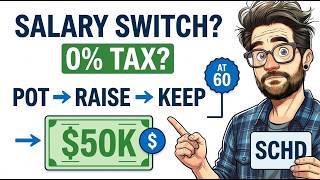
Assembled together, the pot, the raise, and the keep form a coherent framework for replacing earned income at 60 with dividend income. The full pot — roughly $1.5M to $1.58M in a SCHD, DGRO, and VYMI blend yielding approximately 3.2% — covers the income target from day one without touching principal. The raise — dividend growth running at even a conservative 7% annually — means an investor starting with $1.25M can realistically reach $50,000 in annual income within four to five years, without contributing additional capital and without selling a share. The keep — the 0% federal qualified dividend bracket for a 60-year-old with no paycheck and no required distributions — means that $50,000 arrives in the account whole, outperforming a matching salary in net spending power.
The headline number that stops most people from acting is not a wall. It is a destination, and dividend growth is the path that moves the income toward it year after year, without requiring another dollar of investment to do so. The pot establishes the foundation. The raise grows the income. The keep ensures that income is fully yours.
Watch the Full Breakdown
For a visual walkthrough of the salary switch — including how SCHD, DGRO, and VYMI are weighted in the blend, how the income table builds year by year at different growth rates, and where the tax savings appear on a real income comparison — watch the full video: How Much You Need at 60 to Replace a $50,000 Salary on the Harry's Financial Fitness YouTube channel. The follow-up video covers which accounts to draw from first to preserve the zero percent bracket for as long as possible.