- Key Takeaways
- Reinvesting Doesn't Defer Your Tax Bill
- The 33% vs. 85% Dividend Confusion
- Sequence Risk and the Cash Floor Nobody Can Prove
- The 1983 Social Security Threshold Nobody Indexed
- RMD Age Is 75, Not 73, for Anyone Born in 1960 or Later
- Fund Type Matters as Much as Account Type
- Running the Floor Arithmetic
- Finding Your Own Year
Eighteen years of automatic dividend reinvestment, never questioned once, started as a checkbox ticked in 2008 and quietly compounded in the background ever since. For most investors, that checkbox stays on indefinitely. But there is one specific point in a retirement timeline where leaving dividend reinvestment switched on stops being the smart default and starts being the expensive choice. Using a modelled 63-year-old with $450,000 split between a taxable brokerage account and a traditional IRA, this article works through the exact year that investor should flip the switch, and the twelve-step framework that produces that answer.
Key Takeaways
- Reinvesting dividends in a taxable account does not defer taxes; IRS Publication 550 confirms the dividend is taxable the moment it's paid, regardless of what you do with it.
- This is a cash-flow and sequence-of-returns decision, not a tax-timing decision, and the account type matters more than your age.
- Pfau and Kitces (2013) found that roughly 80% of retirement portfolio failure risk is concentrated in the first five years after retirement.
- Social Security's provisional-income thresholds have never been indexed for inflation since 1983, and qualified dividends count toward that calculation even when taxed at 0%.
- Under SECURE 2.0, the required minimum distribution age is 75, not 73, for anyone born in 1960 or later.
- For the modelled investor, the floor arithmetic lands the switch-off year at age 63 — four years before retirement, earlier than intuition suggests.
Reinvesting Doesn't Defer Your Tax Bill
Most people assume that turning off dividend reinvestment in a taxable account triggers a tax event, or that keeping it on somehow postpones one. Neither is true. The IRS is explicit in Publication 550: if dividends are used to purchase more shares at fair market value, they must still be reported as income in the year received. The dividend is taxed the moment it's paid, not when it's spent. Reinvesting and taking cash are taxed identically in a taxable brokerage account.
Inside a traditional IRA, the opposite rule applies just as absolutely. Dividends inside that account have no current tax consequence whether reinvested or not, because nothing is taxed until money leaves the account. That means there isn't one reinvestment decision — there are two, governed by entirely different logic depending on which account holds the fund.
The 33% vs. 85% Dividend Confusion
Two commonly cited statistics about dividends appear to contradict each other, but they're measuring different things entirely. Hartford Funds puts dividends' share of the market's annual total return at about 33% across 1940–2025; S&P Global puts a similar figure at roughly 31% across an even longer window. Both describe dividends' income share of a typical year's return.
The oft-repeated 85% figure measures something else: the gap in ending wealth between reinvesting and not reinvesting over decades, driven by compounding rather than annual income share. Dividends supply roughly a third of the market's return in a given year, but because reinvested dividends buy shares that pay their own dividends, the decision to reinvest versus spend changes ending wealth by a multiple far larger than a third. That compounding gap is exactly what's at stake in the timing decision.
Mechanically, taking dividends in cash doesn't reduce total return on the shares you already hold — each share performs identically either way. What changes is simply how many shares you own going forward. There's also a quieter benefit to stopping earlier: every quarter of reinvestment creates a new tax lot with its own cost basis and holding period, and any lot held under a year triggers short-term capital gains treatment when sold. Reinvesting right up to the point of selling guarantees some lots are short-term; switching off a few years earlier leaves only simplified, long-term lots.
Sequence Risk and the Cash Floor Nobody Can Prove
The research anchor for this entire framework comes from Pfau and Kitces (2013), whose work shows that roughly 80% of the risk of a retirement portfolio failing is concentrated in the first five years after retirement — not spread evenly across thirty years. A market downturn in year one forces withdrawals at the worst possible prices from a full balance; the same downturn in year twenty-five hits a portfolio that has already compounded for decades. Portfolios that avoid heavy principal depletion in those first five years see materially higher thirty-year success rates.
The commonly repeated advice to hold 12–24 months of spending in cash before retiring deserves scrutiny. A direct search for the academic study behind that figure comes up empty — the safe withdrawal rate literature is built around stock/bond allocation percentages, not a discrete cash-bucket rule measured in months. The principle behind a cash floor (avoiding forced selling in a down market) is well evidenced; the specific 12–24 month figure appears to be a heuristic repeated until it acquired the texture of a finding. Build a floor sized to spending you can actually name, not a borrowed number.
The 1983 Social Security Threshold Nobody Indexed
Social Security benefits become taxable based on provisional income: for a single filer, income below $25,000 means none of the benefit is taxed; between $25,000 and $34,000, up to half becomes taxable; above $34,000, up to 85% does. Married couples filing jointly see thresholds of $32,000 and $44,000. These thresholds were set in 1983 and 1993, respectively, and have never been adjusted for inflation — making this one of the largest quiet tax increases built into the system.
Provisional income equals adjusted gross income, plus tax-exempt interest, plus half of your Social Security benefit — and qualified dividends count toward it in full, even in years taxed at a 0% rate.
That last detail is the sharpest edge in this entire decision: a qualified dividend taxed at 0% under capital gains rules can still push a larger share of Social Security into the taxable column, because it counts toward provisional income at full value regardless of the rate applied. A "tax-free" dividend in isolation can still cost real money once Social Security enters the picture.
RMD Age Is 75, Not 73, for Anyone Born in 1960 or Later
Under current law, the required minimum distribution age is 73 for anyone born between 1951 and 1959, and 75 for anyone born in 1960 or later. A 63-year-old investor in 2026 was born in 1963, meaning their RMD age is 75, reached in 2038 — a twelve-year runway, not a two-year one. That extra runway means a traditional IRA left untouched compounds for longer, producing a larger forced distribution later. For many retirees, the better strategy is drawing the IRA down voluntarily during the lower-income years between retirement and age 75, at a rate they choose, rather than being forced into a larger distribution later at whatever rate the table dictates.
IRMAA, the Medicare premium surcharge, adds another wrinkle: it's calculated on a two-year lookback, so 2026 income determines the 2028 premium. For 2026, a single filer at or below $109,000 (or a couple at or below $218,000) pays the standard premium with no surcharge; crossing that line adds a surcharge starting at $81.20 per person per month. Readers interested in building income streams that avoid these traps across multiple account types may find the 4-ETF dividend ladder using VIG, DGRO, SCHD and DIVO useful as a companion framework for account placement.
Fund Type Matters as Much as Account Type
Not every "dividend" is taxed the same way. Qualified dividends get preferential treatment: for 2026, a single filer pays 0% on qualified dividends and long-term gains up to $49,450 of taxable income, and a married couple filing jointly pays 0% up to $98,900. Above that, rates step up to 15% and then 20%, with an additional 3.8% net investment income surtax above $200,000 (single) or $250,000 (joint) — thresholds that are also not indexed for inflation.
Funds that generate income by writing options don't produce qualified dividends; their distributions are largely ordinary income or short-term gains taxed at marginal rates, with some portion potentially classified as return of capital, which isn't currently taxable but instead reduces cost basis. The practical implication: covered-call and option-income funds generally belong inside a retirement account, where distribution character stops mattering, while qualified dividend payers belong in the taxable account, where they can use the 0% bracket. Investors weighing where to place dividend ETFs may also want to review the risk of pausing reinvestment altogether, covered in Pausing Dividend ETFs for 6 Months: The $13,900 Mistake.
Running the Floor Arithmetic
For the modelled investor — $250,000 in the taxable account yielding roughly 2.1% in qualified dividends, and $200,000 in the traditional IRA — the taxable dividend stream produces about $5,250 a year. If the portfolio needs to supply roughly $18,000 a year in retirement, and dividends across both accounts already cover about $9,400 of it, the remaining gap is about $8,600 a year. A floor covering two years of that gap is roughly $17,000, which the $5,250-a-year stream takes a little over three years to build.
Counting back three and a quarter years from a planned retirement date of 67 (in 2030) lands on late 2026 — this year, at age 63. That's earlier than the intuitive answer of switching off near retirement, because a 2% dividend yield takes roughly fifty years to equal the underlying capital; asking that stream to build two years of spending in only one or two years is arithmetically unrealistic. The floor has to be built well before the five-year sequence-risk window opens, not during it.
Finding Your Own Year
The method, rather than this specific year, is what transfers to any portfolio. Total your annual dividends across every account, estimate what the portfolio needs to supply annually once income stops, and calculate the gap between the two. Multiply that gap by two to size the floor, then divide the floor by the annual dividends available in the taxable account (not the ones trapped inside a retirement account) to get the number of years needed. Counting that many years back from a planned retirement date produces a switch year specific to that portfolio. Readers building a longer bridge to retirement may also want to see The Dividend Bridge: Retire 10 Years Before Social Security for a related framework on sequencing income sources.
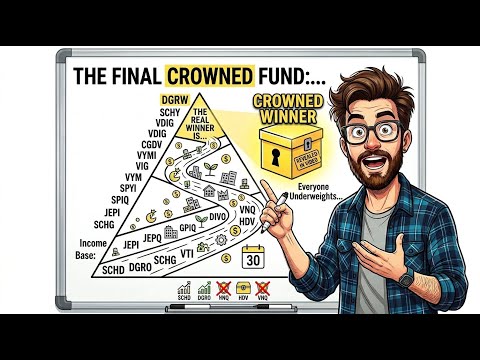
Three conditions would shift this answer: a portfolio large enough that dividends already exceed spending needs (in which case the switch may not be necessary at all), an existing cash floor already in place, or a change in the underlying law — RMD age has already moved twice in recent years, and the provisional income thresholds could be indexed at any time. For a full walkthrough of the modelled investor, the twelve conditions, and the step-by-step calculation in real time, watch the video above — it covers the reasoning behind each number visually and in more depth than text alone can convey.
This is a modelled investor built from current published thresholds that can and do change. Birth year, filing status, state of residence, and account mix all change the answer. This article is educational, not financial or tax advice.