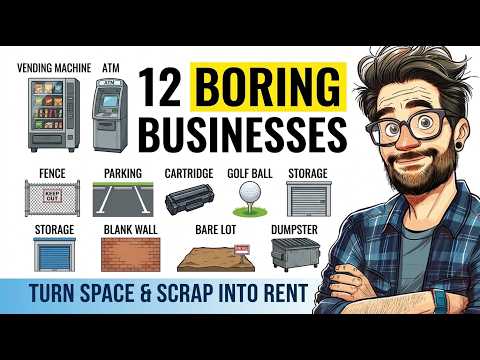
Some of the most reliable small businesses in America don't look like businesses at all. They look like a guy walking a dog, a hive tucked behind a fence, or a pickup truck parked on the same street every Tuesday. No storefront, no employees, no branding — just the same customers, the same schedule, and a check that clears every month. This roundup pulls together two of the most requested lists on this channel: six operations that run on the same repeat-customer route model, and six that let a living organism — goats, worms, chickens, bees — do the actual labor while the owner just manages the system around it.
What ties all twelve together is a simple economic trick: each one charges money for something a customer already wants gone. Dog waste, kitchen scraps, overgrown brush, surplus produce — inputs that would otherwise cost someone else money to dispose of become free raw material for a business that needs almost no staff to run.
Key Takeaways
- A single pooper scooper route can generate $3,000 to $10,000 a month from recurring weekly service to the same residential customers.
- The strongest low-staff businesses share one trait: the same customer, on the same schedule, week after week, which makes revenue predictable and marketing largely unnecessary.
- Six of the twelve models let a living organism do the physical work — goats clearing brush, worms processing food scraps, bees producing honey — cutting labor costs to almost zero.
- The best inputs for these businesses are things neighbors and local businesses are already paying to get rid of, like kitchen scraps, surplus produce, and overgrown vegetation.
- The list is ordered from easiest to climb into to the most capital- or knowledge-intensive, so the earlier entries are the most accessible starting points.
- None of these are "get rich quick" plays — they are boring, unglamorous routes that reward consistency over hustle.
The Service-Route Model: Same Customers, Same Schedule, Every Week
The clearest example of this category is a pooper scooper route. It sounds like a punchline, but the numbers tell a different story: a well-run route servicing a neighborhood on a weekly cycle can quietly generate $3,000 to $10,000 a month, and the neighbors two doors down often have no idea it's a business at all. The appeal isn't the task itself — it's the structure underneath it. The same customer signs up for the same day, the same time, every single week, indefinitely, until they move or get a dog walker who does it themselves.
That recurring structure is what separates a route business from a one-off gig. Instead of chasing new customers every month like a freelancer or a contractor bidding on jobs, a route operator sells a subscription in everything but name. Once a homeowner is on the schedule, they tend to stay on it, because the alternative — doing the unpleasant task themselves — is exactly what they paid to avoid. That's the same logic behind other route-based service businesses covered on this channel, including mobile auto detailing and junk removal, both of which turn a task homeowners avoid into a recurring or repeat-call revenue stream.
Why Route Businesses Need So Little Staff
A route business scales through density, not headcount. The fewer miles between stops, the more customers one person can service in a day, and the fewer employees are needed to keep the schedule running. That's what makes this category so approachable for someone starting with limited capital: the barrier to entry isn't equipment or licensing, it's simply showing up on time, every time, until the schedule fills.
Six Boring Businesses Where Something Alive Does the Work
The second half of this list flips the labor question entirely. Instead of a person doing repetitive physical work, an animal or organism does it — and does it for free, as long as it's fed. These businesses run on inputs that already exist in abundance near most operators: surplus produce that grocery stores and farms can't sell, brush and overgrown vegetation on sloped land that's expensive to clear by hand, and kitchen scraps that restaurants and households currently pay a hauler to take away.
The six businesses in this category are arranged from easiest to hardest to break into, climbing from low-capital, low-knowledge setups to operations that require more land, more permitting, or more specialized care. What they share is a cost structure most conventional businesses can't touch: the "labor" eats grass, scraps, or brush instead of drawing a paycheck.
Feeding the System With Waste Nobody Wants
The most sustainable version of this model doesn't buy feed at retail price — it sources it for free from someone else's waste stream. Restaurants and grocery stores routinely pay to have food waste hauled off. Landscaping crews pay to dispose of brush and clippings. A business built around livestock or composting organisms can intercept that material before it ever reaches a landfill, converting someone else's expense into the operator's free input. It's the same underlying principle behind income properties like donation bin routes, which also monetize something people are trying to get rid of rather than something they're trying to buy.
The Final Entry: Charging for What Everyone Nearby Already Pays to Remove
The last business on the list is deliberately saved for the end because it runs on the single input almost every household and business nearby is already paying someone else to haul away — and almost nobody has thought to charge for taking it instead. That's the pattern worth internalizing across all twelve entries: the biggest margins in "boring" businesses rarely come from a clever product. They come from identifying a waste stream before anyone else notices it's valuable, and building a low-staff system around collecting it.
What Makes a Business Genuinely "No Staff"
None of these twelve operations are literally staff-free forever — most eventually need help as they scale past what one person can physically cover in a route or a feeding schedule. What they are, in the early stages, is staff-light: a single operator can run the entire business without hiring anyone, because either the customer base is small enough to service solo, or the labor is being handled by an animal rather than a person. That distinction matters for anyone comparing these ideas against more traditional small-business models that require a crew from day one.
It's also why these businesses pair well with a long-term wealth-building strategy rather than replacing one. The cash flow from a route or a livestock-based operation can fund other goals — paying down debt, building an emergency fund, or feeding a dividend investing plan like the ones outlined in this ETF dividend ladder breakdown — rather than functioning as a full-time replacement income on its own from month one.
How to Evaluate Whether One of These Fits You
Before picking a business from this list, it's worth being honest about three constraints: available capital, tolerance for hands-on or unpleasant physical work, and access to land or zoning that permits livestock or a route vehicle. The service-route businesses generally require less upfront capital and no land, but more time spent physically working the route. The livestock-based businesses often require more setup — fencing, permits, or space — but less day-to-day labor once the system is running, since the animals are doing the bulk of the work.
Neither category is passive in the way a dividend portfolio is passive. Both require an operator who shows up, checks on the animals or drives the route, and manages the handful of customer relationships that make the whole thing work. What they offer instead is a low-staff structure that doesn't require managing a team, a lease, or a large payroll to stay profitable.
Watch the Full Breakdown
This article summarizes the structure behind all twelve businesses, but the original video walks through each one individually — what it costs to start, how the recurring customer relationship is built, and where the biggest margins actually come from. For anyone considering one of these routes or livestock-based operations, watching the full video is worth it for the visual walkthrough of how each business is actually set up and run day to day.