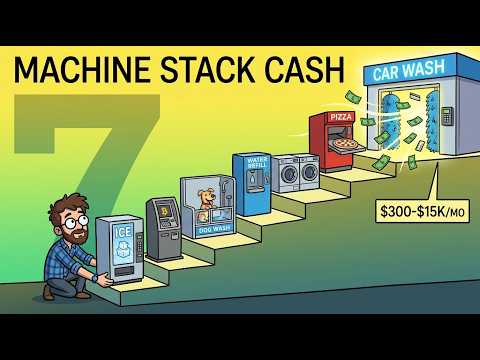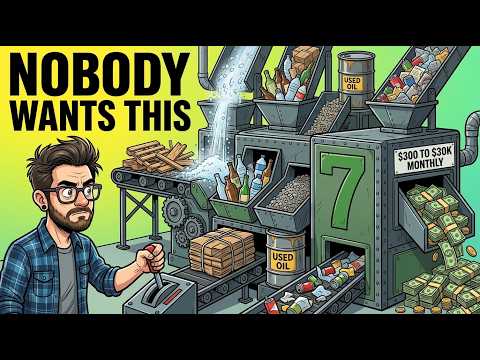
The most durable income in a physical business rarely comes from the sale. It comes from the same asset or route paying you again next week, next month, and next year. This breakdown covers 14 unglamorous businesses built entirely on that logic — seven rental assets where a single purchase generates income on repeat, and seven material routes where you position yourself as the toll between a supply nobody wants and a buyer who will pay real money for it.
Key Takeaways
- Rental income is driven by utilization, not asset price — the same object bought once can pay for years if kept busy
- The best material route businesses collect on both ends: the supplier pays to have the material removed, and the buyer pays to receive it
- Several of these businesses require less than $5,000 to start and can generate positive cash flow within the first quarter of operation
- Physical businesses with recurring customers are more defensible than digital ones — they depend on geography and relationships, not algorithm changes
- The most overlooked materials and assets carry the highest margins because fewer operators are willing to work in those categories
- Every business covered here is already running profitably in small markets across North America
Why Boring Physical Businesses Generate Sustainable Income
The defining feature of a boring physical business is that it solves a problem nobody else wants to solve. That creates two advantages: limited competition and inelastic demand. A restaurant that fills up with cooking grease every two weeks is not going to stop needing it removed because the economy turns. A construction crew needing a dumpster on Tuesday is not going to wait six months for a better deal.
Both deep-dives that make up this compilation share the same underlying thesis: in a physical service business, margin comes from positioning, not innovation. You either own an asset that earns while it sits somewhere else, or you stand at the intersection of a supply that is a problem and a demand that is invisible to most people. Either way, the income keeps arriving on a schedule.
Part One — 7 Rental Assets You Buy Once and Rent for Years
The first half of this breakdown covers what might be called the utilization model. The asset is the product. Once purchased, it generates revenue each time it is rented out. Depreciation is slow, margins are high, and the math is straightforward: a piece of equipment generating $400 a week, rented for 35 weeks a year, returns $14,000 annually on a $5,000 investment — before accounting for a second or third unit running simultaneously.
1. Roll-Off Dumpster Rental
A single 10-yard roll-off dumpster costs between $4,000 and $6,000 new. Rental rates run from $350 to $550 per week depending on market and duration. One container with moderate utilization — rented 35 weeks out of the year — generates between $12,000 and $19,000 in annual revenue. Operators with five or more containers running simultaneously report net margins between 35% and 55% after fuel and hauling costs. The key variable is turnaround: operators who keep containers moving consistently outperform those who allow open-ended rental periods.
2. Portable Toilet Rental
New portable toilet units cost between $800 and $2,000 per unit. Weekly rental rates range from $75 to $200 depending on the market. Events, construction sites, and outdoor festivals create predictable demand spikes that allow operators to run units at full capacity across spring and summer. Year-round contracts with construction firms provide a stable winter base. The business scales linearly — each additional unit added to the fleet adds a predictable revenue line, assuming the service route stays within a manageable radius.
3. Utility and Cargo Trailer Rental
A quality utility trailer costs between $3,000 and $8,000 new. Daily rental rates run from $60 to $120, with weekend packages ranging from $150 to $250. The customer base includes homeowners moving furniture, landscapers hauling debris, and contractors moving tools. Unlike equipment that requires technical knowledge to operate, a trailer rental business requires minimal customer support — and many operators supplement direct bookings through peer-to-peer rental platforms.
4. Party and Event Equipment
Tables, folding chairs, canopies, and tent structures are individually inexpensive — often $15 to $80 per unit — but rented as a package at $500 to $2,000 per event. A modest starter inventory of 100 chairs, 20 tables, and two 20x20 tents can generate $2,000 to $4,000 on a single busy weekend without the operator leaving the warehouse. Storage space, not startup capital, is the primary constraint in this category.
5. Pressure Washer and Surface Cleaning Equipment Rental
Commercial-grade pressure washers rent for $100 to $200 per day. Units capable of generating this rate cost between $2,000 and $5,000. The customer base ranges from homeowners preparing a property for resale to contractors needing temporary capacity on a large commercial project. Weekend and holiday demand reliably outpaces weekday demand, making this a strong complementary addition to an existing tool rental inventory.
6. Portable Storage Container Rental
Portable storage containers can be purchased on the secondary market for $3,000 to $5,500 per unit. Monthly rental rates in most mid-size markets run from $120 to $200. Customers needing temporary storage during a renovation or relocation often keep containers for two to five months, making the average rental significantly more valuable than the headline monthly rate suggests.
7. Scaffolding and Staging Rental
Scaffolding is the highest-cost entry in the rental category, with a functional starter system running $4,000 to $12,000. Daily rates run from $150 to $400 depending on configuration. The customer base is almost entirely professional — painters, window installers, masonry contractors — which means shorter sales cycles and repeat business from the same operators across multiple projects. Liability insurance is a non-negotiable operating cost, but it is also a built-in barrier that keeps casual competition out of the market.
Part Two — 7 Material Routes That Pay You on Both Ends
The second category operates on a fundamentally different model. Instead of renting an asset, the operator positions themselves as the intermediary on a material that creates a problem for one party and has value for another. The revenue structure is often double-sided: the source pays to have the material removed, and the processor pays to receive it.
The mechanism is a toll on a material nobody wants — you stand between the person who wants it gone and the person who will pay for it, and you collect on both ends of the same trip.
8. Used Cooking Oil Collection
Restaurants generate cooking oil waste continuously. Operators who collect used cooking oil can charge a small pickup fee — or collect for free — and then sell the oil to biodiesel processors and rendering companies that pay between $0.30 and $0.55 per pound. A single mid-size restaurant route of 15 to 20 locations can generate $1,500 to $3,500 per month in net revenue after fuel and container costs.
9. Cardboard Baling and Resale
Retailers, warehouses, and distribution centers generate significant cardboard volume every week. An operator with a used baling machine — typically $3,000 to $6,000 on the secondary market — can collect cardboard from commercial accounts, bale it, and sell it to mills and paper recyclers at $80 to $120 per ton. The input material is free. Routes with 8 to 12 commercial accounts generating consistent volume have been documented running at margins above 60%.
10. Scrap Metal Collection
Construction crews, appliance removal companies, and businesses with surplus equipment represent consistent sources of scrap metal. Copper, aluminum, and steel each carry distinct market prices that fluctuate with commodity markets but historically remain above zero. An operator running a dedicated scrap route with a flatbed truck reports gross revenues of $4,000 to $9,000 per month in active markets.
11. Tire Disposal Routes
Tire shops and automotive service centers pay to have old tires removed — typically $1.50 to $4.00 per tire. The collected tires are then sold to crumb rubber processors and tire shredding facilities that pay $0.50 to $1.00 per tire. Routes of 20 to 30 accounts collecting 200 to 400 tires per week generate $800 to $2,400 in weekly gross revenue before disposal and fuel costs.
12. Pallet Collection and Resale
Warehouses, grocery distribution centers, and manufacturing facilities generate broken and surplus pallets continuously. An operator can collect these at no cost, repair serviceable units, and resell them to businesses that need packaging materials. Standard 48x40 wooden pallets resell for $5 to $12 each in most markets. Operations focused on high-volume commercial accounts have been documented processing 500 to 1,500 pallets per week with minimal equipment beyond a truck and basic hand tools.
13. Electronic Waste Collection
Businesses and consumers pay disposal fees to have old electronics removed — typically $10 to $30 per item for monitors, printers, and servers. The collected material is then sold to certified e-waste processors who pay for the commodity value of the metals inside. Margin is highest on items containing copper wiring and circuit boards, and compliance regulations create consistent demand among commercial accounts regardless of economic conditions.
14. Grease Trap Cleaning and Waste Resale
Grease trap cleaning sits at the highest-margin end of the material routes category, and it is also the one most operators will never look at twice — which is precisely why the margin is still there. Restaurants are legally required to have grease traps serviced regularly — often quarterly, sometimes monthly — to remain in compliance with municipal codes. An operator with a pump truck charges $150 to $400 per service call and then sells the extracted waste to rendering companies that process it into animal feed ingredients and industrial lubricants. The compliance requirement makes this a non-discretionary service, and the customer relationship is inherently sticky.
The Real Lesson: Margin Lives Where Nobody Looks
The consistent theme across all 14 businesses is that margin is a function of how willing you are to operate in a category other people find uncomfortable. Nobody wants to pump a grease trap. Nobody wants to haul old tires. Nobody wants to manage the logistics of keeping dumpsters moving on a tight turnaround schedule. That reluctance is exactly what creates and preserves the margin — and why these categories continue to pay well even as better-known businesses get crowded out.
For a deeper look at the rental side of this model, the breakdown of 6 rental business ideas that make money without doing the work covers the operator model in detail. On the material side, the full cost and margin analysis of starting a junk removal business is a useful companion read for anyone evaluating the routes covered in part two.
Watch the Full Video Breakdown
This article draws from two separate deep-dive videos on the Harry's Stash YouTube channel, compiled into one extended breakdown. For a visual walkthrough — including market-specific examples, operator logic, and the full ranking rationale behind how each business was scored — the complete video is available at 14 BORING Physical Businesses That Pay You On Repeat. The final routes in part two are deliberately the most overlooked, and that section alone is worth the full runtime.