The most durable income-producing assets in small business often look exactly like what they are: machines sitting in a parking lot or a corner of a convenience store, collecting payments around the clock with no one watching. These are not passive income schemes requiring ongoing hustle. They are unmanned storefronts — physical infrastructure you buy once, place in the right location, and let operate indefinitely. The barrier to entry is capital, and that is precisely why competition stays thin.
Key Takeaways
- All seven machines run on one model — the Unmanned Storefront — collecting revenue without employees.
- The capital barrier is the competitive moat, not a warning sign; it keeps the market from flooding once a machine is placed.
- Placement agreements with existing foot-traffic locations eliminate the need to own real estate.
- Revenue scales by adding placements, not by upgrading a single machine.
- Real operators — Steve Slagle of Beachside Ice, Keith Caldwell of All Paws Pet Wash, Jeff Schulmeister of Speed Clean Coin Laundry, and BreAnna Nixon's three-location car wash operation — have built income streams using this exact model.
- Permits, water codes, and money-transmitter registrations vary by market — verify local requirements before committing capital.
The Unmanned Storefront Model
Every machine on this list runs on the same underlying logic. A customer arrives, pays, receives a service or product, and leaves — all without a single employee involved. The owner's responsibilities are maintenance, restocking where applicable, and securing placement. That last step is where most of the strategy lives.
Placement means access to existing foot traffic without owning the property. A gas station already draws customers every hour. A laundromat already has the right clientele for a dog wash bay. A corner store already has people walking in to pay for things. The machine owner negotiates a host agreement — a flat monthly fee, a revenue share, or both — and the host gains a new amenity without any additional work. The machine owner gains traffic they did not have to build.
Tim Ferriss described this logic in The 4-Hour Workweek: systems that generate income independent of your direct time. These machines are physical implementations of that idea, and they have existed for decades in boring, unsexy form. The money compounds on the number of placements — never on any single box.
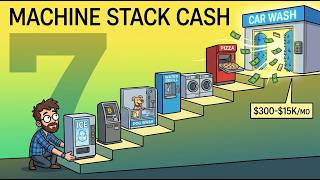
The 7 Machines, Ranked Cheapest to Biggest
1. Ice Vending Machine
Ice vending machines sit outside gas stations, grocery stores, and convenience stores and sell bags or loose ice around the clock. Steve Slagle of Beachside Ice, featured in Business Insider, built his operation on exactly this model. The machines are self-contained — they make, bag, and dispense ice using municipal water and electricity, with no daily labor required beyond periodic maintenance and cleaning. Side Hustle Nation has documented the economics in detail: the primary inputs are water and power, so margins are structurally high. A well-placed machine on a busy rural highway or beach-adjacent lot generates consistent monthly cash flow. The host property owner typically receives a monthly rent or a small revenue cut; the machine operator collects everything else. Start-up cost is the lowest on this list, making it the most accessible entry point into the Unmanned Storefront model.
2. Crypto ATM
A Bitcoin ATM installed in a corner store requires no equipment purchase by the host location. The ATM operator installs and maintains the machine; the host collects a flat monthly fee or a small percentage of transactions. For the operator, revenue comes from a transaction fee charged to each customer — typically a percentage of the transaction value. VendBuddy data covers the host economics in detail. The regulatory side is distinct from every other machine on this list: operators must register as money-services businesses at the federal level, and most states layer additional money-transmitter requirements on top. That compliance barrier keeps the market from flooding even as demand for crypto on-ramps remains consistent in underbanked neighborhoods and tourist corridors.
3. Self-Service Dog Wash
Keith Caldwell of All Paws Pet Wash operates self-service dog wash bays — enclosed stations with a raised tub, warm water, blow dryers, and shampoo dispensers that a dog owner uses independently. The unit charges by the session, activated by a timer coin or card payment. No groomer is present. The owner stocks supplies and cleans the bay between sessions. Placement inside a pet supply store, veterinary office, or existing car wash facility pairs the machine with the right foot traffic. The moat here combines capital with a specific requirement for plumbing infrastructure, which eliminates most casual competitors before they start.
4. Water Refill Station
Water refill stations dispense filtered or purified water by the gallon at a fraction of the cost of bottled water. The machine is plumbed into the local water supply, runs filtration, and collects payment per gallon or per fill. VendBuddy data covers the host economics; placement in grocery store parking lots and laundromats is the most common format. The appeal is straightforward: the consumable costs nearly nothing to produce, the machine handles every transaction, and the customer base — anyone who prefers purified water over tap — is both broad and recurring by habit.
5. Coin-Op Laundry
A small coin-operated laundry is the most capital-intensive machine in the first half of this list, but Jeff Schulmeister of Speed Clean Coin Laundry has demonstrated what a focused operation can produce. The economics are well-established: core costs are equipment, lease or placement fee, water, gas for dryers, and maintenance. Revenue is entirely machine-driven — customers arrive, pay per cycle, and leave. A small format — four to eight washers and dryers in a strip mall bay — can operate without the owner on-site. The coin laundry business has a long, documented track record; the full breakdown of costs, returns, and red flags is covered in How to Buy a Laundromat: Real Costs, Returns, and Red Flags.
6. Automated Pizza Machine
The automated pizza vending machine is the newest category on this list. These units prepare and dispense a fresh pizza in minutes — dough, sauce, toppings, and baking all handled by an internal robotic process triggered by the customer's payment. Placement targets high-dwell, late-night-demand venues: college campuses, hospitals, airports, and hotels where staffed kitchens are impractical or unavailable after hours. The machine commands a premium price point per unit sold, carries a higher equipment cost than the machines earlier on this list, and typically secures long-term placement agreements with institutional hosts — which makes each placement more valuable once locked in.
7. Self-Service Car Wash
The ceiling play on this list is the self-service car wash, and BreAnna Nixon's three-location operation, documented in Business Insider, illustrates why operators who clear the capital barrier build something difficult to dislodge. A self-service bay — where customers wash their own vehicles using high-pressure wands and foam dispensers activated by coin or card — requires significant upfront infrastructure investment but generates revenue on every car, every hour the facility is open. Nixon's three-location structure demonstrates the central lesson of the model: money compounds on the number of placements, not on any single machine. A single bay has a ceiling; a second location doubles the ceiling without doubling the owner's time.
Why the Capital Barrier Is the Moat
Every machine on this list shares one defining feature: the upfront cost makes a meaningful percentage of potential operators stop and turn back. That is not a bug in the business model — it is the business model. The same reluctance that makes people hesitate to commit capital is what keeps the market thin once a machine is placed and generating revenue.
This dynamic is different from a low-barrier business like a pressure-washing route or a digital storefront, where competition can arrive the same week a niche becomes visible online. A well-placed ice vending machine or a car wash bay cannot be instantly replicated in your location by someone who saw your idea on social media yesterday. The infrastructure takes time to source, negotiate, install, and permit. That friction is the moat. If the same capital-as-moat logic appeals to you in a different format, 6 Boring Cash-Flow Machines to Buy With $30,000 (No Skills Needed) covers several adjacent models using the same framework.
The One Mistake Operators Make
Across all seven machine types, operators report the same recoverable error: choosing placement convenience over location quality to avoid a difficult negotiation. A host who accepts a low revenue share can feel like a win. But a machine placed in a low-traffic location generates low revenue regardless of how favorable the host agreement looks on paper. The fix is embedded in the mistake itself: audit foot traffic before committing to any placement, renegotiate or relocate if the numbers are not materializing after the first few months, and treat the initial placement not as the destination but as the first data point. The Unmanned Storefront model rewards operators who manage their portfolio of placements systematically rather than those who treat a single machine as a finished business.
Watch the Full Video Breakdown
The video accompanying this article walks through all seven machines in order — cheapest to biggest — including real operator stories from Steve Slagle, Keith Caldwell, Jeff Schulmeister, and BreAnna Nixon. If you want to see the host economics, placement framework, and machine-by-machine logic explained in sequence, watch the full breakdown on YouTube: 7 Boring Machines You Buy Once That Quietly Pay You for Years. At the end of the video, Harry asks viewers to drop a number — one through seven — in the comments for whichever machine they would start first. The machine with the most replies gets the full deep-dive in the next video.
For educational purposes only. This is not financial advice. Permits, water codes, and money-transmitter registration requirements vary by market — verify your local and state rules before committing capital.
Sources: Business Insider (Steve Slagle / Beachside Ice; BreAnna Nixon self-service car wash) · Side Hustle Nation (ice vending economics) · VendBuddy (ice vending, water refill, crypto ATM host economics) · All Paws Pet Wash operator data (Keith Caldwell)