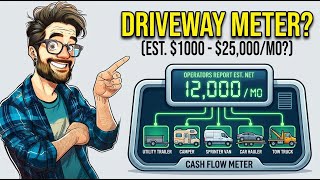
- Key Takeaways
- Vehicle #1: Utility Trailer Rental — Lowest Entry Cost, Fastest Payback
- Vehicle #2: RV and Camper Rental — Seasonal Model, High Upside
- Vehicle #3: Cargo Van via Amazon Relay — Highest Active Income Potential
- Vehicle #4: Car Hauling — The Underrated Middle Ground
- Vehicle #5: Towing Service — Highest Monthly Income Ceiling
- The Dispatch Density Stack: Why the Platform Matters More Than the Asset
- Three Filters to Choose the Right Vehicle
- Watch the Full Video Walkthrough
A used utility trailer purchased for $1,500 on Craigslist was netting $1,200 per month within six months — while the owner kept his day job. No license upgrade. No specialization. Just a piece of steel parked in a driveway, listed on a free platform, and booked consistently. The five vehicle businesses below follow the same logic: buy an asset once, plug it into the right dispatch platform, and let utilization rate do the work. Startup costs range from $5,000 to $60,000. Monthly net income ranges from $1,000 to $25,000. None require a CDL. None require quitting a day job.
Key Takeaways
- A $1,500 utility trailer listed on Facebook Marketplace and HaulIt can net $1,000–$2,000 per month in year one
- Amazon Relay owner-operators average $4,395 per week gross; year-one solo net lands at $70,000–$80,000
- A tow truck operation with AAA contracts and two municipal police rotations can net $15,000–$25,000 per month by year two
- The platform matters more than the vehicle — every one of these businesses lives or dies on dispatch access, not the asset in the driveway
- Insurance is the actual moat: operators who stack three complementary policies are virtually immune to a single event wiping out the business
- Every vehicle on this list has a documented path to a first paying customer within 48 to 72 hours
Vehicle #1: Utility Trailer Rental — Lowest Entry Cost, Fastest Payback
The utility trailer sits at the top of this list because the math is the most forgiving. A used six-by-twelve utility trailer runs $1,500 to $2,500 on Facebook Marketplace. Commercial trailer rental insurance costs $1,000 to $2,000 per year. Storage cost for anyone with a driveway is zero. Add booking software such as Reservety or HaulIt at $60 to $100 per month, plus hitch and tie-down accessories, and total startup cost comes in under $5,000.
Real operators report 10 to 15 rental days per month per trailer at $150 to $250 per day — translating to $1,500 to $3,750 in gross monthly rent on an asset purchased once. After insurance, software, and any delivery costs, year-one net lands between $1,000 and $2,000 per month per trailer, with margins of 20 to 30 percent once the asset is paid off. Break-even on the trailer itself occurs within four to eight months.
Year two changes the picture. Operators who scale to three to five trailers and optimize their listing photos report $3,000 to $8,000 per month net. The travel trailer and camper rental market is projected to reach $200 billion by 2034, growing at an 8.8 percent compound annual rate, with peer-to-peer rental as one of the primary growth drivers.
To land the first customer: list on Facebook Marketplace with a headline such as “Six-by-twelve enclosed cargo trailer for rent. $149/day, $499/week. Hitch included. Message to book.” Set up a free Google Business Profile and place a yard sign near the nearest home improvement store. Most operators report a first booking within seven days; some within 48 hours.
Critical insurance note: A standard auto policy does not cover a trailer while it is in a renter's possession. A dedicated commercial trailer rental policy is mandatory. Smart operators build that annual premium directly into the daily rental rate from day one.
Vehicle #2: RV and Camper Rental — Seasonal Model, High Upside
The RV rental model demands more capital than the trailer but offers a significantly higher income ceiling. A used travel trailer or Class C camper costs $15,000 to $60,000. Outdoorsy and RVshare are the two dominant peer-to-peer platforms, each charging roughly 20 to 25 percent commission on bookings. Listing on either platform is free. A host insurance gap policy adds $1,500 to $3,000 per year, with another $500 in initial prep supplies.
Peak season runs May through September. During those months, real operators report 10 to 20 rental nights per month at $150 to $350 per night. Off-season volume drops to two to five nights. Year-one net across the full season lands between $10,000 and $30,000 for a single rig. Outdoorsy has published data indicating that well-utilized rigs can potentially earn more than $50,000 annually.
Year two, with two rigs and a library of five-star reviews, operators report $25,000 to $60,000 per year net.
To find the first customer: list on Outdoorsy with instant book enabled for the first 30 days, price 10 to 15 percent below comparable rigs to seed initial reviews, and cross-list on RVshare for free. Local Facebook groups focused on RV rentals frequently generate direct off-platform bookings at full rate. Operators building a broader rental income base may find useful context in this overview of rental business models that generate recurring revenue without constant active management.
Insurance note: Outdoorsy's protection plan can be slow to process damage claims. Experienced hosts carry a separate commercial RV rental endorsement on top of the platform's coverage.
Vehicle #3: Cargo Van via Amazon Relay — Highest Active Income Potential
The Amazon Relay cargo van model is the highest-earning active vehicle on this list. A used cargo van costs $15,000 to $40,000, with $5,000 to $10,000 down if financed. Federal DOT and MC authority through the FMCSA costs approximately $300 to file. Commercial cargo van insurance runs $3,000 to $6,000 per year. An electronic logging device adds $200 to $500. DOT number decals cost $50 to $200. Total out-of-pocket to launch: $5,000 to $20,000.
Operations are systematic. After registering at relay.amazon.com as a carrier, uploading insurance documentation, passing the safety score review, and activating the Post a Truck feature, operators accept four to six load blocks per week, each lasting four to eight hours. Average load pays $300 to $600.
ZipRecruiter aggregated owner-operator data reports the average Amazon Relay solo carrier grosses $4,395 per week. The 75th percentile hits $6,500 per week.
Net income after fuel, insurance, and maintenance runs $1.00 to $1.20 per mile. Year-one solo nets $70,000 to $80,000. Year two, once preferred lanes are established and deadhead miles are minimized, operators report $80,000 to $100,000 net annually.
A significant market signal: the Q1 2026 FMCSA carrier population report showed the first net positive carrier influx since Q2 2025, indicating that freight demand is recovering and the market is reopening to small operators.
There is no customer to acquire in this model — there is a flywheel to plug into. Register, get approved, activate Post a Truck, and loads arrive within 48 to 72 hours. No broker relationship required. No cold calls.
Performance warning: Amazon Relay performance scores function like a credit score. A single missed pickup window can flag an account and drop the score significantly. Experienced operators run only the lanes they know thoroughly and consistently arrive early — not on time, early.
Vehicle #4: Car Hauling — The Underrated Middle Ground
Car hauling sits between the low-cost trailer model and the high-overhead towing model in both capital requirement and income ceiling. A used single or two-car open trailer costs $7,000 to $15,000. An F-250 or F-350 capable of towing it requires $5,000 to $10,000 down if financed. FMCSA MC authority plus BOC-3 filing totals approximately $500. On-hook insurance plus cargo insurance runs $3,000 to $8,000 per year. A Central Dispatch membership costs $75 per month. Total launch cost: $15,000 to $40,000.
Standard operations involve moving two to four cars per week — dealer to dealer, auction to dealer, or consumer routes through platforms such as uShip. Drive radius is typically 200 to 800 miles per run. Average ticket per car is $150 to $500 depending on distance, with break-even reached at eight to ten cars moved per month.
Year-one solo net, after fuel, insurance, and truck payments, lands at $5,000 to $7,000 per month. Year two, once direct dealer relationships reduce dependence on broker boards, operators report $7,000 to $12,000 per month net. According to TransportVibe's 2026 car hauler salary guide, owner-operators in this space report grossing over $200,000 annually, with net income landing between $80,000 and $150,000 — compared to a company CDL driver's typical $50,000 to $75,000 salary cap.
Two paths exist to the first customer. Path one: sign up at centraldispatch.com, post the truck with available dates and preferred lanes, and brokers typically reach out within hours on active corridors. Path two: cold call dealers near regional auction houses with a direct pitch: “Hi, this is [Name] with [LLC Name]. I run a two-car open carrier on the [City A] to [City B] lane three times a week. Do you have any auction pickups or dealer trades you're brokering out right now? I can do same week.” Most operators report two to five dealer relationships established within 30 days using this approach.
Critical insurance note: On-hook insurance is a separate endorsement from basic cargo coverage. Basic liability will not pay if a vehicle is damaged while on the carrier deck. Smart operators carry on-hook coverage, cargo coverage, and garage keepers coverage — three layers, not one.
Vehicle #5: Towing Service — Highest Monthly Income Ceiling
Towing carries the largest startup cost on this list and the highest income ceiling. A used light-duty wrecker requires $5,000 to $10,000 down. A state towing license plus business license costs approximately $1,500. Commercial towing insurance with on-hook, liability, and garage keepers coverage requires a $2,000 to $3,000 initial deposit. Dollies, chains, and winch gear add $2,000 to $3,000. A three-month operating reserve of $15,000 to $17,000 is the financial foundation smart operators build before launching. Total bootstrapped cost: $50,000 to $60,000.
The model is built on contracts. AAA and Agero dispatch through their apps. Operators who accept and respond within a 30 to 45-minute window average $75 to $150 per ticket base, plus $2 to $4 per mile. A single-truck operator reports monthly gross of approximately $16,800, with expenses of $4,000 to $6,000, netting $10,000 to $12,000 per month in year one.
Adding a municipal police rotation changes the income profile significantly.
A single police rotation slot adds 40 to 120 tows per month at $180 to $280 each — generating $7,200 to $33,600 in pure recurring monthly revenue.
Year two, with AAA contracts and two police rotation slots, operators report $15,000 to $25,000 per month net.
Absolute rule: Insurance cannot lapse for a single day. A lapsed policy means losing the rotation slot, which can take months to recover. Garage keepers liability — which covers vehicles stored on the lot — is also non-negotiable. It is the policy most new operators skip and the one that most commonly wipes out those same operators the first time a customer's vehicle is damaged while in their possession.
The Dispatch Density Stack: Why the Platform Matters More Than the Asset
Every vehicle business on this list succeeds or fails based on platform access, not the asset parked in the driveway. The utility trailer does not earn money — Facebook Marketplace and HaulIt earn money. The cargo van does not earn money — Amazon Relay earns money. The car carrier does not earn money — Central Dispatch earns money. The tow truck does not earn money — AAA, Agero, and the municipal dispatch rotation earn money.
This is the Dispatch Density Stack: the vehicle is the admission ticket, and the platform is the flywheel. Operators who build on the densest platform available for their category consistently outperform those who attempt to generate their own load flow from scratch. The correct sequence is to identify the platform first, then acquire the vehicle that qualifies for it. For operators building a broader cash-flow portfolio alongside vehicle income, this breakdown of cash-flow machines available for $30,000 covers how multiple asset types can be layered for compounding monthly income.
Three Filters to Choose the Right Vehicle
Filter 1 — Platform density: Select the platform with the most active loads, hosts, dispatchers, or dealer accounts in your local market. Choose density over novelty every time.
Filter 2 — Utilization rate: Rate times utilization equals income. A trailer that rents 20 days at $200 per day generates $4,000 in gross monthly revenue. A trailer that rents 5 days at $400 generates $2,000. Idle days are the primary enemy of every vehicle-based business on this list.
Filter 3 — Insurance stack: Operators who carry the correct combination of policies become structurally resistant to a single bad event. In every niche covered here, the insurance gap — not the market, not the competition — is what most commonly eliminates new operators before they reach year two.
Watch the Full Video Walkthrough
The YouTube video accompanying this article covers all five vehicles in detail, including real listing copy, a word-for-word dealer cold-call script, and a visual breakdown of the Dispatch Density Stack. Watch The 5 Highest-Paying Vehicles You Can Park in Your Driveway on the HS channel for the complete walkthrough, including the full operator story of how a $2,000 trailer purchase turned into a live, cash-flowing business within 48 hours of listing.
For educational purposes only. Not financial advice. Income figures are reported industry data, not personal guarantees. Results depend on local market, capital, time invested, and platform performance scores.