- Key Takeaways
- Why One Machine in One Building Changes the Math
- Machine 1: Refrigerated Flower Vending Machine ($7K–$12K All-In)
- Machine 2: Fresh Orange Juice Vending Machine ($12K–$22K All-In)
- Machine 3: Direct-to-Film (DTF) Printer ($8K–$20K All-In)
- Machine 4: Single-Head Commercial Embroidery Machine ($10K–$18K)
- Machine 5: Wood Pellet Press ($20K–$50K All-In)
- The Three Filters Before You Spend a Dollar
- What a Three-Machine Stack Looks Like at Month 30
- Watch the Full Video Breakdown
Most aspiring entrepreneurs spend months on courses, coaching calls, and branding—then look up 18 months later having spent thousands on nothing that generates income on its own. The operators quietly building real wealth do the opposite: buy one imported single-purpose machine, place it in one building they already know, and collect recurring revenue while they sleep. Five of these machines—each under $20,000 to set up—are generating $1,000 to $4,000 per month for solo operators right now, in hospital lobbies, mall corridors, garages, and small sawmills across America.
Key Takeaways
- Five imported single-purpose machines, each under $20K to start, can generate $1K–$4K per month in net profit
- A refrigerated flower vending machine placed in a hospital lobby can net $900–$1,200 per month after the venue cut and wholesale flower costs
- Fresh orange juice vending machines report $1,500–$4,000 per month net per machine; a documented sanitation protocol is the difference between operators who keep placements and those who lose them
- A compact DTF printer adds roughly $10,000 to annual profit on just 12 orders per month of 25 shirts each
- Three filters every smart operator applies before spending a dollar: payback under 14 months at realistic utilization, at least one B2B channel already in hand, and warranty or parts reachable within a two-hour drive
- The wood pellet press is the only machine here that plugs directly into a federally tracked commodity with a published price floor—$241 per ton wholesale, per the U.S. Energy Information Administration
Why One Machine in One Building Changes the Math
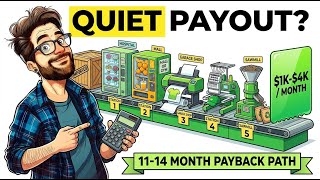
There is a concept in Eliyahu Goldratt's business classic The Goal that most aspiring operators miss: every business has one bottleneck, and the bottleneck is almost never the machine. For imported-machine businesses, this distinction is critical. The machine is roughly 30 percent of the game. The right building, the B2B handshake before the first order, and consistent operational discipline account for the other 70 percent. Get those three right and the 11-to-14-month payback path becomes realistic. Miss them and even a perfectly functioning machine sits idle.
If you are exploring low-cost ways to build recurring income, many of the same principles appear in 6 Boring Businesses That Make Money (Under $500 to Start)—the same playbook of matching a simple tool to an existing local market applies at every price point.
Machine 1: Refrigerated Flower Vending Machine ($7K–$12K All-In)
Picture a refrigerated unit the size of a tall convenience-store cooler, with glass doors and locker-style compartments, each holding a sleeved bouquet. The customer taps a screen, pays by card, and the compartment opens. No staff, no storefront, no closing hours.
The market benchmark: the average supermarket floral section does roughly $99,000 per year in sales, with a 48% gross margin and a 29% net margin after labor and shrink, according to FreshProduce's 2025 floral benchmarks. That is approximately $24,000 per year, or $2,000 per month, net from flowers alone. A single flower vending machine placed in a strong hospital lobby or transit hub can plausibly hit one-third of that supermarket volume—approximately $2,700 per month in sales. Net to the operator, after the venue takes its 10–15% cut and wholesale flower costs are paid, lands between $900 and $1,200 per month.
Chinese-made units from manufacturers like Haloo or Foodline run $4,000–$6,000 FOB. Add ocean freight, customs clearance, last-mile delivery, a payment system, a branded wrap, and initial flower inventory, and the all-in cost reaches $7,000–$12,000. That upfront cost is the moat: it locks out most casual competitors while remaining accessible to a committed solo operator. Walk into a local hospital with a one-page proposal and a photo of the machine. The pitch to the facilities manager or gift shop manager is simple—you install a fully insured, branded refrigerated bouquet unit at no cost to the hospital, the hospital earns 10–15% of revenue, and visitors get fresh flowers at 3 a.m. Day-to-day work runs five to eight hours per week per machine once routes are established: restocking three to five times a week, monitoring the cloud dashboard, and pulling anything past three to five days old. The biggest gotcha is cold-chain shrink. Supermarket floral runs about 9% shrink; if refrigeration drifts or humidity is off, that becomes 20% and the margin disappears. Route discipline—not technology—is the fix. At $1,000 per month net on an $11,000 setup, the payback path is 11 to 14 months.
Machine 2: Fresh Orange Juice Vending Machine ($12K–$22K All-In)
This is the machine visible in airports and malls: it rolls whole oranges down a chute, slices them, squeezes them, and dispenses a cup of fresh juice in front of the customer. The transaction is equal parts theater and product, and that combination drives impulse purchases in high-foot-traffic locations.
An Australian operator published his numbers publicly on LinkedIn, as documented by Chris Koerner: six machines, approximately $4,000 in monthly profit per machine, $24,000 per month total, across 18 months and 32,000 liters of juice sold. That is the ceiling number, not the average. A more conservative U.S. benchmark for a moderate gym or medical-office-building placement is $1,500–$2,000 per month in net profit per machine after oranges, cups, and venue rent—still more than many full-time positions produce.
The U.S. convenience services market reached $31 billion in revenue by 2025, growing at over 8% annually, per NAMA's 2024–2025 industry census. The fresh juice vending sub-segment represents $2.5 billion globally, growing at 7% per year. Equipment options range from Italian and Singaporean brands at the high end to Chinese OEM machines at $8,000–$15,000. All-in—freight, customs, payment system, install, initial orange inventory, and a U.S. food permit—lands at $12,000–$22,000.
The operational reality is blunt: juice machines are mini food factories. Pulp residue plus sugar plus warm air produces mold and clogs. Operators who let sanitation slip get one failed health inspection and lose the placement permanently. The fix is not a fancier machine—it is a written sanitation protocol signed and photographed at every service visit. That discipline sounds tedious, which is exactly why most operators skip it, and exactly why the operators who follow it keep their placements for years. At a conservative $1,500 per month net on a $15,000 setup, the payback path is 8 to 14 months.
Machine 3: Direct-to-Film (DTF) Printer ($8K–$20K All-In)
Direct-to-film printing has quietly taken over custom apparel decoration over the past three years. The process: print artwork onto a special film, dust it with hot-melt adhesive powder, cure it, then heat-press it onto any fabric—cotton, polyester, blends, dark shirts, light shirts, hats. The same single transfer works on everything. No minimums, no screen setup, no color limitations. A screen printer cannot compete on small runs. A DTF operator can.
ColDesi published a side-by-side comparison of outsourcing DTF transfers versus owning an in-house printer. In a modest scenario of 12 orders per month of 25 shirts at $15 each, the in-house printer adds roughly $10,000 to annual profit—before payroll, because there is no payroll. DTF Bank's unit economics place an A4-sized transfer at $0.80–$1.50 in consumables. Applied to a blank T-shirt, that transfer sells for $15–$30 retail or $3–$9 wholesale to a small brand. Net profit per shirt after the blank and press time lands between $5 and $20.
The U.S. decorated apparel market is projected to reach $29.4 billion by 2033 at a 12.9% annual growth rate, per Impressions Magazine. The North American promotional products distributor network sold $27.7 billion in 2025, per ASI industry data. Many of those distributors outsource the actual printing to small shops. A professional DTF printer runs $3,000–$15,000, a curing or shaker unit $1,000–$5,000, and a heat press $500–$3,000—total equipment of $8,000–$20,000. Operator success comes down to sales and systems management, not printer specs. The proven approach is to pre-sell three to five recurring B2B accounts—a local gym's team shirts, a school's seasonal spirit wear, a restaurant's branded aprons—before placing the equipment order. Idle DTF printers clog. Busy ones print money.
Machine 4: Single-Head Commercial Embroidery Machine ($10K–$18K)
A single-head commercial embroidery machine is a sewing machine rebuilt for industrial output: 15 needles, automatic color changes, computer-driven, capable of stitching a logo onto a hat, polo, or jacket in 6 to 10 minutes. ColDesi's published case study on the Avance 1501C single-head machine, running a 12-piece jacket order, calculated over $65 per hour in operator profit.
The market is the same $27.7 billion promotional products pond, but with a structural advantage for small operators: many distributors in that network do not own machines. They subcontract the actual stitching to small one-machine shops. Ricoma's published case study on R&R Custom Embroidery documents a husband-and-wife team that produced 30,000 caps in six months on Ricoma machines and was on track for $1 million in annual revenue by adding additional heads. Separately, Abby Price invested $20,000 to open Abbode in New York City—$15,000 of it on a single embroidery machine—then pivoted into live monogramming events and grew the company past $1.5 million in revenue by 2024, per Yahoo Finance.
A single-head commercial machine from Ricoma or ColDesi runs $10,000–$18,000 through a U.S. distributor that includes training and warranty. Realistic first-year revenue for a one-machine solo shop is $20,000–$30,000, per K-Embroidery's small-shop guide. The customer list nearly writes itself: hospital scrubs, school spirit wear, corporate uniforms, monogrammed wedding robes. One or two warm B2B accounts—contacts already in your existing network—can fill the entire first year of production volume without a single cold call.
Machine 5: Wood Pellet Press ($20K–$50K All-In)
The wood pellet press is the industrial outlier in this group. Feed it sawdust, wood shavings, or agricultural biomass. It crushes, dries, and compresses the feedstock through a flat-die or ring-die at thousands of pounds of pressure. Out comes a stream of cylindrical pellets—the size of a pencil eraser—ready to burn in pellet stoves, commercial boilers, or BBQ smokers.
The U.S. Energy Information Administration tracks this commodity monthly. Domestic densified biomass fuel sells at approximately $241 per ton wholesale, inside a domestic industry where 73 operating manufacturers produce roughly 13 million tons of capacity annually. A small flat-die pellet mill from manufacturers like KMEC or GEMCO runs $5,000–$15,000. Add a hammer mill, dryer, conveyors, bagger, site prep, and permitting, and the fully compliant micro-plant total reaches $20,000–$50,000—touching the top of this startup band.
The feedstock economics are the core of the business. Each ton is 2,000 pounds of compressed wood waste that most sawmills currently pay to dispose of. Hauling it off-site for free is the deal. The spread between near-zero feedstock cost and $241-per-ton wholesale is the entire margin. GEMCO documented a small UK biomass business, Mi Generation Living Energy, which installed two ring-die pellet mills to produce three tons per hour and supply clients who saw 30–70% fuel-cost savings versus their prior fuels. The U.S. Bureau of Indian Affairs has also published guidance on small-scale wood pellet manufacturing for tribal and rural economies, citing low-cost feedstock and local heating demand as the core advantage. The North American wood pellet market is approximately $910 million in 2026, growing toward $1.09 billion by 2031, per Mordor Intelligence. Most U.S. production is exported—domestic consumption is only 349,000 tons against 10 million tons produced, per IndexBox—meaning small operators are building local micro-businesses in a pond the export giants ignore. A small flat-die operation feeding local hardware, BBQ, or farm stores can realistically clear $3,000–$6,000 per month net once feedstock and routes are stable.
The Three Filters Before You Spend a Dollar
Every machine in this list can fail if placed in the wrong context. The operators who build durable cash flow run three filters before committing capital:
- Filter 1 — Payback in under 14 months at realistic utilization, not hero numbers. The Australian OJ operator's $4,000 per month per machine is a ceiling, not a baseline. Model at half that figure. If the math still works, proceed.
- Filter 2 — At least one B2B channel already in your life today, with no introduction required. The building you already work in. The gym you already use. The school your kids attend. The first placement should require a conversation, not a cold call.
- Filter 3 — Warranty and parts reachable within a two-hour drive. One importer ordered a juice machine directly off a Chinese manufacturer's website for $12,000 with no customs broker and no U.S. distributor. The shipment was flagged at port. Storage fees stacked for three weeks. When it finally cleared, the refrigeration coil was leaking and the touchscreen was flickering—repaired over a video call. He wrote one rule on a sticky note above his desk: Never buy capital equipment you cannot get serviced within a two-hour drive. That rule is worth the $12,000 he paid to learn it.
Any machine that fails one of these three filters is not easy mode—it is advanced mode. Walk away and wait for a better match.
What a Three-Machine Stack Looks Like at Month 30
Consider an operator with $22,000 saved who applies all three filters and stacks machines methodically over 30 months. The picture: a flower vending machine in a hospital lobby netting roughly $1,000 per month; a fresh OJ machine in the adjacent medical office building netting roughly $1,800 per month; a single-head embroidery machine in the garage handling scrubs and team jackets netting roughly $1,200 per month. That totals approximately $4,000 per month in net income on top of a regular salary, from three pieces of imported equipment that fit inside one parking space. No brand built. No capital raised. No job quit. Just three single-purpose machines matched to three B2B handshakes that already existed.
For operators ready to deploy a larger capital base using the same cash-flow philosophy, 6 Boring Cash-Flow Machines to Buy With $30,000 (No Skills Needed) covers the next tier up.
Watch the Full Video Breakdown
The full video walkthrough covers the day-to-day workflow for each machine, the complete financial model for each 11-to-14-month payback path, and the failure story behind filter number three. Watch it on YouTube for the visual breakdown: 5 BORING Imported Machines Quietly Paying $1K to $4K a Month (Under $20K to Start).
For educational purposes only. Not financial or business advice. Always verify city, county, and state licensing, health permits, and import requirements for your specific market before starting any business.