- Key Takeaways
- The Absent Host Model: One Mechanism, Six Buildings
- 1. Cabins, Cottages, and Backyard Builds
- 2. Stocked Fishing Ponds
- 3. Tiny Homes and Accessory Dwelling Units
- 4. Event Barns and Studios
- 5. Container and Portable Offices
- 6. Glamping Pitches
- How It Played Out for One Operator
- Three Filters Before Spending Anything
- Watch the Full Breakdown
- What to Do Tomorrow
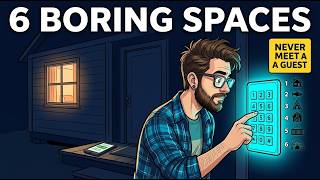
Every mental image of renting a place out involves the same three fears: meeting strangers, handing over keys, and being on call at midnight when something breaks. There is a category of small business built specifically to eliminate all three. A guest arrives late at night, reads a numeric code off their phone, lets themselves into a space, and leaves days later without ever learning what the owner looks like. The owner never answers a call. The money is already in the account before the guest finds the light switch. This is not one business model — it is six, spanning cabins, fishing ponds, tiny homes, event barns, container offices, and glamping pitches, all built on the same underlying mechanism.
This is for educational purposes only and is not financial advice. Rates, occupancy, and permitting requirements vary enormously by location and county.
Key Takeaways
- Six distinct rental categories — cabins, fishing ponds, tiny homes, event barns, container offices, and glamping pitches — all run on the same “absent host” mechanism: a phone booking, a time-limited access code, and a flat-fee cleaner.
- Occupancy, not nightly rate, decides profitability. Break-even on a standing cabin structure is typically just six to nine nights a month.
- Fee fishing ponds offer the fastest payback on the list ($4,000–$9,000 per season) but only run seasonally, from roughly May through October.
- Glamping delivers the best cost-to-revenue ratio: a basic dome costs $2,000–$9,000 but can command $150–$500+ a night, three to eight times a traditional tent pitch.
- Every category has a local permitting “moat” — registration, occupancy certificates, zoning, or aquaculture permits — that keeps casual competitors from undercutting an established, insured operator.
- A real operator, a night auditor named Harry, scaled two spaces from roughly $600–$1,400 a month in his first bookings to about $6,147 a month by month eighteen, without quitting his job.
The Absent Host Model: One Mechanism, Six Buildings
The six businesses covered here could not look more different — a cottage, a pond, a shed, a barn, a steel container, a canvas tent. What they share is identical: a booking arrives through a phone, entry happens on a code with a defined start and end time, and someone who is not the owner resets the space for a flat fee. The owner’s entire job collapses into two tasks handled in advance — pricing the slot and having it ready before the code goes live. Authors Jason Fried and David Heinemeier Hansson made a version of this argument in their book Rework, writing that a business ought to require less of its owner, not more, and that constant presence is not the virtue most people assume it is. Call it the absent host rate: the guest pays full retail price for hospitality, and the hospitality part never actually happens.
1. Cabins, Cottages, and Backyard Builds
The most familiar entry point is a standalone cabin, cottage, or backyard annexe. A standalone unit lets for $80 to $300 a night depending on the market. A small backyard build sits at the lower end, around $89 to $129 a night, while a scenic destination cabin runs $150 to $300.
Nightly rate is not the number that decides profitability — occupancy is. Year one realistically lands at 35% to 45% while a listing gathers reviews; a mature listing in a decent drive-to market reaches 55% to 75%. At $150 a night and 50% occupancy (roughly 180 nights a year), that is about $27,000 a year, or $2,250 a month. A stronger market at $220 a night runs closer to $3,000 a month. Break-even on an already-standing structure is typically six to nine nights a month — about one weekend, with everything after that pure margin.
Costs only matter once income is established. Turnover cleaning runs $60 to $150 per turn, laundry and consumables add $20 to $40, utilities land around $100 to $250 a month, and short-let insurance riders run $300 to $800 a year. Most counties require a short-term let registration and a transient occupancy tax before the first booking — one county charges over $900 a year plus 12% occupancy tax, another charges $200 for registration and a safety inspection. That paperwork is exactly what prevents a neighbor from listing an unregistered spare room and undercutting an established host. Precious Price built a backyard tiny home in Georgia for about $35,000, went over budget, and now rents it at $89 to $129 a night on land she already owned.
2. Stocked Fishing Ponds
A fee-fishing pond charges $2 to $25 per adult for a day pass, with premium trophy waters reaching $100 a day. One operating farm charges $15 on a weekday and $18 on weekends, plus a $125 pavilion rental on top. A nearby campground charges $15 a day for non-campers and $8 for campers, with passes expiring at 8 a.m. the next morning.
A pond does not sell out. Eight to ten anglers at $15 a head on a Saturday, roughly half that midweek, puts a modest pond around $1,500 to $3,000 a month in season — and most fee fishing runs May through October, with weekends doing two to three times weekday traffic. The honest way to size this business is as a season rather than a monthly figure: $4,000 to $9,000 across a summer on a single modest pond. That is the fastest payback on this entire list and also the smallest total number, and both facts are true simultaneously. There is no lock and no turnover — just a gate, a card machine or QR-code honor box, and a sign. Restocking is the real recurring cost, along with a farm liability rider. Some states require an aquaculture permit, which functions as the moat separating an insured pay pond from an uninsured handshake arrangement.
3. Tiny Homes and Accessory Dwelling Units
A tiny home or accessory dwelling unit (ADU) on land already owned rents nightly for $80 to $300, with a genuinely unique unit in a scenic market holding $100 to $300. At $180 a night and 60% occupancy, that is $3,240 a month; at 70% occupancy it is closer to $46,000 a year.
Almost nobody runs the obvious comparison: the same unit let to a long-term tenant brings $700 to $2,500 a month depending on the market. Nightly beats monthly only once occupancy clears roughly 35% to 40% after cleaning, commission, and utilities. Below that threshold, a monthly tenant is the better business — zero turnover cost and zero vacancy risk. Building one runs $30,000 to $150,000 delivered and installed depending on finish, though the marginal cost of power, water, and internet is lower than any standalone structure since it sits beside an existing house. A dozen or so states have deliberately loosened zoning to permit ADUs, and that permissive zoning is itself the moat — it took years of legislation a competitor in a restrictive state cannot shortcut.
The most common mistake in this category is a static door code that never changes. Nothing dramatic happens at first, which is exactly why the problem goes unnoticed: a departed guest’s friend tries the old code and it works, a returning guest assumes theirs is still live, and by week three the owner is fielding messages about a code failing for exactly the wrong people. The fix is one line: issue a new code every turnover, and make testing it the last item on the cleaner’s checklist. The rule worth writing down is that the code changes before the guest does, never after.
4. Event Barns and Studios
A basic heritage barn rents by the hour for around $130, but full-day event rentals are the real business. One named barn charges $500 to $1,500 Monday through Thursday, $2,000 on a Friday or Sunday, and $3,000 on a Saturday. Another charges a flat $3,000 for a full day.
This category doesn’t sell occupancy — it sells Saturdays. A barn has four sellable Saturdays a month, and a mature, well-reviewed venue books three or four of them through wedding season, roughly April to October.
Four to six paid days a month at $1,500 to $3,000 each is $6,000 to $18,000 a month in peak season, though year one typically sees just one or two paid Saturdays, and winter drops off sharply unless the space is heated. Fitting out an existing structure — restrooms, electrics, lighting, flooring — commonly runs $15,000 to $80,000, far below new construction and a one-time cost. Bookings come from wedding directories and vendor referrals; access is a keypad code live only for the rental window; cleanup is a flat fee of $200 to $500 per event, not a wage. The moat here is the strongest on the list: occupancy load certificates, fire code sign-off, and often an assembly use permit, which is exactly what stops a neighbor renting out an uninspected pole barn for the same money.
5. Container and Portable Offices
Portable or container offices let by the month for $250 to $850 depending on size — roughly $450 for a ten-foot unit, $650 for a twenty-foot unit, and $850 for a forty-foot unit. One London container coworking operator lets a whole container for £1,200 a month or individual desks at £320. Three or four units on a spare lot at $450 to $650 each, running 75% to 85% occupancy, brings in roughly $3,000 to $8,000 a month across the small fleet.
This is the lowest ceiling per unit on the list but also the steadiest, with no seasonality at all. Tenants are small contractors needing a site office, startups needing overflow space, or a surveyor or agent wanting a cheap dedicated address. Leases run for months rather than nights, so a code is issued for the lease term instead of rotating nightly, and turnover happens only a handful of times a year as a sweep-out rather than a housekeeping operation. Used office containers run from around $15,000 to buy outright, with delivery, leveling, and hookups adding $2,000 to $8,000 per unit. A lighter version exists too: renting the container itself from a national fleet provider, which means the actual product being sold is the ground, the power hookup, and the address — a lower ceiling, but an entry cost that drops to a lot, a hookup, and a padlock. Bookings come from local listings and contractor referrals rather than travel platforms, and the moat is zoning — commercial or industrial ground only, which filters out casual competition instantly.
6. Glamping Pitches
A traditional tent pitch lets for $30 to $50 a night. A glamping unit on the identical patch of ground commands $150 to $500 and up — the same acre, the same view, at three to eight times the money. The industry average nightly rate across the sector hit $251 last year, up 21% in two years, based on a survey of 473 operators.
At $220 a night and 55% annual occupancy, one mid-tier dome or safari tent grosses around $44,000 a year, or about $3,680 a month; a more cautious model at $150 a night is closer to $2,500 a month. What makes this the best category on the list is structure cost: a basic dome or safari tent runs $2,000 to $9,000 delivered, mid-range pods run $10,000 to $60,000, and permits, site prep, and utilities add another $7,500 to $30,000 combined. A structure that can cost less than a used car can let at a nightly rate that rivals a hotel room, and payback on a basic dome at a strong rate and high summer occupancy can land inside a single season.
Seasonality is real: peak occupancy runs 70% to 90% from June through August, drops to 45% to 65% in the shoulder season, and 15% to 35% in the off-season. Roughly 63% of sites now run year-round, made possible by heated, insulated units; without heat, the honest planning assumption is a season and a shoulder, not twelve months. Bookings come primarily from outdoor-specific platforms and secondarily from social media, since this category is unusually visual. The moat is a change-of-use or campground permit, wastewater approval, and fire sign-off for anything that heats or cooks — exactly what stops a $3,000 bell tent from appearing in a field next week and undercutting an established operator.
How It Played Out for One Operator
Harry works as a night auditor at a highway motel, watching guests use a self-check-in kiosk at 2 a.m. without ever speaking to him. The realization that the building itself was earning — and didn’t need a lobby or him at 2 a.m. — led him to start applying this model to his own property. In months one and two, he called the county, confirmed the registration requirement, and listed one space. Months three through five brought uneven, weekend-heavy bookings of $600 to $1,400 a month while he kept working night shifts. By months six through nine, he added a second space in a deliberately opposite season, and combined income reached roughly $2,200 to $3,800 a month. By months ten through thirteen, both calendars ran on rotating codes with a per-turn cleaner he no longer coordinated directly, settling around $4,200 to $5,400 a month. By month eighteen, with both spaces mature and priced against local comparables, Harry was earning close to $6,147 a month — hedged, market-dependent, and still working nights by choice rather than necessity.
Three Filters Before Spending Anything
Run any of these six ideas through three questions, in this order, since the first one eliminates more bad ideas than the other two combined.
- Is the structure or the ground already there? Every number above assumes the expensive part is sunk. If a build is needed first, the payback math changes completely.
- What does the county actually require? One phone call, before anything else, covering registration, occupancy load, campground permits, and zoning. The answer is either a form or a no, and both are cheap to find out immediately.
- Which season does it sell? Pick two ideas that disagree with each other — a heated cabin sells the winter a canvas dome cannot touch. Stacking two off-season businesses lets the same ground earn during months that would otherwise sit dead.
Readers exploring this space alongside other low-maintenance income options may also find 6 Rental Business Ideas That Make Money Without Doing the Work and 6 Boring Cash-Flow Machines to Buy With $30,000 useful for comparing capital requirements and monthly return ranges across other passive income structures.
Watch the Full Breakdown
For a visual walkthrough of how each of these six absentee rental businesses is priced, permitted, and operated — including the exact numbers behind Harry’s eighteen-month progression — watch the full video breakdown on the channel. Seeing the smart lock codes, occupancy math, and real listing examples side by side makes the comparison between categories easier to apply to your own ground or budget.
What to Do Tomorrow
The cheapest possible next step costs nothing. Look up the three nearest listings in whichever of the six categories fits available ground, and record what they charge on a Saturday night versus a Tuesday. It takes about twenty minutes. Even if the area turns out to already be saturated with competitors running full calendars, that is useful information — a fully booked calendar down the road is the clearest proof of demand available for free.