- Key Takeaways
- Why Old Clothes Make a Good Boring Business
- Business 1: Shop Rags From Old T-Shirts and Towels
- Business 2: Thrift Bin Reselling by the Pound
- Business 3: Clothing Collection Bins on Host Lots
- Business 4: A Kids' Clothing Consignment Sale
- Business 5: Upcycled Denim and Flannel Goods
- Business 6: Used Clothing Bale Sorting and Grading
- Business 7: Textile Shredding Into Fiber and Insulation
- The Pound Ladder: Where the Money Really Is
- Try This in the Next 24 Hours
- Watch the Full Video
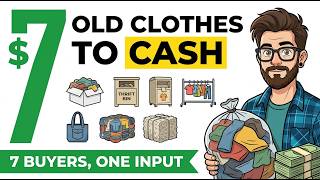
The average American throws away about 81 pounds of clothing every year, according to SMART, the trade group for textile recyclers, which cites the EPA for the figure. Much of that clothing is free to anyone willing to collect it, because people drop it in bins, bring it to sales and leave it at the curb. These seven boring business ideas all run on that one input, and they show how to turn old clothes into money at every stage, from a kitchen table to a textile shredder.
This breakdown follows a single bag of clothes through seven businesses. Each pays more than the one before it and asks more of you. A fictional route driver named Harry ties them together with one idea he calls the Pound Ladder: every pound of old clothing has a top buyer, and the money is in knowing which pound goes to which buyer.
Key Takeaways
- Seven used-clothing businesses share one nearly free input, and the stock is the easy part. The money is in the sort.
- The easiest start is shop rags. RagsCo lists a 50 pound box of white T-shirt rags at $89.50, and the startup is likely well under $100 if you already own a table.
- Sorted clothing sells for more per pound. Premier Wholesaler prices Grade A summer bales at 76 cents a pound against 61 cents for unsorted mixed clothing.
- Startup costs climb from under $100 for rags to $35,000 to $150,000 for a single textile shredder.
- The EPA counted about 17 million tons of textiles in American trash in 2018, and under 15 percent was recycled.
- Check local rules first. Donation bins, resale events and recycling all carry local permits and regulations.
This article is for educational purposes only and is not financial advice. Prices change, and the example numbers here are an illustration, not a promise.
Why Old Clothes Make a Good Boring Business
A bag of T-shirts at the curb is nothing to the family that set it out. To a body shop three streets away, it is a box of shop rags. The shirts are the same and the buyer is different, and that gap is where each business on this list makes its money.
The pattern is simple. Donors, sellers and neighbors supply the clothes at little or no cost. Your job is to get each pound to the buyer who pays the most for it. If you like this kind of low-glamour, repeatable income, our guide to 6 boring businesses that make money for under $500 covers more ideas in the same spirit.
Business 1: Shop Rags From Old T-Shirts and Towels
Shop rags are the easiest business on the list. RagsCo sells white T-shirt rags at $46 for a 25 pound box and $89.50 for 50 pounds. ERC sells a similar 50 pound box for $85.80. Buy 1,000 pounds from RagsCo and it works out to about $1.69 a pound.
Tiedemann Globe, a rag company, names the buyers: machine shops, fabricators, auto body and paint shops, and janitorial suppliers. Anyone who wipes grease, oil or paint all day and tosses the rag afterward is a customer. The idea is old. A and A Wiping Cloth in Los Angeles dates to 1932, when Samuel Berg began cutting unwearable garments into wiping cloths for local industry. His grandson Jeremy Berg, the third generation, took over from his father in 2008.
The startup is sharp shears, a table, a scale and a stack of boxes, likely well under $100 if you already own the table. The stock comes from your own drawers, your neighbors and bags people are glad to get rid of. Your first customer is probably a shop you pass every day, so walk in and ask what they pay now. Big rag sellers have freight to cover, and you are right down the street. Keep the whites apart, because white cotton is the rag every shop asks for first.
Business 2: Thrift Bin Reselling by the Pound
This is thrift store reselling by the pound. Say you pull one good shirt from an outlet bin and sell it for $15 on Poshmark. Poshmark keeps 20 percent on sales of $15 or more, so you keep $12. Goodwill of Central and Southern Indiana publishes its outlet price at $1.99 a pound for clothing in the bins, so you dig, weigh and pay by the pound.
Chris and Stacy Hatfield do this in Texas under the name Flip the World. They buy clothing from Goodwill bins and sell it live on Whatnot. Before this, Chris worked in pest control and learned what sells with no fashion degree. ThriftFlipping puts a small starter batch at about $50 to $150. Weigh what you buy and write down what it sells for, and in a month you will know your real price per pound.
Business 3: Clothing Collection Bins on Host Lots
A clothing donation bin business puts a steel box on a host lot and lets donors fill it. BizBite puts what bin owners get from regional recyclers and exporters at about 8 to 15 cents a pound. Curbside Textile Recycling reportedly sold collected textiles through a distributor for 10 to 40 cents a pound. The per-pound figure is small, but nobody charges you for the clothes.
Ecosmith Recyclers in New Boston, New Hampshire is a family business that has run clothing and shoe bins since 1991. It is for profit and shares money with local nonprofit groups, which is a good offer to bring to a gas station or church parking lot.
On startup cost, LEED Bin Manufacturing in Guys Mills, Pennsylvania lists a steel clothing bin at $1,650. Denton, Texas charges a permit of $162 a year per box. Always get the lot owner's permission in writing. BizBite says sorting before you sell can lift what you get per pound by 20 to 40 percent, so do not sell the good stuff by the ton. For a deeper look, read how donation bins actually make money.
Business 4: A Kids' Clothing Consignment Sale
In this one, people really do hand you the stock. Parents bring the clothes their kids outgrew, you hang and tag them, and you run the sale. When something sells, the parent is paid and you keep a cut.
At Just Between Friends Northern Colorado, sellers get 60 percent of what sells, so the sale keeps 40 cents of every dollar. A $15 registration fee also comes out of each seller's check. Just Between Friends runs kids' sales across the country, and its sale in Oaks, Pennsylvania expected 9,000 shoppers and nearly 2,000 sellers, NBC10 Philadelphia reported.
You do not need a franchise. Just Between Friends lists its franchise fee at $24,900. Trading Hands Kids Sale in Springfield, Missouri skipped that. Two Arkansas couples, Kim and Brandon Green and Trisha and Andy O'Neil, started it and ran the model themselves. The startup is racks, tags, flyers and a room for the weekend. Sign up your sellers before you book the room, because a room full of empty racks makes a very long weekend.
The sorting lesson: Harry's first big order was ten boxes for a body shop. He cut for two weekends and boxed every shirt he had, including big prints, shiny blends and a few zippers. The owner opened one box and handed it back, because he wanted white cotton. RagsCo's own listing says white knit rags allow only about 5 percent print.
Harry changed the method. Every bag is now sorted into three piles before the shears come out: whites, lights and colors, with hardware removed first. Colors sell as a mixed box for less, and whites go to the shop that pays the most. His rule is four words: sort before you cut.
Business 5: Upcycled Denim and Flannel Goods
An upcycled denim business turns old jeans into finished goods. Debi runs FraysandFabulous in Fort Myers, Florida and lists an upcycled denim half apron at $34. Makers Market lists an upcycled denim tote bag, handmade from old jeans in Milwaukee, at $110. Etsy shows Debi's shop open since 2025, with 31 sales so far.
If you already own a sewing machine, you are most of the way there. SewingMachinesPlus lists a new Juki HZL DX5 at about $1,100, and its page shows it sewing through three layers of folded denim. Buyers are Etsy shoppers, craft fairs and holiday markets. Make one thing really well before you make ten, because one great tote beats twenty okay ones.
Business 6: Used Clothing Bale Sorting and Grading
Here the money is all in the sort. Premier Wholesaler sells Grade A summer clothing bales at 76 cents a pound on a 22,000 pound order, while unsorted mixed clothing from the same seller is 61 cents. That is 15 cents more a pound just for being sorted. Grades run Cream, A, B, C and rags. Closo says graded lots that are ready to resell can bring three to five times more per pound than unsorted ones.
The market is huge. SMART says America exported about 1.6 billion pounds of used clothing in 2016, worth more than $550 million. Buyers include exporters, wholesalers and resellers, and Ecosmith both collects and exports. The startup is a warehouse corner and a baler. Altitude Recycling Equipment lists a used vertical baler at $10,500, or about $17,000 new. Closo puts sorting labor at 15 to 35 cents a pound, so know that number before you quote anyone a price.
Harry keeps Secondhand: Travels in the New Global Garage Sale by Adam Minter in his cab. It follows used goods through sorters, graders and exporters worldwide. His takeaway is that nothing in the bag is one thing. It is ten products waiting for ten buyers.
Business 7: Textile Shredding Into Fiber and Insulation
The biggest business on the list is last for a reason. Every business before it leaves something behind: stained shirts, torn jeans, C grade and rag rejects. For a shredder, that is the stock.
Energycle, a shredder maker, puts opened fiber at about $150 to $400 a ton and fine fiber at $250 to $600 a ton. Buyers include insulation makers and companies that make batting and padding. The GAO says shredded fibers become furniture stuffing and insulation.
The EPA counted about 17 million tons of textiles in American trash in 2018, and under 15 percent was recycled. G and A Recycling in Vernon, California turns leftover garment-factory fabric into shoddy, a fluffy recycled fiber used in denim insulation, sound panels and car insulation. It is an established company, not a garage start, which shows the size of this business.
Energycle puts a single shredder at $35,000 to $150,000 and a complete line at $120,000 to $350,000. You will want real power, real space, and dust and fire controls. Line up your fiber buyer before you buy the machine.
The Pound Ladder: Where the Money Really Is
None of the seven businesses really buys its stock. People drop it in a bin, bring it to your sale or set it on the curb. The money is in the sort. One good shirt can leave you $12 on Poshmark. A white T-shirt brings about $1.70 a pound as a rag. A mixed bale brings 61 cents, and the clothes nobody wants still sell as fiber by the ton. Every pound has a top buyer, and the work is getting it to that rung.
Harry's Example Numbers
These are Harry's numbers, an example and not a promise. He kept cutting rags and added a spring kids' sale in a church hall. In his best month he sold 30 boxes of rags at $85.80 a box, which is $2,574. His sale moved $6,200 of kids' clothes, and his 40 percent was $2,480. Sixty sellers paid the $15 fee, adding $900. After boxes, the hall and flyers, he kept about $5,147. His new problem is that neighbors hand him more bags than he can cut, so he is looking for someone to sort.
Try This in the Next 24 Hours
It costs nothing. Call one body shop or auto shop near you, ask who sells them rags and what they pay for a 50 pound box, and write the number down. If it is close to what RagsCo charges, you have found your first customer's price, and maybe your first customer.
Watch the Full Video
Want to see how the Pound Ladder works step by step? Watch the full video, 7 Boring Businesses That Turn Old Clothes Into Cash, for a visual walkthrough of all seven businesses. Tell us in the comments which number, one through seven, you would start.